Friday, 17 October 2014

Review: An English Ghost Story, Kim Newman

More in the mood of Jago than the Anno Dracula books, An English Ghost Story sees us returned to the West Country as the wonderfully named Naremores flee city life, attempting to escape the tensions and neuroses that almost destroyed them. Coming to the idyllic Hollow, they begin to rebuild their relationships, aided by the strange, magical atmosphere of the house. Yet, as they grow closer and more confident in their magical surroundings, things take a rather more sinister turn.
First things; this book is addictive. Newman is a master of pace, and An English Ghost Story has a real nightmarish intensity. It sneaks into your head, making a world both treacherous and real. What's more, as one would hope from the title, it is very English. The first 'movement' as the family discover and fall in love with the Hollow captured all the wonder and mystery of an ancient house, and succeeded in being distinctly eerie without ever being openly menacing or distractingly twee. For me, it recalled Lucy M Boston's Green Knowe series, where fear was balanced with magic, so that a child reader suffered anxiety as to the benevolent intentions of the house's other inhabitants,whilst feeling cared for and protected by the narrative - and indeed the house - itself. Newman taps into this vein of national consciousness, conveying the confidence which the protagonists have in their story, whilst our more adult awareness renders their hopefulness creepy in the extreme.

However, as the novel moves into its second and third phases this slow build of anxiety, this hat-tip to the traditional ghost story, is dispelled by Newman's trademark focus on characters, and the self-destructive tendencies of the human mind. The drama leaves the dream-house itself and refocuses upon the hell apparent in the human mind. This section has all of the strengths and weaknesses of Newman's work; his characters are alive, brilliantly realised and compelling. However, the text is at times difficult to follow, the sudden changes of mood and behaviour a little jarring. There is madness here, and it is powerfully portrayed, but sometimes off-putting.

As I would have expected it is also gloriously nasty. This is not going to be everybody's thing, but I found some laugh out loud moments, as well as a couple of sly jokes that were at once hilarious and devastating. Artfully gruesome, Newman takes no prisoners with either his prose or his themes. His characters are not especially likeable. They are (to quote another novel) strugglers rather than saints. Jordan is the best of the bunch, but she is still a teenage girl with all that entails. Speaking of characters, there is at least one familiar face - as I would expect - but in a much more minor role than in many of Newman's other cross-novel references.

If I had any major complaints, they would be structural. While it hangs together better than last year's Johnny Alucard and is more cohesive than Jago, the different sections of the book don't always gel perfectly, and the reader is at times bombarded by with information, subjectivity and events. Things leap and lurch in places, the p.o.v. and narrative focus shifting as often as the territory inside the characters' minds. I feel like I need to give it a careful rereading, which for me is a plus, but might be annoying for others. The ending, which obviously I won't spoil, left me uneasy - but I'm not entirely sure as to why.

Generally, though, yes. A quick, affecting and occasionally vicious novel about the flexibility of identity, about the roles we play and the ways they can control and destroy us. A fabulous read for Hallowe'en - just as I expected it to be.

Friday, 10 October 2014

Review: Lexicon, Max Barry

 Okay. About a week ago I had the thought that the government was monitoring us via the ubiquitous Playbuzz quizzes that I and everyone around me find addictive. They would use these endless list of questions, preferences and gameplaying to identify subversive elements, to mark us out, to control us.

Isn't is nice when fiction pays into your paranoia?

Actually, Lexicon is pretty fantastic. (Thanks Debs!)

 Rippingly well paced, it tells an engaging, intelligent story with some wonderfully threatening overtones. A thriller with a brain, a heart and a political conscience, it moves through real sweetness, visceral intensity and laugh out loud wit. It twists, turns, and confounds you. It's a full on, all boxes ticked wonder. It is genre fiction at its best.

 So, the premise: words create chemical signals in the brain. The right words spoken in the right order can create hormonal conditions which bypass our societal defences, leading to a state of euphoria and suggestibility. With the right words one can control a person, utterly.

The words used depend on a person's psychological profile, their 'segment', or 'type'. Even without these control words it is possible to manipulate someone by knowing their type - by knowing a more superficial set of buttons to press, by being able to guide their thoughts.

Hence all the questionnaires.

An organisation who call themselves 'Poets' study these words, teaching themselves defence against them, using them to shape the world that we know.They recruit Emily, a young woman from the streets with a natural ability for verbal manipulation, or 'attack'. Elsewhere in the narrative, Wil is 'the outlier', a man kidnapped by the Poets, a man who words cannot control. He is the only man to walk away from a disaster engineered by the sinister Woolf.  People want to know why, and how they can use his power of defence.

Any more information would constitute a spoiler. Go, read it, it's brilliant. Not perfect, and the ending... yeah, I had issues with the ending. But go read it, like right now.

Full out recommendation, no caveats.

Review: No Country for Old Men, Cormac McCarthy

A little while ago, someone suggested I subtract my age from the biblical threescore and ten, work out how many weeks that was, and multiply the resulting figure by my average 'books read per week' score. The diminutive aspect of the answer was intended to make me think more carefully about my reading choices.

It may interest you to know that the same person who suggested this also suggested No Country for Old Men as October's book group selection. October's book group, which I could not attend on account of concussion.

And it took me a week. A whole %*&£$% week. One week closer to death. One whole week's worth of brilliant books I am not going to get to read.

Come, come, Alys, let's be fair.

I don't think I'm the target audience for this book. This is the sort of book that - if I read it for a course - I would detest until I read all sorts of interesting and thoughtful essays upon it, whereupon I would start to see how Cormac McCarthy's writing is oh-so-clever. Then I might see hidden depths and, convincing argument permitting, become a champion of it. Even if that didn't happen, I would begin to appreciate the skill behind it and accept that it was worthy, interesting and not for me.

But I was supposed to be reading it for pleasure and by all the Gods in Asgard it was a slog. I'm sure McCarthy got what he was aiming for with the prose, but reading it was interminable. Perhaps I was supposed to drift into some zen-like state from the accumulation of minutia ("He pulled in at the filling station under the lights and shut off the motor and got the survey map from the glovebox and unfolded it across the seat and sat there studying it.") but mostly my eyes just glazed until we reached the crux of the matter. I have a four-year old with a similar attitude to conjunctions, and it is the only way to survive.

Sadly, when my four year old gets to the sodding point, I have some idea of what she's talking about. In this book, it was mostly to do with guns.

To make it worse, I couldn't tell any of the characters apart. I mean, I know, I know, defamiliarisation and taut, minimalist expression (you see McCarthy occasionally catch himself out in a bit of imagery that he seems immediately to regret) but everyone spoke, thought, acted and engaged with the world in the same way. It felt as though it were a blow by blow account of a movie whose cast consisted solely of Clint Eastwood. Each part played by one man with subtly and intensity which, however faithfully it is recorded, cannot be conveyed by the listing of each taciturn movement.

In fact, I spent most of the novel trying to work out which of the several male characters we were dealing with at any given time. They all did the same sorts of things, anyway; get shot, check into a motel (or trailer park, or tar paper shack, or big ol' ranch), speak in homilies for a bit, perform some rudimentary First Aid on their wounds and then go and threaten, interview or shoot someone else.

Eventually some of them died.

Put like that, it sounds almost like a Beckettian masterpiece, which I might have quite liked. But this ain't Beckett.

I got the feeling that I was supposed to be engaged, that I was supposed to care. Occasionally, a character would have a moment of introspection, or honour code, or of not shooting the dog and I got the impression I was meant to be invested in this, somehow. That I was meant to be reading this as some great tragedy set in the "it just happens" of real life that undermined and contextualised the the Romance of the Old West. It's just, for that to work I would need to care for and  believe in these fatally macho "good ol' boys" and their retiring, saintly, much younger wives.

Like I say, I don't think the target audience was me.

Wednesday, 8 October 2014

Kill the Moon: Maidens and Mothers in Doctor Who

After Saturday's Doctor Who, Kill the Moon, I went into the kitchen with my husband and dredged up some pretty tough things from the last five years, and cried for a good twenty minutes.

Then I drank a glass of wine, watched two episodes of Blackadder and - typing this twenty four hours later - am feeling a lot better.

Better enough to say some things that have been on my mind for a while.

It is a truism in some corners of the interwebs that while Doctor Who under RTD was a joyous experiment in tolerance, feminist messages and the trampling of conservative thought patterns, current showrunner Steven Moffat is a misogynist dinosaur who is intent on dragging our favourite show back into the Dark Ages™ and normalising all kinds of horrible things. While this is an opinion I do not share, I can see some aspects of justice in it. RTD's vision was carefully inclusive, squeaky clean and PC (not a criticism), whereas Moffat seems to have an much more cavalier attitude to such matters, instead telling the stories he wants to tell (and using the writers he wishes to use) while letting the pieces fall where they may. Moffat's showmanship seems characterised less by wilful offence than by unexamined prejudices and whilst I agree this is a problem, I'm not sharpening my guillotine about it. 

So, yeah. There are problems. There are also - despite all his best efforts - problems in RTD era Who, as well. As I've said elsewhere, we live in a society that is by its very nature unjust and problematic, so that - however hard we try - we cannot make our work just and utopian. No, this doesn't mean that we shouldn't try, but we should also accept that however hard we do try, we're still going to mess it up. And,when we spot it, we should call it out. So, it's calling out time.

Some people just can't hack it.
One of the things that bothers me enormously in RTD era Doctor Who are his concepts of worthiness. In classic Who, companions travelled with the Doctor because they wanted to, because they needed a lift home, or because they were refugees with nowhere else to go. Under RTD's guidance, they travel with the Doctor because they are 'worthy'; they ask the right questions, they make the right choices, they can - in short - hack it. Throughout the series, we repeatedly meet people who 'fail' this simple companion litmus test, they attempt to exploit the possibilities of time travel, they assert themselves in a non-Doctor approved fashion, or they simply fail to have the stomach for the role.

In some ways, this was an improvement. Eccleston and Tennant's companions are no wilting flowers, they do not archetypally 'fall and twist their ankles', they do rather more than pass the Doctor his test-tubes and tell him how wonderful he is. The problem comes, however, in the dynamic it creates in the relationship between the Doctor and his companion. Classic Doctors were frequently exasperated by their co-travellers, and companions were often hurt, dismayed or angered by the Doctor's less pleasant attributes. There was spark and conflict in the TARDIS - companions were anything from colleague to antagonist, friend to grudgingly accepted stow-away. The Doctor was generally kind towards Nyssa (refugee), playfully scornful of Tegan (getting a ride) and openly abrasive to Adric (stow-away). However, if a companion needs to pass a necessary test of worth to gain admission in the first place, an immediate onus is placed upon the Doctor to respect that worth, to give Nu-Who companions a kid-glove treatment that those in the classic series were not guaranteed. This is not to say that he is uniformly kind, gentle and forgiving to them (the writing is too good for that), but that their relationships are more static and less conflicted.

It also raised the question of what constitutes worthiness. All three RTD era consistent companions are female, human. They all have an implicit, absolute dependence on the Doctor. None of them have a serious romantic relationship at the time of them travelling with the Doctor. None of them have children. 

All three of them have a bad relationship with their mothers. In fact, all three of them come from what are arguably single parent homes - Martha's parents are divorced and one assumes the mother had custody, Donna's father is absent, Rose's is dead. These are mothers who have fought everything to raise daughters who are worthy, daughters who are strong, confident and feminist-icon enough to go to the distant ends of time and space with a man they hardly know, daughters who are clever and articulate and compassionate.

Yet, the mothers are unarguably awful. Shrill and hysterical to a woman, they cannot be trusted not to start making a horrible fuss. They don't trust the Doctor, and are not happy with their child's new-found adventurous life-style. They attempt to stunt, to close in, to drown these wonderful children of theirs in domesticity - arguments about laundry and marriage and car-sharing schedules. Every time these daughters leave their mothers in the lurch, with every blasé, "I'll be fine!" kiss goodbye, every, "but I trust him!" truism, every pair of car keys thrown into a bin, we are supposed to smile and nod and applaud their liberation from the cloying maternal clutches. Of course, we sympathise with poor old mum getting a call that says, "I'm okay, but I'm being shot at," from God knows when, meant to congratulate her on each, "You'd better take care of my daughter", but ultimately, these women are not worthy. They are not companion material. Unless they learn to sit back, have faith in the Doctor and allow him to send their child into whatever danger he so chooses, they are in the wrong.

Feminism has always had a problem with motherhood

To accept the role of motherhood implies a biological imperative, a role which women naturally fulfil, for which they are uniquely suited. Essentialism, determinism, biology as destiny. Of course, it postulates a utopian ideal of childrearing, one which is split equally between the parents, one which pays no heed to a person's chromosomal make-up. But, ultimately, it is the female-bodied who pay the toll of pregnancy, childbirth, breastfeeding. It is the female-bodied who have a hormonal response that makes the cry of their child physically painful. Regardless of the intentions or ideals of the people in your life, it is the female bodied who have to take the rap for this one.

And it's such an awful job. The pay is terrible and the hours are crap. You will be hit, kicked, bitten, shouted at. You have to clean up all manner of bodily fluids. You are responsible, ultimately, for the way this child grows up, for the actions they make as an adult, for the people they hurt. Parenthood; someone has to do it and, despite all the rhetoric and the promises of equality, the majority of unpaid carework in this country is done by the female bodied. In the main, it is done by mothers. Every lunch box to be packed; every tantrum to be endured; every boundary, lesson, hygiene rule to enforce; every broken heart to console, this is on you, girls.

Motherhood will rip you apart.

No wonder so many feminists want no part in it. It's hard to do your best thinking when you've had an hour and a half's sleep because a there was a baby with colic who wouldn't latch and then wouldn't settle.

And here's a thing - it's difficult to write your Master's dissertation when you're freaking out about teething, or to compose a letter to an agent when you're busy sewing name-tapes into school uniform. No matter how loved your baby, no matter how wanted, when you're neck deep in dirty laundry and there is Lego everywhere you aren't thinking about travelling the world, or activism, or fighting the Daleks. No. You're hoping that the kids will stop fighting long enough for you to get the house tidy and that the baby won't choke on something your elder child has left on the floor and that you set the timer on the washing machine correctly because otherwise no-one will have anything to wear tomorrow. In those moments your ambition shrinks to managing the school run, to at least sweeping the kitchen floor, to getting five minutes by yourself with a cup of tea. It sets you down a few levels on Maslow's hierarchy of needs. It trivialises you. It limits your horizons.

It makes you unworthy.

But there's a get out, of course, isn't there? There's a way not to get ground down into that biological essentialism that is forced by way our society manages leave, finance and expectation around childbirth. Simply don't have kids! Be young! Free! Single! Travel the universe and really far-out stuff. Join the boy's club by virtue of not being a housework-bound-child-rearing-drudge. Be the exceptional woman. Be worthy of the Doctor.

Never mind who you leave behind. They had it coming, after all. They chose that life, didn't they? They opted to give it up.

But who else was going to do it?
 
Amy and the tragedy of motherhood:

One of the most vicious criticisms I've seen levelled at the Moff during his tenure on Doctor Who is that Amy Pond was "just a womb to him". Because, of course, in between her many adventures and her active role within them, she married, got pregnant, had a plot significant baby and then a plot significant discovered infertility. As though to turn an unflinching eye at the choice of motherhood and its unwilling denial utterly deleted her person-hood. As though this wasn't an issue women faced, as though it wasn't a terrible, silent tragedy in so many people's lives.

As though there were a 'just' in this scenario.

I'm sorry, I'm getting fervent. The thing is, though, with Amy, Moffat turns the gaze of the viewer onto a woman who has made a choice that does not fit into the comfortable worldview of someone who has her 'freedom', as someone who turns her back on the grant of tolerance we give to an unattached young woman who doesn't bring her messy, fertile 'baggage' on an adventure with her. But we condemn this because mothers are not 'worthy', they do not count as people.

Moffat, for all the questionable things he has said about women, for all the legitimate complaints that can be raised against his tenure, has a respect for motherhood that RTD seemed unable to compute. Yes, I admit, he takes this too far at times (The Doctor, the Widow and the Wardrobe...) but that is always the danger. If one treats motherhood as a valid choice, an honourable choice, a worthy choice, one does play into the hands of gender essentialism - and the aforementioned cavalier attitude to nuance really does not help with this. But not running this risk is a far more questionable strategy - who is raising all these strong, remarkable, forthright women who cheerfully clutch the ninth and tenth Doctors' arms? Who is doing the grunt work, the laundry, the duty of care while being shoved into the background as hysterical, demanding, unreasonable?

And, dear God, the pain that comes with motherhood, with its creation, with its denial. With Amy Pond, Moffat delves deep into the territory of the 'lost' baby, the 'missing' baby, the baby 'denied.' With the everyday tragedy that women you know will have faced, and will almost certainly not tell you about.

 I am pro-choice. I am not ashamed of this. A bundle of cells is just that - a growth which has a very low chance of survival. An embryo, a fetus, is not a baby. It cannot survive independently, and actually, its chances of surviving with a maternal body are not that hot; 1 in 4 pregnancies end in miscarriage, usually in the first twelve weeks.

But I also knows what it feels like to want a baby, painfully, physically with a gut-deep ache of need, a constant, nagging absence in your head, with tears of frustration at each little, blue 'negative' pregnancy test. The difference between an embryo and a baby is not scientific, it is emotional, it is philosophical.
The month before I conceived my first child, my period was a week late. When it came, there was a sense of loss, of mourning. What I had lost was not simply that month's blood, it was a baby. Not a real baby - it's likely I hadn't even conceived - but a baby nonetheless. With that week of negative tests, that thundering torture of hope, I was building a narrative in my mind. A baby. Nine months of pregancy, childbirth, a little downy head snuggled against my chest. The warmth of it, the smell.

Gone.

As soon as I got a positive the next month, it was confirmed for me. What I was carrying was not a bundle of cells, was not an incidental meeting of sperm and ovum, it was immediately all the potential of an entire life. It was a baby. My baby.

1 in 4 pregnancies end in miscarriage, usually in the first twelve weeks.

Amy tells the Doctor she's pregnant. A week later, "I was. I mean, I thought I was. Turns out I wasn't."

You just have to get on with your life.

Even if you're lucky, even if you are the three in four, there is terror there. You are powerless to stop this little life growing inside you in whichever way it chooses. There is nothing you can do if one day it stops moving, stops growing, if it develops a disorder that threatens its life, or your own. Every moment of a wanted pregnancy is like this, fear and helplessness. What if it goes wrong? What if it can't live? What if it kills me? When the longing, the need, is so intense, when there is so much love for a thing the rational part of your brain knows isn't even alive...

Motherhood rips you apart. 

In some families, there is a baby who is missing. Late miscarriage, stillbirth, cot-death. They are so frail, so vulnerable. I know women who will say they have two children, even though only one survived pregnancy. I know women who will still choke up when they talk about that missing baby, ten, twenty, sixty years down the line. Ordinary women. Women with lives, and interests and passions. Women that you might know. 

Having a wanted baby is an amazing thing, a bliss and a joy, a struggle and a chore, it is also an investment in fear. They can just melt away into nothing. That's the terror of it. When they are so small, so vulnerable, they could vanish and leave no trace except the scar you do your best to hide. Two days after my first was born, I was beginning to feel human again. My baby was asleep in my arms and I was back in something approaching 'my' body as I like to perceive it. There, in a moment of bliss, of peace, I had the sudden terror that this had all been some kind of mistake, that the 'real' grown-ups were going to be back any minute, that they were going to take this baby away. That she would simply vanish, melt, just like little flesh-Melody.

That horror is primal, absolute.

For some mothers, it is also real.

And you just have to get on with your life.

The same goes for infertility, that final, grace-note of cruelty that Moffat throws in from The Church of the Papal Mainframe. "Whatever they did to me at Demons Run, I can't give you children."

Dear Christ, that line hurts. The sense of total loss, the feeling of failure and bewilderment. 'Whatever they did to me' - because you never know, really. There's no sense or logic or kindness to it. And as somebody who has wanted a child, wanted a child the way Rory probably wants a child, this is a huge deal. When it becomes an absolute like that, a 'never' rather than a, 'maybe not', a 'not now', an 'I'd rather not'. All of those others suggest a mutability, a possibility of change, or retraction at some future date. One can live in hope, even if that hope is never satisfied. There is no 'over-reaction' when feelings that strong are at play. And Amy, knowing the irrevocable truth of it, that one child lost, and all possibility of another snatched away. Because it feels like a theft, it will always feel like a theft, like someone has cheated you of it.

There's a lot of talk online about the fact that Doctor Who is a sci-fi universe, that somewhere, there must be a 'cure'. But that misses the point. Science fiction gives us metaphors through which to understand the world, and sometimes - in the world - there is no fix, no get-out, no reset button. There are all kinds of things people can try to overcome infertility, but there is no guarantee that it will work. Sometimes the sentence is immutable.

Being a Mother, being a person:
Also, because this is fiction, just because the character of Amy has been used to explore the darkest sides of fertility does not mean she can't be utilised to explore a more fully realised, sympathetic version of motherhood. After all, the whole tragedy of infertility, miscarriage, stillbirth, is that they are invisible. One can already have children, or (infertility aside) go on to have more. The lost child becomes simply a mark in your life, as you continue and are not defined by it.

And, of course, having children, these children grow up, they become independent, outgoing, confident people in their own right. They fly off around space and time, making decisions that are not necessarily healthy and bringing themselves into all sorts of danger, and - as a parent - you kind of have to live with that.

Don't get me wrong, I think we are much too harsh on the 'overbearing', 'over-protective' type of mother. One of the things it is very hard to lose is that sense of frailty, of vulnerability that your child has as a very small baby. They will always be your baby, no matter how big and independent they get. Personally, if someone was dragging my child into the firing line of Daleks, Cybermen and evilly inclined Time Lords, I wouldn't be bawling, "You take care of her!", I would be finding out in a very visceral manner just how many regenerations the Doctor had left.

You don't mess with my kids.

At the same time, you do have to accept that your child will run risks on their own, will have to make decisions and mistakes and - I hate typing this - suffer the consequences. You have to accept that one day you will hand them off to people you don't entirely trust - schools, partners, friends - who will take them away and turn them into someone that you don't quite recognise, who cannot be the same little baby who didn't recognise anyone in the world but you.

Hell, I still have a nervous collapse when I consider letting my eldest walk to the swings on her own in a few years. But in another six, she'll be walking across town (or getting the bus) to get to school on her own. In another ten, she'll probably want to be going out of an evening, with all that entails.

I'll probably be letting her. You just have to set your chin and deal with it.

Motherhood. It tears you apart.

But Amy handles it, just like most of us have to handle it. She lets River have her independence, and they remain on good terms. Not cloying, patronising, 'dear old mum', terms but as two separate adults with their own lives. Motherhood is a part of Amy, it is a part of her and Rory's marriage, but it does not define her in the way it defines Jackie Tyler, or Francine Jones, or Sylvia Noble. She continues as herself, a woman with her own interests and pursuits, while also having a good relationship with her daughter. Even if, for story reasons, she missed the messiest and most exhausting bits of parenting.

Frankly, that's why I prefer Moffat's stuff. I'm a mother, and I get the feeling he takes me seriously.

Finally, to Kill the Moon.

Okay, I went on a bit.

The thing is, Kill the Moon - while not written by Moffat himself - is another story commissioned and approved by him that gives a serious, thoughtful look at some of the terrible dilemmas around parenting, most specifically around motherhood.

Obviously, Kill the Moon engages with this in relation to the question of abortion. It looked at the matter as being a 'woman's choice', as being something private and personal that cannot be decided by opinion pole. Yes, on some levels it had an anti-choice (or, more generously, a pro-life) message that as a pro-choicer, I found deeply unsettling. But, as science fiction, as metaphor, it had the possibility of asking a bigger question, of addressing a wider set of concerns about parenthood and risk and life.

Every pregnancy is a gamble for the female body that hosts it. However wanted, however desired, however remarkable you are sure the offspring will be, however invested in the philosophical ideal of 'baby' lodged in that fetus - it could kill you. In pre-modern times, every pregnancy carried a roughly 1 in 13 chance of mortality for the mother (if I remember my figures correctly). What's more, once labour starts, it cannot be stopped. Every action is made in a pressed time-frame of irreversibility. Decisions have an effect that is immediate, and potentially fatal.

A friend of mine haemorrhaged and, without modern medical care, probably would have bled to death.

During my first labour, my heart-rate went from around 80 to about 120 in the space of five minutes, which isn't too much of a worry, except I'd been lying down for four hours and my contractions had all but stopped. It was also weak enough to be mistaken for the baby's. Hers, however, had dropped from around 120 to about 80 - and become so weak as to be difficult to find. I was on the sofa in the front room, a fifteen minute drive from the hospital, with no ambulance present and six inches of snow on the ground.

An hour earlier, the midwives had suggested going in to hospital, but my birth partner had convinced them to wait. I wanted a home-birth so badly.

They said they could leave it another sixty minutes.

Perhaps we would have been okay. Perhaps another couple of lacklustre contractions and she would have been born. Perhaps neither of our lives were ever in danger. The speed with which the midwives acted suggests differently.

You get one shot of this, one try, one chance, and, ultimately, it is down to you.

When my second child turned breech at 36 weeks, I had to make the decision of whether to stick to my principles (natural birth, home birth, low-intervention), or take the medically recommended Caesarian at 39 weeks. I had to research things like cord prolapse, foetal brain damage, popliteal pressure, Lovset's manoeuvres. I read that extended breech births were perfectly safe if delivered by a confident and experienced midwife, but that few midwives felt that way because of the ubiquity of Caesarian for breech delivery. I had to decide whether my baby's personal safety was more important to me than the preservation of skills in the community for the furtherance of natural birth.

And the choice was mine. I had brilliant doctors, consultants and midwives (thank you NHS!), I had a supportive family and the best husband anyone could hope for, but the choice was mine. My body, my baby. Ultimately, I got to hit the switch. The stress, the trauma of those three weeks is still with me.

There was no right decision.

Actually, the wriggly little beggar turned back at 39+1, the day after I would have had the Caesarian, had I made that choice. Like Clara, I lucked out. I never had to live with the consequences of fouling it up. It still hangs over me. If I had folded at the last minute, I would have had an unnecessary medical procedure, a scar, a weakened uterus. If I hadn't had that thousand to one luck, I would have had to live with the consequences of attempting home-breech birth, whatever they may have been.

You can't know. You just can't know, and you can't ask anyone else to make that decision for you. You don't even get to say, stop, no. I don't want this. It's too late for any of that. You missed your chance on that call. You have three weeks, 45 minutes, one hour, whatever - you can open it up to a poll, you can take expert advice, but no-one can tell you what to do.

The decision you make will always be the right one, because it is the only one you get.

That doesn't mean it's easy. It doesn't make it comfortable television.

But necessary?

Yeah. Maybe it does make it that.

Friday, 3 October 2014

What I've been Reading: The Thirteen and a Half Lives of Captain Bluebear

If I were giving prizes, this one would cheerfully sweep the board on the weirdest damn novel I've read this year. But I'm there, I've done it and, in the last couple of 'lives' it actually started to develop something resembling a plot.

It was strange.

Very strange.

And, actually, quite a lot of fun. It takes the shape of a series of very tall tales, each piling absurdity on to fabrication until some part of your mind just goes, "You know what? I can live with this." And after that, it's a pretty smooth ride, even when the narrative comes blundering through the fourth wall with all the subtlety of a tractor on amphetamines (I don't deal in spoilers - I will simply say, "Congladitorial Duel".)

It has swash and buckle in reasonable quantities, bizarre coincidences in spadefuls and so much deux ex Machina that Moers names a character after it. Plus, it tells you what really happened to Atlantis.

I'll be honest. This is not a book to be undertaken lightly - it will eat a good month out of your reading schedule. And, in the main, it isn't really a novel in the conventional, modern sense of the word. It's an exercise in creativity, in verbal dexterity, in performative storytelling.

I've encountered a lot of discussion as to whether it's a children's book or not, but that isn't really relevant. It's a book for a certain type of person. Personally, as a child, I would have found the book high-handed and frustrating - but that does not mean it isn't suitable to children. As a teenager, I would been put off by the illustrations, the fact the protagonist is a bear of middling size (I was pretentious as hell)... But other teenagers may well enjoy the satire of it. As an adult, I thought it was a brilliant laugh.
Yes, I have issues with it (the characters are all rather shallow, there are so few women in it...) but I'm finally the kind of person who will pull up a stall and let Captain Bluebear tell me all about the cinnamon and wood-smoke smell of adventure.

Friday, 26 September 2014

What I've been reading: The State of the Art, The Thirteen and a Half Lives of Captain Bluebear

If you ever plan on coming to visit me, my house has an important rule: don't leave your books unattended.

Seriously, unattended books will be kidnapped, and read, and you may get them back when I have finished. It is a known hazard, a general health warning applying to any house which I inhabit. You think that my husband might have worked that out by now...

Yay! Banks.
So, I've just reread The State of the Art and endured the ensuing resentful glances. Oh, but I do like this book. Yes, it isn't Surface Detail, and, yes, Iain M. Banks was clearly feeling out the possibilities of this genre rather than pushing them, and - if I'm honest - it reads like something written near the beginning of someone's career, but none of that matters. If you're sick minded, cynical and left-wing, it's a total gem.

A collection of short stories with a SF bent, told with all of Banks' freshness and wit. Although some are clearly better than others, and none of them reach the scope or heart-rending grandeur of some of his later work, there is not a single bum note. And, invariably, his world-building floors me. In the two Culture stories, we see a civ that is fully realised and remarkably rendered. Okay, I wouldn't recommend it as an introduction to Banks, or to anyone who wasn't already into their SF, but it's worth picking up a copy. Or stealing one from your life partner.

Now for something a little more....

....

....

Okay, sometimes, you just encounter a book that leaves you utterly unsure how to... I don't even...

What does this cover tell you?
The 13 1/2 Lives of Captain Bluebear by Walter Moers! Perhaps I'm taking it all too seriously. I don't know. Send help. Send supplies. Send me a bloody bookmark.
It's huge, it's confusing, it's...

Part memoir, part encyclopaedia of the continent of Zamonia (you know! Zamonia, with the Demerara Desert and Atlantis and the Gloomberg Mountains...) it feels very eighteenth century. I suspect it reads a little like Gulliver's Travels (which, to my shame, etc. etc.) except that Gulliver's Travels was not narrated by a blue bear of middling size.

I have got through just over half of the titular lives and... No idea. Completely lost. Don't even know why I'm still reading other than the fact I seem to have lost the ability to stop. This is not the kind of book I'd recommend to read when from sleep deprivation. It doesn't make any sense and I really don't think its going to start any time soon. I will keep you posted - unless I actually start to hallucinate.

If that happens you can all send me cards during my convalescence.

Take care!

Wednesday, 24 September 2014

Functions of Fantasy, or, Alys's Addicition to Villains

It appears I have mentioned in passing something of a predilection for fictional bad guys and characters so morally grey that they could be used as camouflage on the dark night of no moon. Give me cads, rogues, and schemers of all types. Give me a character who is something of a bastard, who is ruthless, conniving, swaggering, manipulative, and the chances are I'll swoon and maybe put his name on some kind of t-shirt.

No. I am not joking. Yes. This is the way my mind works.

I read Fantasy novels and Adventure novels, I read Horror, and Historical Fiction full of sweet, charming, beautiful men and women. People who are honorable and upstanding, who are intelligent, kind, devoted and if I have to list the fiction heroes who get my heart racing, it stands at Wilhelmina Murray, Percy Blakeney and that's your lot.

I don't get crushes on heroes. Anti-heroes, maybe. Morally questionable, domineering types on a redemption arc, sure. Flat out, total bastards? Well, duh.

Used for review purposes.
Okay. Maybe not all interest.
This is not Draco in Leather Pants. Sure, a bit of emotional complexity, a little bit of grayscale does not go amiss, but I do not want these characters redeemed. I do not want them to be any less evil and bastardy. I do not think they can be saved by the Love of a Good Woman™.

If they were saved, I would lose all interest in them.

Yes, Edmond Dantès is sweet, and lithe and kind of pretty to think about, but it's only when he emerges as the socially aggressive and unprincipled Count of Monte Cristo and people start mistaking him for a vampire that I begin swooning in this ridiculous fashion. Frankly who would take a night with one of Shakespeare's vaguely insipid romantic leads if there was the offer of a night with Oberon? Sure, you'd regret it in the morning! Does that mean you shouldn't do it?

Well, probably, yeah. 

Actually, I wouldn't advise it at all.

But that is entirely beside the point

Were I to draft a checklist of necessary qualities to invoke my fawning and excessive devotion to a character, it would start something like: powerful, ruthless, proud, unpredictable, amoral/morally questionable, domineering. After a few thousand synonyms, I might think to include some physical characteristics (cheekbones!) but no matter how pretty a character might be, unless xie can muster a fistful of evil, I'm not interested.

I might get emotional attachment to a hero, my heart might melt for them, I might cry myself to sleep at their pain. I might love Percy Blakeney with all the passion and truth that I could muster at thirteen, but if you put him a fight against Christopher Syn (something I'd pay to see), my feelings are going to be totally on the side of the Scarecrow. 

Used for review purposes.

Mmm. Murderously ambiguous morality.


Yet I have a husband. He is not a supervillain. In fact, he is one of the sweetest, kindest, gentlest and most honorable men you will ever have the pleasure of encountering. 

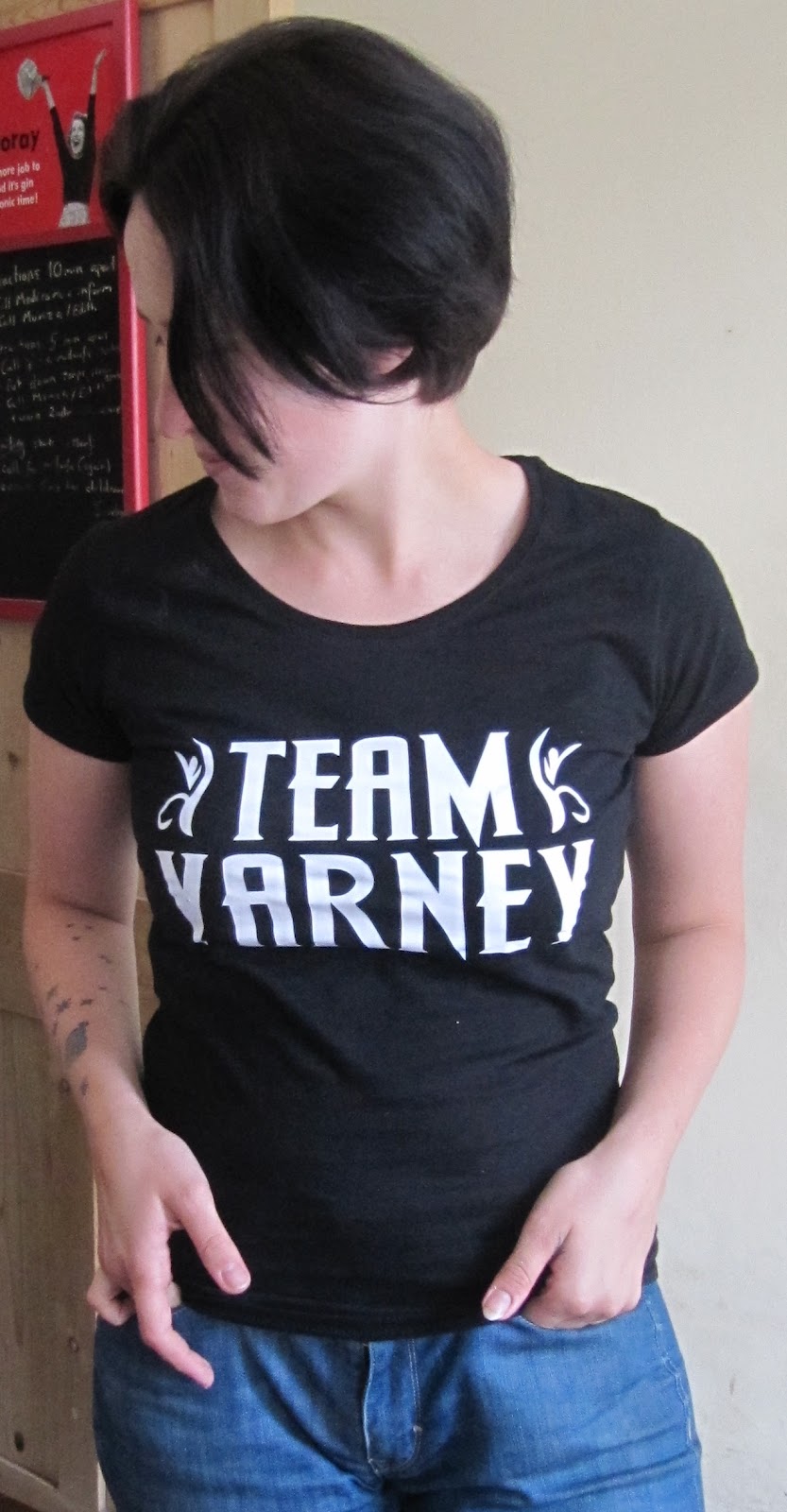
Because, as far as the daily life goes, domineering bastards are obsolete. Dear Christ, can you actually imagine actually living with any of these people? Athos, with his brooding man-pain and his alcoholism? Sir Francis Varney and all the theft, the molestation, the jumping-on-chair-backs shenanigans?  

None of this is real:

Being the submissive floozy of some supernatural baddie is nice for one's head-canon, but in real-world emotional terms it isn't exactly sustainable. Frankly, I don't see Jareth bringing me a cup of tea in the morning because I can't be bothered getting up. I don't see Nathaniel Crozier offering any sympathy if I get myself involved in a flame war and need a hug. Those among my literary crush stable who aren't actually malevolent tend to be emotional wrecks. Besides, they aren't exactly pleasant to be around. Villains, remember? 

Used for review purposes
Difficult themes through metaphor
Their lack of flat-mate qualities aside, their very unreality is sanctioned by the texts in which they appear. People like this simply do not exist. Romantic highwaymen and charming vampires are a thing of fiction. And that's a good thing, by the way. Fiction is a door into a world that lets us weigh up people and actions with far more care and nuance than we can permit when dealing with flesh-and-blood individuals, with real emotions. We can explore motivations that we would not normally consider, try to understand moralities that are beyond our usual scope of acceptability, and - most importantly - ask questions the which the real-world forbids. As such, we need to create characters that do not exist, that will never exist because they allow us to explore difficult themes through metaphor. They allow us to push events in a certain way, to lead to emotions and decisions that we would not otherwise understand. 

The tension that this creates in the reader or the viewer allows feelings and attachments that our real-world selves would not countenance. In some people this creates a turmoil, a breakdown of the boundaries of reality and fiction, but most people just get over it. We find a way to frame these emotions in a form we understand. I suspect the aforementioned  'Draco in Leather Pants' trope arises from people attempting this, that the conflict between sexual attraction and the repulsiveness of the character leads people to the 'walk two moons' approach: if we only saw this from the villain's p.o.v, they would not seem so bad. Others have, simply compartmentalise, drawing a line between 'real' and 'fantasy' and leaving it at that.

 Well, that's the theory...

Which leads us to Rhett Butler

As I was making my pigheaded slog through Gone With the Wind and having one of my little kicking-the-kitchen-cupboard fits and ranting about how Rhett Butler was the most odious, manipulative, abusive bastard I had ever had the misfortune to read about, an unwelcome voice popped into my head and asked, "So why the hell don't you fancy him?"

Interesting.

I went back to the book with a more clinical perspective. Look, he's vile, overbearing and something of a bully - all strong indications. Ruthless, amoral, yep. He's even vain, which is always a plus. I came to my conclusions - Rhett Butler is essentially a shit. It really should have been a no-brainer.

So, in the thick of that literary annoyance of a book part of me was thinking, Just why the hell not? Heck, it would have made reading it more enjoyable.

Fiction allows us to go to places that reality will not take us, allows us to feel things that are not grounded in the logical world, but doing this requires a backing-away. In order to be lead into the darkest places within us, and come back more-or-less unscathed, we need to suspend some aspect of our disbelief, to recalibrate our moral compass. Even if, in real life, I would find Rhett Butler abhorrent, surely I'd fall for him in the context of the book? That's my whole thing.

No.

Why no? 

Fiction, by its very nature, simplifies and sanitises. No matter how evil a character, the people they injure bleed ink, not blood. The results of their actions do not matter in actual human terms. Their glamour is a direct consequence of this. A healthy dose of realism would destroy any one of them, or at least the charms they appear to possess. 
Used for review purposes
Go read Mystery Babylon

To go one further, the splendid, uncomplicated, ruthless evil they represent is only possible within the boundaries of that fictional world, the metaphor through which they are created. If he weren't a vampire, Sir Francis Varney would be a dirty old man, Dracula a rapist. Sans magic, Nathaniel Crozier becomes a two-bit confidence trickster and thief. By inhabiting magical, or at least fantastical, worlds, these characters become part of a whole other moral discourses that daily life cannot touch. We allow them to display both the malevolence and the grace with which real-world monsters do not trouble themselves. 

Much as it grieves me to admit it, you're never going to meet a Jareth, or a Christopher Syn, or a Milady. In the unlikely event that you did,  you would probably run a mile. I know I bloody would. They are safe only because they are remarkable, exceptional, unreal. In short, they are a fantasy. 

But you will have met a Rhett Butler

"That Rhett Butler," as Angela Carter wrote, "with his travelling salesman's lines...". You know the type, haunting the pub at University campuses, amateur philosophers with their well thumbed copy of Ayn Rand and their leer at any woman brainwashed enough to think that something is worth hearing just because it's a man saying it. Oh, Gods, have you met men like Rhett sodding Butler.  They'll spout forth about how much they like, "strong women", but if they meet one will retreat as quickly as if they've been kicked in the nuts. They have a nauseating belief that everyone, everything, has it's price, and that price is well within their remit. They will say things like, "Your girlfriend is too clever for her own good."

Speaking of fierce, beautiful challenges...
The most terrible thing about real life bastards is that they are so grubby, so mundane. Vampires, femme fatales, Goblin Kings all these represent a fierce, beautiful challenge to the established order, to one's expected beliefs. Their purpose is to disrupt, to bring about change. They force the heroes, the reader, to confront their own shadows, to face their monsters. And to face a monster is to be transformed. Literary monsters are a test of fire, even if the status quo is eventually restored. A well written villain (especially an ambiguous one) is as much a threat to the powers-that-be as any rebellious hero. Even Richelieu feared Milady.

But Rhett Butler and his ilk are too much a part of this world to unsettle it. They are too invested in the dominant, cultural paradigms. Rhett is a misogynist, a capitalist. Oh, sure, he shakes things up a bit, but only within the sanctioned means of commerce and predatory male sexuality. The disruption he causes rides the same waves of profit and speculation that caused 12.5 million human beings to be shipped across the Middle Passage like so much cargo. Had he been born fifty years earlier, he would have wound up a plantation owner. If he lived today, he'd have made a killing selling bad debt and food securities, and sod the consequences. He's an opportunist, nothing more.

The same goes to his attitude towards women. The male examples of my adored villains can hardly be held up as examples of 'feminist ally of the year', but they at least have a basic respect and understanding of a woman's potential, a fear of that potential turned against them. Jareth might smoulder, "You're no match for me", but when push comes to shove he never denies that her will is as strong as his nor her kingdom as great. Nathaniel Crozier - misogynist extraordinaire- uses his sway over women to draw out their darkest, most terrifying capabilities (capabilities which he respects even as he abuses them.) Even Athos gives credit where credit is due when during a diatribe on Milady's wickedness he admits, "it must be allowed, she supported her rank becomingly". Nor does he ever underestimate her. When they meet face-to-face, he is smart enough to keep a pistol between them.

So, what of Rhett Butler and his claims that Scarlett is too good and too clever to waste away in widowhood? 

He never seems to speak to Scarlett but to belittle her, never admits that her faculties might be on a par with his own. The women who are as smart as him (and smarter) he either flatters or avoids. He pursues Scarlett because she is not dangerous to him - she is 'gorgeous' when she is angry rather than potentially fatal.  And from this position of arms-length, unshakeable tormentor he proceeds into a kind of abuse that is horribly familiar. He isolates Scarlett from her community by manipulating the perceptions of those around them, bringing the full weight of patriarchal disapproval upon her for behaviour which he has incited. He removes her children from her custody without her consent, vanishing with them for unspecified periods of time. He forbids her from taking contraceptive measures and threatens her with violence. When she withdraws sexual favours from him, he casually asserts that if  he really wants to have sex with her, he will rape her.

There are too many men like Rhett fucking Butler. They all too real. I don't want my fantasy landscape cluttered with them as well.

Rant Aside
If you are one of those people who find his mojo alluring, then that is your fantasy life and I have no right to police it. I might hate the guy with a vengeance, but given the record of my literary crushes, any moral high-ground is currently avalanching from beneath my feet. The above few paragraphs of vented spleen are the merely the more or less logical thought processes which helped me understand my reaction. 

Which is about where we draw the line on reality.

Because real world powerful, unprincipled seducers do not believe women to be 'fine, dark death-hounds' - they bully and bluster, manipulate and abuse. For all I might get into a girlish fluster about Mr Crozier (historian, warlock, philanderer) in the real world I do what I can to make sure men like him wind up before war-crimes tribunals. Edmond Dantès might charm me senseless between the pages of a book - but if I met him down the pub, I'd probably pick a fight. 

For years, I struggled with this paradox. The scorn, the anger, the disbelief that people face when they admit such a predilection is remarkable. You will be mocked, belittled, told that your critical opinions have no worth. Often - in my experience - these verbal attacks are gendered. In terms of self-worth, it has an emotional toll. For all I said I wanted a lover, a friend, a soul mate, my mental space was packed with people who could be nothing of the kind. How could I claim to be worthy of love, respect, affection while still having a total passionate yen for utter, tyrannical bastards? 

So, I write. It's what I do. I work through it in short stories, in novels, stretching existing metaphors, setting up the problematic of the attraction, creating terrible villains who allure, and their victims who bleed... 

Well, it's still just ink, but I flatter myself that it's scarlet ink.

In my own life, though, I just drew a line. There is reality and there is pretend. Reality is where I live, and pretend is writing, is fantasy, is questions of morality the real world can not address. And, just as a child falling back in the playground, clutching their shoulder and crying, "Yah got me, pardner!" does not wish to be shot with an actual gun, neither do my escapist desires or worrying at a theme change or reframe my real-life rights and needs. The game is more complicated, but the rules remain. Pretending a thing does not make it real, but not wishing for a thing to be real does not mean that one is not permitted to pretend. 
Used for review purposes
Alan Moore, there. Nailing it.

But what Rhett Butler made me realise is that the line I have drawn is permeable, that it plunges and dives encompassing this, but not that, refusing one foible, but permitting its neighbour free reign. It does not only contain that notional space that is created when one opens a book, or watches a film, but is an ongoing conversation with the worlds of fiction and reality. It is personal, tied implicitly to how we escape, how we engage with those fantasies. It makes us uneasy.

For me to fancy Rhett Butler would be to reconcile myself with everything I detest. I cannot view him, or Gone With the Wind as anything other than a cultural artefact of genocide and misogyny. As such, he belongs to this world, to this reality. I tell myself that my creations are only fictions, but they slip this way and that, they hurt and they worry.

There is nothing empirical about unreality.