Literary criticism, recommendations and whimsy from a devotee of the story in all its forms. Updates Fridays and every other Wednesday. All views my own, or thereabouts.
Okay, full disclosure. I wanted to hate this one. Since I saw it advertised, I've been thinking of it as The Girl with the Perfectly Reasonable Hatred of Being Infantalised When She is Actually a Grownassed Woman. I came to it with the narrowed eyes of suspicion, the acerbic comment of dismissal already framed and sitting on my tongue.
When you call a woman (and with a divorce, a round of failed IVF and a drink problem, there is no 'girl' about Rachel) a girl, you are presenting the kind of attitude towards women and their problems that wrecked Gone Girl for me. I was expecting another round of 'psycho ex-girlfriends' and false rape accusations - which is, I admit, generally better than the tough-but-vulnerable manic pixieness you get when men use such titles.
I wanted SO BAD not to like this book.
But I'm sorry to tell you that it's brilliant.
No, it's not the best book I've read this year, but it is a gripping, sickening and intelligent thriller. The characters are complex, realistic and never entirely likeable. Their problems are real, and - even if you hate them - you will pity them. Their suffering wrenches through the novel with a powerful 'here but for the grace of god'. It's the stuff of nightmare, but the worst nightmares, the kind that bubble so close to the surface of our experience of the world. It presents, terrifyingly, the real stakes of living as a woman in the patriarchy, and the way that you will often find yourself at the mercy of men, with no guarantee of their good intentions.
I struggled, I admit, at points with some of the set-up (spoilers, sorry) - the plot relying on a couple of tropes we could do without for the next eight decades - and found the ending possibly a little sensationalist. The mystery aspect itself was competent and well structured. I admit, I sussed it a little before time, but only due to certain personal reasons - my suspicions did not cement until the proper moment, when the careful laying of clues coalesced into certainty. One aspect of this was especially well presented, and actually did catch me by surprise.
The real draw of The Girl on the Train, however, is not its mystery, but the claustrophobic, almost unhealthy intensity of emotion within it, and on that count it hits every single mark. Fantastic, and well worth your time.
Regular readers of this blog will know how much supernatural fiction means to me. Time's Fool is my lovesong to the genre - an homage to Dracula and an edgy, contempory take on the conventions of the Victorian Gothic.
So, it was introduced to our book group as "The Next Night Circus", a book which has thus far been the standard aginst which all others fall. However, I'd scarcely got half dozen pages in to it when it struck me that this was not The Night Circus, no.
This was Nights at the Circus.
Well, no, it wasn't. Logan is no Angela Carter (considering that I hold Carter to a cross between be a messianic figure for the study of fairytale and a literary Godhead, I'm doubt if I would ever make that comparison without caveat.) Her prose does not sparkle with endless profundity, she makes no bold, brain shattering arguments with her plots. However, the comparison can be drawn, the influence recognised. The main difference is that The Gracekeepersis a profoundly quiet novel.
The Night Circus rings with wonder, glory and magic. Nights at the Circus dazzles, swoops and blazes much as Fevvers herself. The clue with both of these is in the name - we are being invited to an entertainment, a spectacle. The Gracekeepers is named for the small, brightly coloured birds whose slow starvation marks out the length one should spend upon grief.
The quietness of The Gracekeepers suits its vast, empty, watery world, suits its lonely, voiceless protagonists, suits the very queerness of the novel. Because it is a queer novel, contrasting the safe, prosperous, conformist world of the landlockers with the uneasy itinerancy of the damplings - forever in the shadow of religious fanatics, or at the mercy of a violent militia.
The Circus Excalibar's play with gender and subversion is at once celebrated and reviled by their landlocker audience, and they inhabit a tenuous existence, tolerated only for the thrill they can give. Aboard ship, their loves are passionate and non-normative, their identities fluid and impossible to discern in binary terms. Their bodies are covered with scars they have taken.
To further the metaphor, the damplings are repeatedly described as a family, albeit one marred and made dysfunctional by the clear stratification of power within it. Some members embrace their outsider status, others long to return (or to gain) the respectability of land. In to this mix comes North - unrepentant dampling, an outsider even in the Circus - and Callanish - a landlocker gracekeeper trapped by her past, resisting the call of the sea.
And, until I was two thirds of the way through the novel, this was what I was enchanted by, this is what I was lost in. Whether North and Callanish's connection is asexual, lesbian, or a sweet, moving portrayal of twin spirits who understand each other on a level that transcends gender and sexuality, that connection is the heart of the book, the strength of the novel. It moved as slowly as the tide, each beat heart-rending, gorgeous, captivating.
But the problem with The Gracekeepers is that it felt the need to have a plot. And whereas most of the novel's other characters (even bit parts) are drawn lightly, cleverly, that plot rested upon the antagonist who felt like like the cheapest caricature grabbed from the brashest story of woman against woman. Her actions, which drive the so-called climax, were inexplicable, unconvincing, and unfitted - in tone, or matter - for the novel. The only explanation I can think of for the inclusion of such an event was that it permitted a neat and unproblematic ending to a novel that otherwise would have continued, troubled, tragic, ambiguous.
As always when reviewing YA, I feel I
should state that not being the intended audience puts something of a
dampener on my relationship with it. Worse, I can no longer claim to be
au fait and can therefore no longer assess it in context of its peers.
My gods, is it possible to sound more pompous?
Well, anyway, I really quite enjoyed The Hunger
Games. Roaringly compulsive, I read the entire trilogy over three days.
Collins' world is sharp, frank and horrifying - although yes, it pales in
comparison to other speculative and real-world settings - as a preteen
it would have led to the kind of horrified captivation that would have
kept me from sleeping. Collins presents - through Katniss and Peeta - a
frank idealism that is both powerless and inflammatory against the
corruption of the world they inhabit.
However, The Hunger Games, Catching Fire and Mockingjay are not equal. Neither sequal has the claustrophobic intensity of the orignal novel -by comparison, Catching Fire is directionless and perfunctory, whereas Mockingjay rushes along a adventurous thriller of a plot that overshadows what should have been the emotional heart of the novel. Yet I get the impression that the books were intended to be distinct in mood, genre and pacing. They almost need to be vert different books, to attempt very different things. Whether they succeed or not is moot - as a cynical reader, I was
unconvinced. As a teenager, more open-hearted and engaged, I may have felt differently.
The greatest strength of the novels, though, was neither their plot nor their emotional intensity. What holds them together is the character of Katniss, whose stark, occasionally abrasive character convinces entirely. Collins unashamedly presents Katniss as a
child warped by the dreadful circumstances of her youth.
At once
sharply worldly and desperately naive, she is a survivor whose
faults are redeemed by her commitment to a better world. Even more refreshingly, Katniss' emotions amd relationships are transient and adolescent
- their intensity informed by the horrific circumstances in which they develop, rather than some high ideal of being 'more real' than those of her peers. More still, Katniss mimics and manipulates her own feelings in order to survive, an experience I remember keenly (although under less deadly conditions) from my own adolescence. Katniss' kisses move neither heaven nor earth. Instead, she acknowledges that they feel nice, and she would maybe like to have another. You
know, when her life isn't in direct danger.
From what I know of relationships formed against a backdrop of war
and uncertainty (not so very far in this country's past, if we're
honest), it is this very lack of sparkle and that let's us know what is happening is 100%
real. Without spoilers, the ending satisfied, too, refusing to tidy away the bodies or the trauma of the narrative. What we are left with is not some ride into the sunset but survivors clinging to one another, hoping, one day, to heal.
So, on balance, not flawless, but The Hunger Games series provides a clever and engaging exploration
of how circumstance shapes us, of how we are always responsible for our
actions, but perhaps not the way those are used. An enjoyable read, and some pretty awesome YA.
You know what I was saying about random library finds?
Well, my gods, I love this so much. I admit, a fraction of this enjoyment is because (shortly after picking up) I had a run in with my favourite local mansplainer who benignly asked what I was reading, and I had the pleasure of showing him the cover and watching the vague interest turn to an actual recoil.
Still this book is astonishing. Did you know I'd never heard of it before? Me, whose doorway to adulthood was Angela Carter, whose undergraduate adulation was spent on Carl Jung, James Frazer and Clarissa Pinkola Estés? No-one even thought to tell me this book was around?
And okay, yes, it is one of those sweeping, slightly too-universal acts of poetic anthropology which are a) academically a bit suspect, and b) not to everyone's taste. However, the value of such works is not solely in their content, or the viablity of their research. No. What they do is shatter open the closed doors in our minds, bring us face to face with the impossible, with the things that, bone-deep, we have always suspected to be true. Their worth is not measured in intellectual terms, but in spiritual and socieological ones. Their sweeping deconstruction may not be entirely accurate, but it reframes our mental narratives, makes us interrogate our understanding of our bodies, our spirituality, our world.
To her credit, Grahn recognises this. By her own lights, she is a poet, and the story she offers here - overwhelming and encyclopeadic as it might be - is never intended to be more than one voice among many. More importantly, it is a female voice, one rooted in the female body - specifically in the act of menstruation - an act and a body that has faced and faces so much discrimination, so much legislation, disgust and ostracisation worldwide.
Grahn takes the balance of shame laid upon the female head, the female gaze, upon female blood and female decoration, and draws out its global import. Rather than shame and staining, menstrual blood becomes the original creator of human consciousness, the single thing whose expression and management keeps the world in order. She reframes it as the root of all science, all craft, all religion, language and clothing. It is the originator of diet and ritual. In her language, all blood is menstrual blood.
Her methodology is engaging and pursuasive, hopping through academic disciplines to create a welter of evidence and arguement, drawing parallels and concordances across time periods and civilisations. She shows consciousness, humanity, society as a gift that was begun by women and passed - through actions she calls metaforms - into the hands of men, whose mimetic 'menstruations' can be traced through every hero's journey we have ever read.
Naturally, a book so focused on periods is going to be pretty essentialist. Yet, even so, Grahn leaves the door open for queer theory. Civilisation could not begin and end at bodies which menstruate - the truths so learned must be commicated to those that do not. The narrative she constructs suggests that gendered behaviours not only can cross the line of bodies, but more specifically that they must. That, for society to function, men can and have simulate menstrual forms to access that same ritual power associated with the original menstruation.
A more marked criticism is that Grahn's methodology and examples are not always entirely sound. She makes much of menstrual etymology, but her focus is almost entirely upon the English language. What is more, with my limited knowledge of etymology, I was able to spot a few mistakes - a more experienced scholar would doubtless notice more. Perhaps more seriously, her universal focus could be open to the criticism of approriation and misrepresentation of other cultures. Her repeated reference to the practices of the Dogon people made me uneasy, and although I am not an anthropologist, I am always wary of the constructions European scholars put upon the practices of other cultures. That said, however, if recognised as a flawed work that exists as one voice among many, Blood, Bread and Roses should really take its place as a central text of mythic history. It should be spoken of in the same breath as Man and his Symbols, The Golden Bough and The White Goddess.
Anyone who knows me will be aware that I spend half my life seeking the wild rush of bliss that is discovering a writer I've previously not read (I admit it, I have a problem) and this is the drive behind at least half the random shit I bring back from the library. Still, as I picked up this one, the name Victor Pelevin rang a bell and not because he was - as a quote on the cover suggested - he was the "zen Buddhist Will Self from the former evil empire." Although, that is an undenaibly formidable set of images.
Turns out the reason it seemed so familiar was because I already had a Pelevin novel at home that I had never quite been in the mood for reading. Still, this one with its promise of werewolves, sex work and a spontaneous combustion seemed rather more up my street. In fact, it looked so incredibly weird that it might even be one of those books that you only ever seem to get in translation, that completely ignore Anglocentric ideas of acceptable genre, subject matter or writing devices. And, in all fairness, it does.
This is a clever book, a lurching, strange mish-mash of styles, themes and characters. Sudden changes of register throw the reader as our slightly prim narrator veers from playful discussions of sexuality to heated philosophical arguments and back again via passionate defence of Nabakov. Combine that with its engagement with the politics of Russia and its fraught relationship with black gold. Throw in some myths and folktales and it should have been my kind of thing entirely.
Alas, it wasn't a book I could love with an open heart. Something about it was a little colder and more didactic than I find easy to engage with; part of this is a problem inherent in attempting to create a sacred text. If one does not 'buy' the precepts of the form of Buddhism there described, one is left a little bored by the earnestness with which they are proposed. There was also the occasional clumsiness with which the autobiographical (and romance) aspect of the plot combined with the spiritual journey of A Hu Li. At times, a pitch perfect indictment of spiritual disintrest and the way a brutal free market undermines all attempts at interpersonal sympathy and warmth, at others it felt like two badly realised concepts, crammed in together.
Also, from my rather left-wing persepctive, perhaps some of the commentary on
sexuality, gender and essentialism was not entirely palatable. However, Pelevin is a skillful enough writer that in the main his narrator and
his characters remain constructs, rather than authorial mouthpeices; in
personal matters, at least.
There was, also, the issue of translation. Pelevin seems to be a writer much enamoured of the pun - his narrator's name apparently translates into Russian as "What the fuck", something that is sadly lost in translation. Other plot points, especially names, encountered similar problems - an unfortunate state of affairs that is nobody's fault, really. Except perhaps mine, for being unable to read this in Russian.
For all that, it was a fascinating, intelligent and mind-bending book. Pelevin draws characters with great care, balancing grossness, prejudice and real passion against the possibility both of redemption and monstrosity. Where it worked, this was an immersive experience that lingers in the head, raw and uncomfortable. Where it didn't, it perhaps had the misfortune to be a little dull, but otherwise an ambitious and interesting read. I'll check out some of his other stuff, some time. When I'm in the mood for it.
So, if you missed it, my Sunday was started by Germaine Greer being transphobic on a national platform. The general thrust of her arguement is that identification does not affect a person's gender and that "a great many women" feel like trans women do not "look
like, sound like or behave like women". Hateful as I might find this I'm aware it's a fairly widespread view, that a good proportion of the population - female or otherwise - feel that one's ability to 'pass' as any specified gender is more important than one's own sense of it.
As a philosphocial arguement, of course, it fails. It's a bloody ridiculous standard. If gender is decided by comittee, then where do we stop? Because there are transwomen who pass in the eyes "a great many women" and *whispers* there are those who biologically female who don't. And, of course, what with my chosen soapbox being Twitter, I was halfway through my rant before I realised what I was doing.
Oh, bollocks. I was coming out.
Making it all about me:
Because I'm a special snowflake, I am. There, the self-denigration required my Englishness being done, can we ditch it? Excellent.
The fact is, my life has been haunted by my failure to exist as that nebulous thing called "a woman". Every time I've been in a meeting where a comment was made about how "we're all girls here" so "multitasking won't be a problem", I would smile falsely, flinch, and find myself excluded tacitly. Every time a friend has consoled another, "Oh, but real women have curves", I'd cross my arms over breasts that look more like mosquito bites and try not to think about the way I was wearing jeans that fell down because they were cut for someone with hips. I'd be told that women were less violent when I spent most of my adolescene with brusied knuckles from punching walls, that women 'prefer an emotional narrative to straight up pornography' when honestly...? That women have high voices, when my contralto is lower than some tenors. That oh, sigh, you know what girls are like about shoes when I have four pairs in total (walking boots, gig boots, smart boots, sandals.)
And, yes, this is all essentialist crap. But the fact is, "a great number of women" have a very narrow and exclusionary view of what womanhood entails. It didn't matter to 'a great many women' that my chromosones were XX, that I had breasts and a uterus, that I menstruated, that I have birthed and lactated - despite all of that, I didn't "look, sound or behave" like a woman. If we left it up to them, it wouldn't just be transwomen who wouldn't qualify. I'd be out on my ear as well.
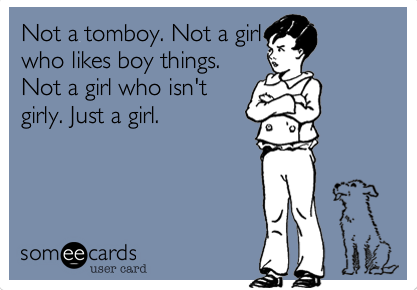
But... but surely that was all just social constructions? Surely the real thing to do was just continue on my way. I am a WOMAN, hear me ROAR. Surely I'd ditched all that crap along the way. I didn't need social constructions of gender to inform me, I was a gender-nonconforming woman, I was an honest woman who didn't buy any of that bollocks, as the omnipresent e-card company has it...
Yes. About that.
When the meme came up for the first time, I felt something inside me wince. I stopped, I rationalised. No. It was great. Behaviour is not destiny. The whole binary is fucked. Who cares if I liked comics and broadswords and tailcoats? Who cares if, at thirteen, being told that, yes, I had breasts now and should probably start wearing a bra, I asked my horrified mother "couldn't I just bind them?" So what if Viola has been my hero since I was seven years old, or that my crush of Gwynneth Paltrow stems entirely from her part in Shakespeare in Love?
None of that undermined my right, my ability to be a woman. Did it?
And, anyway, wasn't I more radical here? As a woman? Undermining all this backwards, sexist bollocks? Wouldn't I do more good as the voice of "well, actually, I'M a woman, and..."? And, yes. That would be a good thing to do. That was an important thing to do. My feminism required it.
Except... except.
Look, on the best days, on the perfect days, I don't think about my gender. It's irrelevent. Like, if you asked me what I was I'd answer like Eli in Let the Right One In, like my eldest daugther did when she was 3, "Just Eli", "Just [Sprog1]". That's me. I'm not straight, I'm not gay, not bi, not male, not female. I don't want to think about it. I'm "just Alys." Can we forget about this now?
But perfect days are pretty bloody rare. Always, there'll be someone. "I think this young lady was before me," "Oh, we're all girls here", "Come on, ladies, let's apply ourselves to this." A touch of fear, a flinching. Not always, not every time it happened. Sometimes, YES, I was a woman, thank you for noticing.
Why the gratitude? Of course I was a woman. Anyone would see that.
Right?
Surely it was just that bloody binary, the way it had been crushing me my whole life. Of course I was woman. Of course I was cis. I was just non-conforming and flat-chested and didn't buy into the popular construction. I'd had years of crap about it, imposter syndrome was a natural reaction. I was a woman. No-one could take that from me.
Picking a Side:
A Spoonful of Jam is probably my second favourite Michelle Magorian novel. It's a novel about courage, about being honest about who you are, to your family and to wider world, despite how bigoted those things might be. It is beautiful and compelling and heartbreaking in equal measure, and Elsie is the kind of heroine we need more of in this world.
So. Elsie be with me now.
The narrative is of a young, working class girl with a grammar school scholarship in post-War London, about how she faces all the obstacles put in her way by her accent, her class, her education, her family's poverty. And about how she longs for her father to accept her, the way he does her elder brother. She longs, aches to be a boy so that he will take her down the allotment and - finally brave after a novel of new experiences - takes herself to a barbers for a Number Two so that her father will finally accept her.
Of course, it doesn't work out that way. Everyone is horrified, "have you got nits?" becomes the refrain. But at the novel's end, at her final triumph, her father gives her a gift:
She pulled out a long cylindrical bundle tied with a piece of string and a bow. She didn't need to guess what it was. It was a comic. Not a second-hand one, either. It was brand, spanking new, and it was a girl's comic! It was then that she realised it was wrapped around something bulky. She undid the string. A heavy object fell on the bed. It had a wooden handle with leaves and flowers carved into it. Her father must have made it for her while she was in Kent. It was attached to triangular-shaped piece of curved metal. As she held it up to the shaft of streetlight that filtered through the threadbare curtains, she could see what it was only too clearly. It was a trowel. Her very own trowel. It was her invitation to the allotment. And not as a boy, but as a girl! [emphasis mine]
This moment, that should have been perfect, beautiful, affirming made something in me wither the way the courgettes at my very own allotment have gone limp and black at the frost. Why must the comic be a girl's comic? Why the trowel carved with 'girly' patterns of flowers? Why must the haircut become some kind of shame? Some kind of mistake? Why she be invited to the allotment "as a girl"? It should have been a glorious scene, something affirming and brilliant. Instead it took my wonderful, brave Elsie and put her firmly back in the box marked XX, marked female, marked girl.
But surely that was right? Surely she was a girl and never doubted that she was a girl and her hobbies and interests never affected that one iota. Surely I was the one being essentialist and and stupid and...
Fast forward.
I'm a young mother and I'm Disneyed out. Of course, I've heard PAINT's fantastic After Ever After and I play it to my long suffering friends with annoying frequency, until the day someone says, "Hey, have you heard there's a sequel? It's got a Frozen bit."
No! Wild with joy, I flee to YouTube and play it. (For the purposes of this post, you only need to listen to the first
segment, but listen to the whole thing anyway. It's hilarious.)
And, inside me, something is squirming. Something flinching.
No. No. That's wrong about Mulan. A woman who cross-dresses isn't automatically trans*. I mean, great for men who are and all power to them, but that doesn't mean... Look. I cross dress. Often. Frequently. Okay, for months. But that doesn't mean...
Couldn't Mulan just be... Mulan? Does she have to chose which side to play for? Are those really the only options? Do I have to chose between getting to go to the allotment "as a girl", or admitting that I always was "a guy in my soul"?
Couldn't I just be me? And when I want to femme, couldn't people look at me and say, "yes, that's a woman" and when I want to butch*, could people just assume I'm a guy, and the rest of the time could people just say, "Well, that's Alys" and let the whole pronoun business be swept away?
Bravery and Cowardice
Because, there's the thing. I could hide behind being "just Alys" my whole life. I could pretend it doesn't bother me that I'm read as a woman. Not just in the smash-this-fucking-patriarchy way, or the benevolent sexism way, but just the she/her/woman/mother/daughter/wife way. The way my martial arts teachers call me "Ma'am" because the alternative is "Sir" and I'm not that either. I could pretend that I don't feel the blaze of total, helpless joy when I overhear people trying to puzzle me out because I don't fit into any of the boxes they've learned.
I wasn't being disruptive like that. I wasn't being challening or honest or anything like that. I was making myself the anomoly who would neatly be smoothed out because the alternative was frightening.
Elsie would be disgusted.
So. Here we go: I'm not a tomboy. I'm not a girl who likes boyish things. I'm not a girl who isn't girly. You're right. I don't have to qualify my femininty. Because I'm not female.
And I'm not male either.
I'm just Alys. Always. And Alys is genderfluid.
And sometimes that means I am a woman, yes. And sometimes it means that I'm a man. And sometimes I'm neither. My gendered behaviours are never more than a form of drag. Sometimes ultra femme. Sometimes super butch. Mostly just jeans and a t-shirt and hair in a mess with my nose in a book.
Genderfluid. No apologies, no qualifiers. If Germaine Greer and her "great number of women" read me as female then that is their problem, and if they decide I don't qualify for "real womanhood" then that's their fucking problem as well.
And to anyone else, of any other gender (especially cis men who are aggressive about it) I'm not playing that game any more. I'm not going back in that box.
I never fitted anyway.
---------------------------------------------------------------------------------------------------------------------------
*I'm not mad keen on this term because the masculinty I present is generally more dandyish than it would imply. I wear frock coats rather than plaid, cravats not braces. But for matters of comprehension, butch it will have to be.