Showing posts with label Dracula. Show all posts

Wednesday, 29 June 2016

Sympathy and Consent: The problems of vampire love

The vampire is prone to be fascinated with an engrossing vehemence, resembling the passion of love, by particular persons. It will never desist until it has satiated its passion.... In these cases it seems to yearn for something like sympathy and consent. -Sheridan Le Fanu, Carmilla

"Resembling?"

I remember reading it the first time. I put down the book, stared up, frowning at the ceiling (light green, artex. My adolescent bedroom), rubbing the tattered paper of the spine.

"Resembling?"

After all, I was a Buffy fan, had seen enough of Angel's brooding, heard Spike's immortal line:


I wasn't surprised to find the idea of vampiric obsession, the idea that vampires were capable of strong, even affectionate, emotion towards humans and each other - what bothered me was the line being drawn. "Resembling."

The affection Carmilla has for the narrator is evident, her passion clear - why, then, the reluctance to call it by it's name?

Dracula, too, is charged with an inability to love, and answers, "Yes, I too can love. You yourselves can tell it from the past." What's more, the person accusing him is one his 'wives' - another vampire, suggesting that love is valued by the Undead, that Dracula's lack of it is an aberration. However, context is important; the 'love' to which the wives are refering involves eating the object of their desire. What's more, Dracula counters their criticism by claiming that he had once loved them in the same fashion - three women whom he seems to ignore when he isn't indulging them with a baby-in-a-bag, women he is in the process of abandoning.

The Dracula we see in the novel is alone, almost tragically so.

Vampiric love, then, is one which it is difficult to seperate from appetite, from death. After all, Carmilla talks of love and passion without reservation, but it is clear she means something a lot less sanitary than chocolate boxes and billet doux. She recalls "a cruel love - strange love, that would have taken my life," believes, "Love will have its sacrifices." Even in Buffy (which was my teen-relationship textbook) vampire romance is never healthy - there's Angel's painful impossible love of Buffy; there's  Spike and his glorious, dysfunctional infatuation with Dru; and there's Dru swooning over Angelus, the monster who drove her insane.

Perhaps that's what Le Fanu was getting at - we can recognise the strength of the feeling, its passion, its realness - but ultimately it either fickle, self-serving, or destructive. It is not a wholesome, it offers no support or strength, can only kill one or both parties. Although similar to love in many ways, it cannot be love because, by definition, its focus, its practicioners are perverse.

Transgression, Perversity and Otherness:


Hmmm. Yes.

Hopefully it is news to no-one that vampires are often used as a sexual metaphor. However, the sex they represent is seldom normative, sanctioned sexuality - monogamous, heterosexual, vanilla, and focused on reproduction. Vampires are used to explore Otherness, and one way to do that is to present them as sexually 'transgressive'. This holds true, even at a surface reading: Carmilla is a lesbian, Spike a male submissive, Dracula a bigamous foreigner. If I started to list the gay vampires out there, we would be here all day.

And one of the ways that Othering dehumanises a figure is to present their emotions and reactions as deviant, immature, perverse. Because they are different to us, because they are 'less' than us, their emotions and motivations can never be as real, important, or respectable as the feelings of mainstream groups.

So just an Other cannot be forthright, but rather is shrill or beligerant, what they believe to be love is not really love. It is merely lust, infatuation, obessession. Their relationships are perversions and inverstions of the ones that 'we' practice, the 'real' relationships. When they run against us, their attentions are clinging, embarrasing, unwelcome. Their influence is corrupting by default.

Yes, this fits the metaphor of vampirism rather nicely, doesn't it?

And metaphors are powerful. If these stories show, over and again, that the only 'right' love is male-dominated, heterosexual monogamy, then anything which falls outside of that, which is represented by vampires, is dangerous, evil, corrupt.

And, like many things didactic moralists preach against, it also looks kinda fun.

Take me away from all this death.


"Make me into one too," said the boy. "Please? I want to be one. I want to walk the night with you and fall in love and drink blood. Kill me. Make me into a vampire too. Bite me. Take me with you." - Poppy Z. Brite, Lost Souls
 Oh, who hasn't at least thought about it? About being eternally beautiful, unbreakable, strong?

Sympathy for the vampire is not an uncommon reading, or indeed response to the genre, and the reaction against such sympathy it is always strong, morally guided and didactic.It's well known that the British Board of Film Classification pushed for censorship of Hammer's vampire films because of the sexual element of the biting scenes, especially Mina's almost gleeful acceptance of Dracula's advances.

Even today, there are no shortage of people who seem to want to drag vampirism back into the realms of 'good, clean horror'. But these currents have always been there. The real power of vampirism is neither in its desirability, nor its horror, but in the ambivalence it raises. As the narrator of Carmilla says:
In these mysterious moods, I did not like her. I experienced a strange tumultous excitement that was pleasurable, ever and anon, mingled with a vague sense of fear and disgust. I had no distinct thoughts about her... but I was conscious of a love growing into adoration, and also of abhorrance. - Carmilla
We are aware of the moral failings of vampires, even as we are drawn to them. They may be tragic and lovely, but they cannot be saved.
Something in him ached for that boy. For the sadness in his face, for his eyes yearning to stay young. He wanted to grab Nothing away from his companions and tell him that sometimes, everything could be all right, that pain did not have to come with magic, that childhood never had to end. And yet he wondered whether Nothing had not known all those things when he made his choice.  - Lost Souls
Writers do fascinating gymnastics to navigate this problem, but ultimately, it will always be as Carmilla says, "I live in you; and you would die for me, I love you so." It is a mad love, is amour fou - another thing which is belittled, mocked, denegrated. It is another thing that is often described as not 'really' being love, only 'resembling' it.

But, oh, it is so very real, and so very tempting. It is a love which transgressive, morally ambivalent, one that can bring with it an entire world of pain. And many vampire writers chase so hard after it, trying to bring it to a happy ending. But tidying away its danger, its nastiness, its utter disregard of morality, it is very difficult to maintain its white-hot intensity. If a vampire is prepared to call your father, 'sir' and wait until marriage, passion can hardly be consuming him that badly, right?

Well, maybe. There is such a thing as self-control. And, after all, Le Fanu speaks of an "artful courtship" of longing for "something like sympathy and consent"?

Take me away from all this death!

That "like" again.


The Boundaries of Metaphor, the Limits of Consent:
 

As mentioned above, the sympathy is easy. It's the heart of the vampire's allure, after all. It is precisely that balance of attraction and disgust. The idea that something about you is being admitted that you would never have owned before. It is about a sense of transgression, of non-normativity. It's about self discovery - and the ensuing shame, ambivalence, emergence.

The reinvention of the vampire as a romantic hero comes from that longing, that desire to put away all the weakness and uncertainty, to have your secret desires unfolded, to be lifted up on a love that is actually forever. So, of course it appeals, it is so tempting to leave it at that. 

But consent? Oh, how on earth do do we negotiate the morality of this?

After all, this is not coming out or getting laid. It's not asking your partner to spank you: we are talking about a vampire. This is someone who kills humans in order to live. So, yeah, you might sympathise, but that won't stop you reaching for the stakes and the communian wafer.

Besides, even if it didn't, can a word like consent actually be used in these circusmtances? The watchword of the BDSM community is SSC - safe, sane and consensual - and if consent is the most discussed, it does not exist in isolation. The three are interdependent - without consent and safety, it cannot be sane; without consent and sanity, it is not safe; without safety and sanity you cannot be said to have consented.

Also, legally, certain things are out of bounds, no matter how much you might want someone to do them to you. Being eaten, for example.

How can vampire romance ever be unproblematic?

So people tidy things up. They removed the Otherness of vampires,  stop them being killers, make them just humans with better hair and super-strength. But this overlooks the power of that Otherness, the importance of vampire mythos to groups who have been Othered, told their desires are dirty, immoral, or just worthy of mockery.

Contemporary vampire novels are frequently queer, or kinky, or else the dream relationships of lonely women of various ages*. To love a vampire is to desire to turn outsider status in to the ultimate in-group, to rewrite loneliness and frustration in to endless pleasure, to cast off low self-esteem nd find body confidence, beauty and sexual agency.

So we write stories where there are 'good' vampires, where they have souls and don't eat humans, and it becomes all about the metaphor. These are good people, just like us, facing unfair discrimination. The fact they must live in secrecy is unjust. The huge taboo surrounding vampire love is misguided.

However, as an idea of 'devaint love reclaimed as permissible', vampirism is a flawed model. To be able to embrace it wholeheartedly involves tidying away the ugliness, the whole vampire bit of vampirism. Female sexual agency isn't actually fatal, and lesbianism is does not cause aneamia. There is a lacuna between the metaphorical truth of vampirism-as-sexuality and its narrative reality. A young queer person may be justified in feeling that coming out will get them treated like a monster - it happens far too often - but they will never become one. Kinky sex (or, honestly, just sex) may feel dangerous, furtive and transgressive - but it should never actually be so.

Vampirism is. Its whole draw is the idea of being wanted so badly by someone that they will devour you. But this isn't a brutal slash and hack job - it is tender, loving, slow. It is romantic, sensuous, arousing.

And it will kill you.

------------------------------------------------------------------------------------------------------------------------------
* Mine is, arguably, all three. 

Wednesday, 24 September 2014

Functions of Fantasy, or, Alys's Addicition to Villains

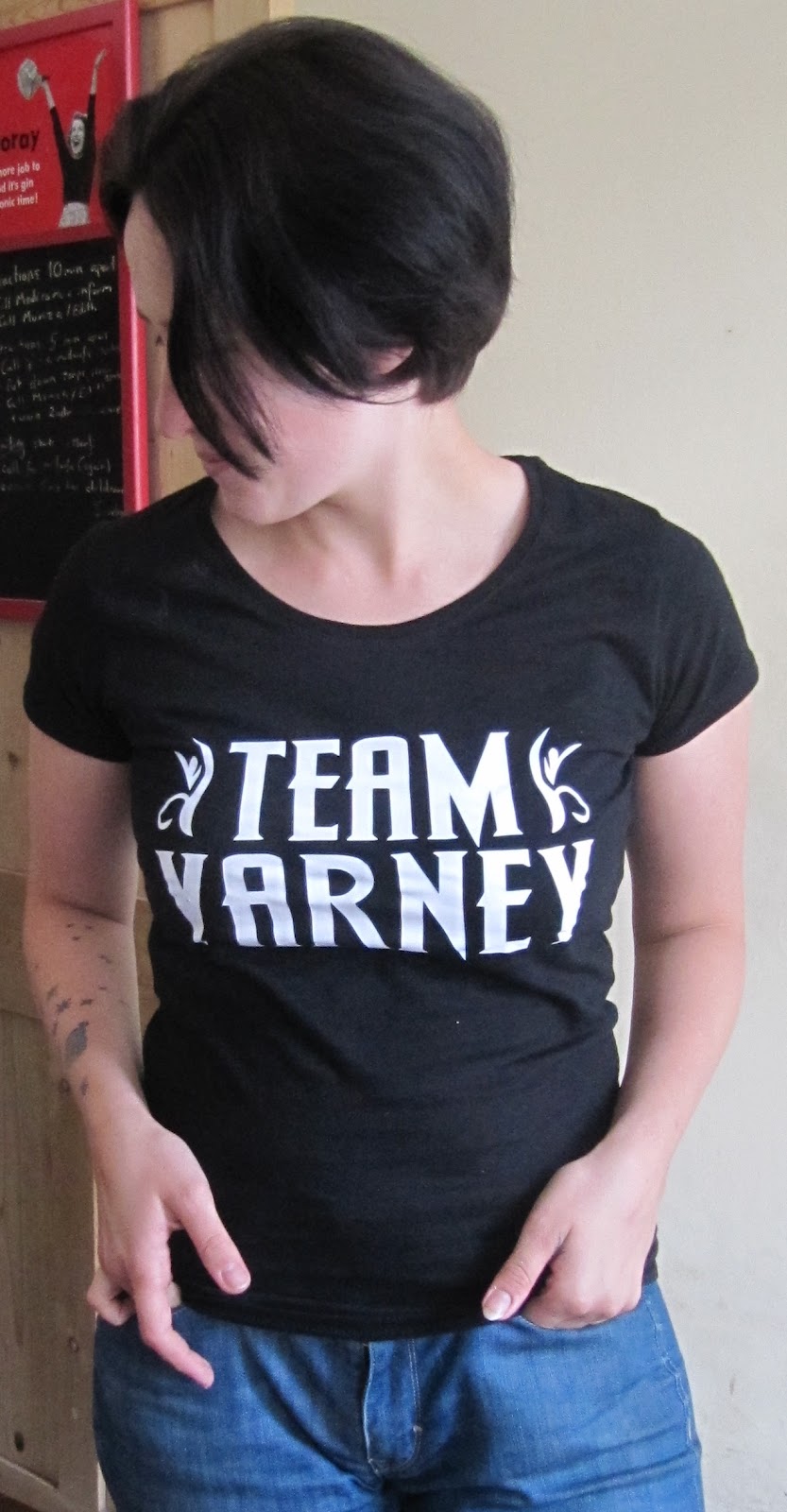
It appears I have mentioned in passing something of a predilection for fictional bad guys and characters so morally grey that they could be used as camouflage on the dark night of no moon. Give me cads, rogues, and schemers of all types. Give me a character who is something of a bastard, who is ruthless, conniving, swaggering, manipulative, and the chances are I'll swoon and maybe put his name on some kind of t-shirt.

No. I am not joking. Yes. This is the way my mind works.

I read Fantasy novels and Adventure novels, I read Horror, and Historical Fiction full of sweet, charming, beautiful men and women. People who are honorable and upstanding, who are intelligent, kind, devoted and if I have to list the fiction heroes who get my heart racing, it stands at Wilhelmina Murray, Percy Blakeney and that's your lot.

I don't get crushes on heroes. Anti-heroes, maybe. Morally questionable, domineering types on a redemption arc, sure. Flat out, total bastards? Well, duh.

Used for review purposes.
Okay. Maybe not all interest.
This is not Draco in Leather Pants. Sure, a bit of emotional complexity, a little bit of grayscale does not go amiss, but I do not want these characters redeemed. I do not want them to be any less evil and bastardy. I do not think they can be saved by the Love of a Good Woman.

If they were saved, I would lose all interest in them.

Yes, Edmond Dantès is sweet, and lithe and kind of pretty to think about, but it's only when he emerges as the socially aggressive and unprincipled Count of Monte Cristo and people start mistaking him for a vampire that I begin swooning in this ridiculous fashion. Frankly who would take a night with one of Shakespeare's vaguely insipid romantic leads if there was the offer of a night with Oberon? Sure, you'd regret it in the morning! Does that mean you shouldn't do it?

Well, probably, yeah. 

Actually, I wouldn't advise it at all.

But that is entirely beside the point

Were I to draft a checklist of necessary qualities to invoke my fawning and excessive devotion to a character, it would start something like: powerful, ruthless, proud, unpredictable, amoral/morally questionable, domineering. After a few thousand synonyms, I might think to include some physical characteristics (cheekbones!) but no matter how pretty a character might be, unless xie can muster a fistful of evil, I'm not interested.

I might get emotional attachment to a hero, my heart might melt for them, I might cry myself to sleep at their pain. I might love Percy Blakeney with all the passion and truth that I could muster at thirteen, but if you put him a fight against Christopher Syn (something I'd pay to see), my feelings are going to be totally on the side of the Scarecrow. 

Used for review purposes.

Mmm. Murderously ambiguous morality.


Yet I have a husband. He is not a supervillain. In fact, he is one of the sweetest, kindest, gentlest and most honorable men you will ever have the pleasure of encountering. 

Because, as far as the daily life goes, domineering bastards are obsolete. Dear Christ, can you actually imagine actually living with any of these people? Athos, with his brooding man-pain and his alcoholism? Sir Francis Varney and all the theft, the molestation, the jumping-on-chair-backs shenanigans?  

None of this is real:

Being the submissive floozy of some supernatural baddie is nice for one's head-canon, but in real-world emotional terms it isn't exactly sustainable. Frankly, I don't see Jareth bringing me a cup of tea in the morning because I can't be bothered getting up. I don't see Nathaniel Crozier offering any sympathy if I get myself involved in a flame war and need a hug. Those among my literary crush stable who aren't actually malevolent tend to be emotional wrecks. Besides, they aren't exactly pleasant to be around. Villains, remember? 

Used for review purposes
Difficult themes through metaphor
Their lack of flat-mate qualities aside, their very unreality is sanctioned by the texts in which they appear. People like this simply do not exist. Romantic highwaymen and charming vampires are a thing of fiction. And that's a good thing, by the way. Fiction is a door into a world that lets us weigh up people and actions with far more care and nuance than we can permit when dealing with flesh-and-blood individuals, with real emotions. We can explore motivations that we would not normally consider, try to understand moralities that are beyond our usual scope of acceptability, and - most importantly - ask questions the which the real-world forbids. As such, we need to create characters that do not exist, that will never exist because they allow us to explore difficult themes through metaphor. They allow us to push events in a certain way, to lead to emotions and decisions that we would not otherwise understand. 

The tension that this creates in the reader or the viewer allows feelings and attachments that our real-world selves would not countenance. In some people this creates a turmoil, a breakdown of the boundaries of reality and fiction, but most people just get over it. We find a way to frame these emotions in a form we understand. I suspect the aforementioned  'Draco in Leather Pants' trope arises from people attempting this, that the conflict between sexual attraction and the repulsiveness of the character leads people to the 'walk two moons' approach: if we only saw this from the villain's p.o.v, they would not seem so bad. Others have, simply compartmentalise, drawing a line between 'real' and 'fantasy' and leaving it at that.

 Well, that's the theory...

Which leads us to Rhett Butler

As I was making my pigheaded slog through Gone With the Wind and having one of my little kicking-the-kitchen-cupboard fits and ranting about how Rhett Butler was the most odious, manipulative, abusive bastard I had ever had the misfortune to read about, an unwelcome voice popped into my head and asked, "So why the hell don't you fancy him?"

Interesting.

I went back to the book with a more clinical perspective. Look, he's vile, overbearing and something of a bully - all strong indications. Ruthless, amoral, yep. He's even vain, which is always a plus. I came to my conclusions - Rhett Butler is essentially a shit. It really should have been a no-brainer.

So, in the thick of that literary annoyance of a book part of me was thinking, Just why the hell not? Heck, it would have made reading it more enjoyable.

Fiction allows us to go to places that reality will not take us, allows us to feel things that are not grounded in the logical world, but doing this requires a backing-away. In order to be lead into the darkest places within us, and come back more-or-less unscathed, we need to suspend some aspect of our disbelief, to recalibrate our moral compass. Even if, in real life, I would find Rhett Butler abhorrent, surely I'd fall for him in the context of the book? That's my whole thing.

No.

Why no? 

Fiction, by its very nature, simplifies and sanitises. No matter how evil a character, the people they injure bleed ink, not blood. The results of their actions do not matter in actual human terms. Their glamour is a direct consequence of this. A healthy dose of realism would destroy any one of them, or at least the charms they appear to possess. 
Used for review purposes
Go read Mystery Babylon

To go one further, the splendid, uncomplicated, ruthless evil they represent is only possible within the boundaries of that fictional world, the metaphor through which they are created. If he weren't a vampire, Sir Francis Varney would be a dirty old man, Dracula a rapist. Sans magic, Nathaniel Crozier becomes a two-bit confidence trickster and thief. By inhabiting magical, or at least fantastical, worlds, these characters become part of a whole other moral discourses that daily life cannot touch. We allow them to display both the malevolence and the grace with which real-world monsters do not trouble themselves. 

Much as it grieves me to admit it, you're never going to meet a Jareth, or a Christopher Syn, or a Milady. In the unlikely event that you did,  you would probably run a mile. I know I bloody would. They are safe only because they are remarkable, exceptional, unreal. In short, they are a fantasy. 

But you will have met a Rhett Butler

"That Rhett Butler," as Angela Carter wrote, "with his travelling salesman's lines...". You know the type, haunting the pub at University campuses, amateur philosophers with their well thumbed copy of Ayn Rand and their leer at any woman brainwashed enough to think that something is worth hearing just because it's a man saying it. Oh, Gods, have you met men like Rhett sodding Butler.  They'll spout forth about how much they like, "strong women", but if they meet one will retreat as quickly as if they've been kicked in the nuts. They have a nauseating belief that everyone, everything, has it's price, and that price is well within their remit. They will say things like, "Your girlfriend is too clever for her own good."

Speaking of fierce, beautiful challenges...
The most terrible thing about real life bastards is that they are so grubby, so mundane. Vampires, femme fatales, Goblin Kings all these represent a fierce, beautiful challenge to the established order, to one's expected beliefs. Their purpose is to disrupt, to bring about change. They force the heroes, the reader, to confront their own shadows, to face their monsters. And to face a monster is to be transformed. Literary monsters are a test of fire, even if the status quo is eventually restored. A well written villain (especially an ambiguous one) is as much a threat to the powers-that-be as any rebellious hero. Even Richelieu feared Milady.

But Rhett Butler and his ilk are too much a part of this world to unsettle it. They are too invested in the dominant, cultural paradigms. Rhett is a misogynist, a capitalist. Oh, sure, he shakes things up a bit, but only within the sanctioned means of commerce and predatory male sexuality. The disruption he causes rides the same waves of profit and speculation that caused 12.5 million human beings to be shipped across the Middle Passage like so much cargo. Had he been born fifty years earlier, he would have wound up a plantation owner. If he lived today, he'd have made a killing selling bad debt and food securities, and sod the consequences. He's an opportunist, nothing more.

The same goes to his attitude towards women. The male examples of my adored villains can hardly be held up as examples of 'feminist ally of the year', but they at least have a basic respect and understanding of a woman's potential, a fear of that potential turned against them. Jareth might smoulder, "You're no match for me", but when push comes to shove he never denies that her will is as strong as his nor her kingdom as great. Nathaniel Crozier - misogynist extraordinaire- uses his sway over women to draw out their darkest, most terrifying capabilities (capabilities which he respects even as he abuses them.) Even Athos gives credit where credit is due when during a diatribe on Milady's wickedness he admits, "it must be allowed, she supported her rank becomingly". Nor does he ever underestimate her. When they meet face-to-face, he is smart enough to keep a pistol between them.

So, what of Rhett Butler and his claims that Scarlett is too good and too clever to waste away in widowhood? 

He never seems to speak to Scarlett but to belittle her, never admits that her faculties might be on a par with his own. The women who are as smart as him (and smarter) he either flatters or avoids. He pursues Scarlett because she is not dangerous to him - she is 'gorgeous' when she is angry rather than potentially fatal.  And from this position of arms-length, unshakeable tormentor he proceeds into a kind of abuse that is horribly familiar. He isolates Scarlett from her community by manipulating the perceptions of those around them, bringing the full weight of patriarchal disapproval upon her for behaviour which he has incited. He removes her children from her custody without her consent, vanishing with them for unspecified periods of time. He forbids her from taking contraceptive measures and threatens her with violence. When she withdraws sexual favours from him, he casually asserts that if  he really wants to have sex with her, he will rape her.

There are too many men like Rhett fucking Butler. They all too real. I don't want my fantasy landscape cluttered with them as well.

Rant Aside
If you are one of those people who find his mojo alluring, then that is your fantasy life and I have no right to police it. I might hate the guy with a vengeance, but given the record of my literary crushes, any moral high-ground is currently avalanching from beneath my feet. The above few paragraphs of vented spleen are the merely the more or less logical thought processes which helped me understand my reaction. 

Which is about where we draw the line on reality.

Because real world powerful, unprincipled seducers do not believe women to be 'fine, dark death-hounds' - they bully and bluster, manipulate and abuse. For all I might get into a girlish fluster about Mr Crozier (historian, warlock, philanderer) in the real world I do what I can to make sure men like him wind up before war-crimes tribunals. Edmond Dantès might charm me senseless between the pages of a book - but if I met him down the pub, I'd probably pick a fight. 

For years, I struggled with this paradox. The scorn, the anger, the disbelief that people face when they admit such a predilection is remarkable. You will be mocked, belittled, told that your critical opinions have no worth. Often - in my experience - these verbal attacks are gendered. In terms of self-worth, it has an emotional toll. For all I said I wanted a lover, a friend, a soul mate, my mental space was packed with people who could be nothing of the kind. How could I claim to be worthy of love, respect, affection while still having a total passionate yen for utter, tyrannical bastards? 

So, I write. It's what I do. I work through it in short stories, in novels, stretching existing metaphors, setting up the problematic of the attraction, creating terrible villains who allure, and their victims who bleed... 

Well, it's still just ink, but I flatter myself that it's scarlet ink.

In my own life, though, I just drew a line. There is reality and there is pretend. Reality is where I live, and pretend is writing, is fantasy, is questions of morality the real world can not address. And, just as a child falling back in the playground, clutching their shoulder and crying, "Yah got me, pardner!" does not wish to be shot with an actual gun, neither do my escapist desires or worrying at a theme change or reframe my real-life rights and needs. The game is more complicated, but the rules remain. Pretending a thing does not make it real, but not wishing for a thing to be real does not mean that one is not permitted to pretend. 
Used for review purposes
Alan Moore, there. Nailing it.

But what Rhett Butler made me realise is that the line I have drawn is permeable, that it plunges and dives encompassing this, but not that, refusing one foible, but permitting its neighbour free reign. It does not only contain that notional space that is created when one opens a book, or watches a film, but is an ongoing conversation with the worlds of fiction and reality. It is personal, tied implicitly to how we escape, how we engage with those fantasies. It makes us uneasy.

For me to fancy Rhett Butler would be to reconcile myself with everything I detest. I cannot view him, or Gone With the Wind as anything other than a cultural artefact of genocide and misogyny. As such, he belongs to this world, to this reality. I tell myself that my creations are only fictions, but they slip this way and that, they hurt and they worry.

There is nothing empirical about unreality.

Friday, 25 July 2014

What I've been reading: The Count of Monte Cristo.

*Checks date*
Still here, I'm afraid.

Eeek. Sorry.

So, I'm on the home stretch with this, and this post this contains spoilers. Also, much SQEEEEEEE!

Where have we got to? Well, the Count of Morcerf has shot himself (YAY!), Valentine is languishing from strychnine poisoning (which has at least cleared her of murder) Albert is adorable (but not particularly bright), the footnotes were written by an idiot and Maximilian Morrel is frankly a bit of a dick.

Oh. And Eugénie is a lesbian. In case you hadn't noticed. Or if you'd forgotten.

 Seriously, if I had one complaint with this novel (besides the chronic idiocy of the editor) it was the sheer iron-bar quality with which Dumas handles Eugénie's sapphism. Because we get it. REALLY. WE GET IT.

Other than that, it's fan-fucking-tastic. After a slow middle bit (blah, gradual bankruptcy, blah, medical details of minor characters we don't really care about, necessesary foundation laying for this bit, blah, Maximillian bloody Morell...) it's all kicked off. Four (count 'em, four) challenges to duels, three deaths by poison, two attempted suicides by honour and AT LAST, someone blows their own brains out from feelings of shame!

Oooooh! And, while we're at it, the honour code in this! All the clenched fists and the deathly pale expressions and the choice of weapons at some place of your choosing! All the fainting and the thrown gloves and sudden reversion to calling your friend, "sir" like it's an insult....It's so delicious, so sharp and complicated and brilliant...

And Haydée, Haydée.... Is she actually the first portrayal of a sexual submissive in literature? Because I am shipping so hard...

So, yeah, this is basically such sheer, sexy, ego packed brilliance that I have been grinning for the last 24 hours. It's better, even, that Three Musketeers. And Dumas is such fun! 

That's one thing I never really realised back when the only copy I had was an abridgement. Sorry to hammer on this theme, but the biggest crime of the abridged versions is how they cut all this to the bone. The important bit is that Dantès shames Fernand, so that's all they give you. They don't give you Albert's anguish, his dilemma, his pride. They don't show him almost chucking his glove at Dantès in a crowded opera house while his friends hang around him with, "Don't do it, Morcerf, really, not smart." (And, seriously, that is a wonderful piece of pacing and building tension, even for someone who knows what happens next.) Oh, you get that Haydée is beautiful and submissive, but you don't see her taking the initiative, you don't see her shouting down her opponent in court. You don't see her bear herself like a queen. Without this, she is a child with a creepy crush, not someone in what is a prototype D/s relationship.

So, after slashing away all this wonderful stuff, you get cardboard cut-outs racing around as much plot as you can fit into 300 pages (a plot whose elegance and complexity is utterly muddled by these cuts) and, reading this, generations of idiots have the audacity to call Dumas a cheap cliché-ridden hack.

And, yeah, it's a bit melodramatic, it's a thing of bold, broad strokes, but there is also subtlety and real passion there. Last night, I read a scene of such breathtaking and tragic intensity that I suspect it will be joining Renfield's desperate plea of sanity  (Doctor Seward's diary, 1st October, 4am, Dracula, Chapter 18) as one of the scenes I murmur aloud in breathless, heartfelt tones every time I read it...  This damn fool of an editor thinks Dumas is condemning Mercédès here, but she shines! She burns like falling star! Oh, these feelings, so lost, so painful, so buried beneath years of torment but strong enough to control them and.... Ah! Perfect. Perfect.

This is everything I ever want in book. This is just....

Actually, it's probably the reason I'm using so many exclamation marks. 

So, go on. Clear your reading diary and have some fun. It's the holidays.

Wednesday, 4 June 2014

Won't Somebody Think of the Children? Problems of gender in vampire fiction, part 3:

This is the third in a series of posts about 19th and early 20th Century vampire fiction, the first and second can be found here and here.

Bad Motherhood and Hungry Vampires:
Perhaps the most significant difference between male and female vampires in the late 19th Century is this: female vampires are hungry.

Oh, male vampires eat people, don't worry about that. But they are not ravenous about it. No. Male vampires may be calculating, conniving, vengeful, insidious. They may be as loathsome and inexplicable to good WASPy masculinity as any stereotypical seducer, but of the bunch only Varney approaches that desperation, that female need for his victims. Besides, even when he gets to that state of frantic single-mindedness, the object of his interest is beautiful, innocent young women. It's peculiar, perhaps, but it isn't unhealthy. Female vampires can't even manage good ol' heterosexuality. Oh, they may bite the odd, unwary man but that's more of an afterthought. Female vampires have a very particular form of sustenance.

Children.

The fear in these narratives, the terror of female sexuality is as nothing to this fear of the influence a corrupt woman might have upon the innocence of youth. As early as Varney, the Vampyre we are told that this is the peak of all horrors the vampire can bestow. When asking Charles Holland if he would wed a woman who has experienced vampiric attack, Marchdale's strongest argument is, “if you wed, you would look forward to being blessed with children—those sweet ties which bind the sternest hearts to life with so exquisite a bondage. Oh, fancy, then, for a moment, the mother of your babes coming at the still hour of midnight to drain from their veins the very life blood she gave to them.”

What an image! It calls to mind Lilith birthing monsters, of Lady Macbeth calling on the spirits of the air to 'unsex' her. A woman who walks outside the divinely ordained strictures of behaviour is, after all, made unfit for her purpose. That purpose being, of course, the nurturing children.

So these vampire-women are a monstrous inversion of the female-biology-as-destiny. Not only are they 'failed' women, rendered incapable of 'normal' reproduction - their appetites, their hunger, lead them to steal that role, that purpose from other women. Harriet Brandt – oh, unwittingly – causes the death of Margaret Pullen's baby by her smothering, off-putting attentions. Sarah, cruel, wicked, sexually deviant, steals the village children to extend her cursed life. Lucy Westernra is a siren, calling toddling East End babes from their games. Dracula's 'brides' fawn and squabble until they are handed what is generally assumed to be a baby in a bag.

The combined image of violence and motherhood – the vampire in her bloodstained shroud, clutching a child to her breast, her face buried in its neck – is such a stark perversion of breastfeeding, of a mother's kiss, that it sits uneasily even with the modern imagination. If we add to the mix the Victorian preoccupation with eugenics and social reform, we see the vampire as the 'unfit' mother, causing the death of her own, and other women's babes. In the light of the high infant mortality rates of the time, this serves to make all women deeply suspect.

Of course, male vampires also suggest an amalgamation of violence and reproductive capacity but, with women, this implication is intensified by the non-supernatural reproductive aspect of femininity. The preserve of life and death, the role of judge and creator are – in Christian iconography – male. The taking and creation of life is pre-ordained – it is God's will, God's plan.

Vampires reproduce in a way that has no divine sanction, they live through taking life. They are an attempt, by a bodily entity, to take control. It is no surprise that Dracula is an alchemist, a proto-scientist, a necromancer trying to wrest control away from divinely ordained means. In becoming a vampire, he is seeking knowledge that, properly, belongs to God. Vampire women, too are attempting to move one step up that hierarchical ladder that places men above women, God above men. They are taking agency, attempting to control their own reproduction. But, like Dracula, they merely find themselves sliding lower. As he attempted to attain the heights of knowledge, of immortality, he became instead grotesque, sub-human, effeminate. Likewise, these women become not liberated or rational, they become mindless sleepwalkers, clutching after their own failed femininity. They become desperate gluttons, furious seductresses, snatching the children they have denied themselves with bloodied hands.

By inference, of course, this warning applies to all men who would be gods, to all women who would be men, who would through sexual agency, through abortion or contraception, seek to attain the male privilege of manoeuvring in the world. By seeking to become masculine, all these women do is fail in their femininity. The men have it worse, of course, by seeking Godhead, they fail in their humanity, because what fate could be worse than becoming a woman?

The Vampire as Cougar:

Of course, if it's difficult being a young, sexually desirable female vampire/victim, if it is all always your fault on account of your weird sexual desires, your frankly alarming reproductive capability, and your inexplicable desire to be something more than a smiling supporter of the substandard men in your life, it sucks1 even worse being a female vampire if you are past nubility.

After all, the sole function of both women and sex is the divinely ordained function of reproduction, and that power is made to be legislated and controlled by men. So, if you can keep these naturally perverse women under control for long enough, then at the age of... oh, somewhere between 35 and 50... they politely disappear. God alone knows where they go, although we suspect its something to do with charity drives and hospital visits. It's not like they have anything left to live for.

Bitter irony aside, even I was surprised by the number of these 'middle aged' female vampires. Oh, they have no representatives as iconic as the white whiskered Dracula, but they exist in some numbers, and the chaotic implications effect they have upon patriarchal and reproductive norms is remarkable. Not only do these cougar-vamps refuse to have the decency to remain in their places and their graves, they have the unspeakable audacity to want to cling on to life beyond their reproductive prime. Again, it's almost as though they want to be men.

They can't manage it, of course. So, we have Mrs Amworth (1922/3), a widow and gadabout who stirs up a small rural community with her whist drives and dinner parties. How are these men to cope? Especially as she refuses to do the decent thing and quieten down into respectable, invisible middle age? Yes, that Mrs Amworth, who has the audacity to look ten years younger than her actual age! I mean, what kind of irresponsibility is that? She might almost be giving the message to men that she is reproductively available! Heavens, if she looks that young, they might almost be deceived by her!

Still, she embarrasses herself as our culture tells us all mature women must do if they attempt to be sexually active. She throws herself at confirmed bachelors, makes unwelcome moves upon respectable, married women and tries to bite the boy who mows her lawn. Shocking stuff. No alternative but to drive a stake through her heart.

Or we have Lady Duncayne (1896), a withered old hag: improper, idle, grotesque. She is a contradiction, a recluse who spends her year circling the pleasure spots, she hungers after continued life long past the date that nature would have told her to be off this earth, to stop being a bother.

Hugely rich, she squats over opulence that she cannot enjoy; too much money to spend it,too much life to enjoy it, she clutters up the fictional landscape, monopolising doctors, hotel rooms, attention, refusing to move over and accept that her bit is done. She employs young women, healthy, robust, nubile young women, steals them away from families and beaus, stifles them in aged company and lack of occupation. If this weren't enough, of course, she literally steals their life, transfusing their fresh, young blood into her withered veins. There is a terrible selfishness in Lady Duncayne; refusing to accept that her day is past, that all the things her gold can buy should pass on to other, younger pairs of hands. She even tries to steal the love interest of the heroine, buying his services as a doctor so that he would be incapable of marrying, of joining the wider current of young, attractive life.

And, like the vampires that have gone before them, these women are effeminate rather than masculine. In refusing to be demure, retiring, they have cast aside what little elevation brought to them by the civilising property of being 'feminine' and are instead sunk to the level of 'bad women'. They are immoral, lacsivious. Lady Ducayne, we are told, reads French novels and laughs at them, while she sleeps through English sentimental literature. She thinks that anyone, anything can be bought. Her power of temptation is not her sexual allure, but her money - the filthy lucre offered to those for whom liquidity is a pressing need. The cost, however is either the life or the morality. She is the Marxist vampire in the truest sense, exploiting the working poor, bleeding them dry, failing even to show the 'feminine charity' expected in one of her rank.

Mrs Amworth seems harmless in comparison, a mere gossip, a mayfly, a flirt. Still, she is disturbing to the established order. She dares to be sensually aware after the death of her husband and her fertility. She speaks warmly, even lasciviously, of the caress of the earth which one feels in the grave – that perverse female sexuality at work again. When she desires a man,she will claw at his window, screeching and battling to get in. If she slips through a crack in his armour, she will stifle him with her neediness. The image – a woman-become-animal scrabbling for admittance – leaves one in no doubt as to the view of female desire or affection held by the authorial voice. To let her in, after all, is to chance damnation. It is telling that she is 'discovered' by a trope often found in the folklore surrounding witches – an injury inflicted in her transformed state being noticeable upon her human body. Like a folkloric witch, she is a mature female body out of control, in need of reprisal.

Just as male vampires defile the sanctity of female chastity and young female vampires bring corruption to the sacred role of motherhood, so mature female vampire unsettles the balance, the equilibrium of the family unit. If Mrs Amworth can get a respectable village of middle-aged rustics behaving like excitable teenagers, what hope then for the younger generations? And it is at the younger generations that she is casting her cap, barging younger, more viable, women out of the way. Who does she feed upon but her gardener? A scarcely legal boy, who is doubtless utterly overcome by the attentions of an experienced woman who looks younger than her years. And when the gardener ails, she attempts to 'trap' other men into relationships, or she displays her sexual ambiguity by attacking a woman only identified as 'the Major Pearsalls's wife.'

To a certain extent, Luella Miller (1903) can be seen in this way, although she is by no means 'aged'. She is desirable, improperly so for a married woman. She draws people in – male or female – she enchants them, makes them lose all sense of self-preservation. Like Harriet Brandt, she is suffocating, bringing on an unexplained malaise to all who are foolish enough to help her. Again, like Harriet, she seems unaware of the effect she has. However fatal, she is no femme fatal. The pain she causes leaves her hurt and bewildered – pathetically so.

Pathetic is the word for it: A feminist hatred of effeminacy? 
 
To stay with Luella Miller for a moment, it's interesting the way this discourse of good and bad women plays in to early feminist discourse. After all, much has been made of Wilkins Freeman's feminism, the way that her story critiques the society which requires women to be beautiful but useless, the way she contrasts Luella Miller's repellent babyishness with the brusque, working class practicality of Lydia Anderson. Yet however scathing a critique this is of the society that keeps women of a certain class unable to help themselves, the very vitriol of Lydia's narration establishes it as a tale of woman against woman.

Lydia's first grief with Luella is that ever popular one, the one that stems from the fear patriarchal culture drills into women from so young an age – the belief that other woman are the enemy because they are trying to steal your man. Indeed, the whole conflict of the story is framed as the struggles of a 'good' woman against a 'bad' one. After all, Luella is indolent, alluring, and callous whilst Lydia is hard-working, compassionate, practical, something that echoes the femininity/effeminacy discourse so closely that I am uncomfortable to claim Luella Miller as a feminist vampire text. Yes, it begins to unsettle that set of expectations but the demands of the vampire narrative are too strong. Luella's behaviour could easily be understood through the prism of Mrs Amsworth, Harriet Brandt. She preys on the children she teaches, the much younger men who admire her. Young women, full of hope and life, fall victim to her unnatural, widow's vanity. Rather than settle to housework and charity to her neighbours - as a woman without a man should, as Lydia did - she continues to intrigue. She even (how dare she?) marries again.

No, Luella is not the model of sedate, culturally acceptable femininity. She is a caricature of effeminacy, she is all the worst bits of which a bad woman is capable. That these are the necessary product of constructed, social femininity is besides the point. Everything she gets is got on the back of those feminine wiles of hers. A 'good' woman has no time for those - Lydia, pipped at the post on her one prospect of heteronormative life settles herself down to spinisterhood, to housework and to helping her neighbours. However, we know Luella is a bad 'un, from a patriarchal perspective, because before she married, she even worked. Shocking, isn't it?

Unsettling the misogynist discourse – where is the blame?

So, for all the questioning that Wilkins Freeman did of that model of gendered expectations (and Lydia certainly does unsettle them) the only vampire story I have found that directly addressed this culture of blame, of 'bad' women, is August Derleth's The Drifting Snow(1939). Here, the vampires are oddly helpless, revenants who have no power to leave the place where they died, no hope but to lure those who wish to aid them out to the same snowy death they encountered on the hill.

Their method of hunting is, of course, codified as feminine: their very existence draws men to them. And, of course, it is always men. The helplessness of these vampires entices the virile, the courageous to assist them, any 'feeding' that occurs is the parasitic effect of weakness upon strength. Naturally, in being drawn to this softness, the man is emasculated, is made a soft snow-vampire, is forced to wait and draw the attentions of those stronger than himself. We could expect, then, the old saw that if a woman is attractive to a man in any way, the consequences of that attraction are entirely her fault.

But Derleth undermines this, specifically and directly. “One night” the explanation goes, “[my father] found out that one of my brothers... had been very familiar with one of the servants, a very pretty girl, older than I was. He thought she was to blame, though she wasn't, and he didn't find it out until too late.”

"Though she wasn't". Three words. Three words and this story is turned on its head. The first vampire, it seems, is a woman wronged, a woman whose obvious allure meant the blame for a man's corruption was laid upon her head. But that assignment of blame is incorrect – the simple fact of her attractiveness does not excuse the male approach. The woman's death, cruel and unearned, finally imbues her with that power, that ability to draw men in to their destruction. But it is interesting that she does it not through her wiles, but through her very real, irredeemable helplessness - a self-effacement that is feminine rather than effeminate, a state to which she was already condemned by the moral laxity and prejudices of men. In under ten words, Derleth addresses the underlying prejudice of most late 19th and early 20th Century vampire fiction, "He thought she was to blame, though she wasn't".

The Alchemy of the Screen Vampire:

But here, in 1939, we have a break, because here comes the screen vampire, the cinematic history. Certain expectations, certain cliches emerge from the stories and become gospel. The vampire ceases to be an almost-ghost, an almost-witch, a borderline thing and becomes, triumphantly, a genre in its own right. There come a generation of vampire writers who have not read Dracula, or at least not until after they have seen Lugosi and Langella and Lee. 

What this does to the perception of the vampire as a gendered being may go some way to explain why a woman's lust for a vampire goes from deviant to predictable, and why it becomes so much harder for women to become vampires at all. 

Part 4 will come after a short hiatus.


1Pun totally intended.

Wednesday, 28 May 2014

From Resistance to Weakness: problems of gender in vampire fiction, part 2

This is the second part in a series of blog posts about late 19th and early 20th Century vampire fiction. The first can be found here.

From Flora to Lucy, resistance to weakness:

While the vampires in early vampire fiction are encoded as effeminate, they find their sustenance, their reproduction, in the weakness, the leakiness, of women. True, not all women succumb. Much of the point of Varney, the Vampyre – if that particular book has a point1 – is that most young women of virtue will not be won over by a well dressed stranger with a charming tongue. Even the narrator of Carmilla, half-seduced, draws back from her vampire-lover's overt declaration of romantic love.

It is only in The Vampyre that we see women as wholly, irrevocably flawed, that we see this effeminacy an innate characteristic that even the most 'feminine' possess: "Remember your oath, and know, if not my bride today, your sister is dishonoured. Women are frail!"

Towards the end of the 19th Century, and beginning of the 20th the frail nature of femininity, its tendency towards effeminacy - become the crux of the vampire narrative. Damn these women, after all, with their bodies that don't give clear signals, their endless 'potential' that only serves to tempt upstanding men! Damn the way the fall out all over the place, their ... fleshy appendages, their wandering wombs, refusal to be contained by our discourses of virtue, of femininity.

Okay, maybe not that thin
And as the female victims fail to remain in their divinely ordained place, so the male vampires cease to be contained by the their skins. From the sang froid of Ruthven, the skeletally thin Varney with his flat, tin coloured eyes, we move the Von Klatka (1860) and Dracula (1897) – no longer serpentine agents of seduction but undeniable lumps of carnal flesh.

Beginning their stories withered, thin, even desiccated, the blood they drink destroys their masculinity. Their cheeks and lips are rouged by it, their mouths become fuller, more sensual. They grow lethargic, glutted and glutinous, getting something of Carmilla's languor with nothing of her cool attractiveness. Yet, despite becoming less male, less 'human', despite becoming more of the body, despite slipping back into their grave-dirt and ruins and shrouds, all of a sudden, women are no longer able to resist them.

Female sexuality as deviant by default:

Franziska, of The Mysterious Stranger would “rather be tyrannized over, and kept a little under” than “loved in such a wearisome manner.” The suitor whom she thus insults is the quiet, kind and cultured Franz, a man who 'serves' her in very much the way traditional Christian rhetoric suggests that Christ serves the Church. She, of course, refuses to submit to his affections. Yet despite her scorn, Franz is the perfect Enlightenment man, a being of the head rather than the body, a creature of reason, not of instinct. It is ironic, therefore, that she levels at him the charge of effiminacy because he does not present something that appeals to her sexuality. Each evidence of his 'true' masculinity is seen as a flaw. Because Franz is rational, she finds him wearisome, because Franz is prudent, she believes him cowardly, because Franz is chivalrous, she thinks him lacking in spirit. Of course, from the moment she meets Azzo Von Klatka - ugly, rude, animalistic - she is utterly taken with him.

Women, eh?” we're supposed to say, reading from the script of 'Nice Guys' everywhere, “Look at everything I've done for her and she runs off with that jerk.” But then, that's women for you, isn't it? Irrational. Dangerous. Sexually deviant. They sleep with lepers, you know?

The women of Dracula don't fare much better. Oh, the don't seek out the vampire with quite Franziska's single-mindedness, but there is something of duplicity implied about them. Of course, with their 'man-brains' they do not want the vampire to attack them, but in their 'woman-hearts?' Why, Mina even states, “I was bewildered and, strangely enough, I did not want to hinder him.”

How do we explain this?

Well, in what is probably the novel's finest double entendre, Dracula announces that the men “should have kept their energies for use closer to home.”

Yes, “While they played their wits against me... I was countermining them. And you, their best beloved one, are now to me flesh of my flesh, blood of my blood... You shall be avenged in turn, for not one of them but shall minister to your needs.”
Used for review purposes
Who wouldn't want that?

Put simply, guys, while you're too busy being macho men, your girlfriend will be getting her kicks by sucking off some backwoods freakshow with hairy palms.2 If there was ever an exercise in heterosexual male paranoia...

The message of Dracula, of The Mysterious Stranger is that women, however good, however pure, are not to be trusted. They are the flaw by which these entities are able sneak into your circle, they will be turned against you by their inexplicable lusts. Oh, of course, they might be the sweetest, kindest, most sensible of women; they may be the most feminine creatures you can imagine, but when push comes to shove, it is that effeminacy that will show through. Effeminacy is nature, it seems, femininity is the construct of society.

It isn't even the vampire's fault, you know, the narratives are pretty clear on that: these women will not want to hinder him.

Male desire, feminine perversity:
Men, of course, fine upstanding, mindful creatures that they are, don't find themselves drawn to such revolting beasts as Dracula or Von Klatka. No. The female vampires that seduce them are much more alluring. Oh, evil, sure, but there is enough there for the attraction to be understandable, even natural, in some measure.

Just as Carmilla is beautiful, forward and unsettling, Harriet Brandt (1897) is “slight and lissome” and desperately improper, Sarah (1900) has a face that is “beautiful in spite of its horror”. The women in Dracula are of “intolerable, tingling sweetness”, they have a “deliberate voluptuousness” which is both “thrilling and repulsive.” It's no wonder the men are attracted to them really – they have all manner of female wiles with which to ensnare him. They do it through that time honoured means, through an appeal to his base nature, through exciting his... flesh3.

used for review purposes
Your classic vamp.
The important thing to remember is that men aren't weird about it. These girls are hot. The desire of the heroes is understandable, given the circumstances. It is sinful, yes, but it is straight-forward rather than duplicitous and self-deceiving. Men are drawn in by these women's deliberate wiles, not led astray by their own, faulty natures.

And these vampire women are studies in effeminacy, too. They are not soft, they are not retiring. If anything they suffocate, they engulf. Gone is Carmilla's light, tripping intensity. Dracula's 'brides', Lucy Westernra and Countess Sarah are seductive, voluptuous. Harriet, more sympathetic, is eager, girlish, hungry for attention, for love, and it is this neediness that smothers those she adores.

The fear against them is simple: these women want. They grasp, they summon. Oh, yes, they are pretty, they are alluring, but to allow these women in, to allow one's lust for them to arise, is to to be seduced, to be made unclean, to be bitten. This, indeed, is a feature of Victorian vampire fiction: one need not, as in the modern myth, 'consent'. One does not need to does not need to drink of the vampire's blood to be turned. In order to be corrupted, all that is needed is to yield to that seduction, to allow oneself to succumb to that bite.

If the men forget their virility, their upstanding virtue and yield, if they show a moment of feminine softness, let themselves be governed by their bodies rather than their minds, then these tempters in such pleasing array will slide in and make leaky vessels of the menfolk, too. Gone will be good sense, intelligence, honest chivalry, worthwhile pursuits. They will be degraded, become decadent, indolent, hysterical, effete. Masculinity will fly out of the window. They will become, in short, effeminate.

But the cause of this is not some inherent flaw of masculinity. Oh, no. The blame is upon these damnable women for desiring, for wanting, for – as the phrase goes – 'asking for it.'

Essentially, you have the classic double bind: it is always the woman's fault.

Vampire women symbolise the lust which will capture a man if his energies are not properly spent. While it is better to marry than to burn, it's better still to be out doing masculine, homosocial things and leaving that wife at home. Sexuality might be a natural drive, but getting so hung up on it, y'know, actually spending time with your missus? That's unhealthy.

Women, of course, are another matter. If you do leave the wife at home, the bizarre perversity of her nature will mean she is not content sitting alone and practicing short-hand – or whatever it is these girls get up to. No. She will allow entrance to a vampire, that weird looking cove who really is repellent in all ways. Yes, the vampire man, that's who she wants, the one who symbolises all that energy that women just cannot expend healthily, all that eternally possible sexuality that cannot be trusted in anyway. Look, when it happens to the ladies, it isn't like you nearly getting bitten that time, no. This is perverse.

Hysterical lot, the females, aren't they?

If they're not utterly overpowered by those wandering wombs, a woman has a very definite place in vampire fiction. That place is... er... not doing whatever it is that she is doing. 

Part Three: Won't Somebody think of the Children


1Questionable, I'll warrant.
2Physically impossible to make someone drink from your chest in that position. Just sayin'.
3No giggling at the back there.

Tuesday, 29 January 2013

Dance of the Undead: Why I don't like zombies and why that doesn't matter

The tide, thank Gods, has finally turned. Twice, twice! in the last two days, my twitter feed has revealed to me people disparaging zombies and the zombie genre. It's overdone! Give it a rest! Too mainstream!

Yippee!

I'll be honest with you: I've never had much time for zombies. If we're going to have revenants emerging grisly from their tombs, I prefer them to be incorporeal. If we're going to have monsters ravening for the flesh of the living, I prefer them to be equipped witty conversation and reasonable dress sense. Between friends, I'm a ghost girl, I'm (and I'm sure this will be a surprise to everyone) a vampire girl.

Zombies. I just don't like 'em.

What? You need reasons from me?

Okay. I think my first reason is the type of surface narrative zombies seem to engender: post-apocalyptic worlds, scratching faceless hordes, heroic (or anti-heroic) types marching round the place toting huge-arsed guns. It's food supplies and water filtration and constant, knife-edged danger. That's... well, that's okay, I suppose. It's not really my scene. I don't, in my escapist moments, imagine myself as some kind of tooled up commando, fighting for survival in a ghost world. I am not hard-bitten and taciturn, I am loquacious and somewhat effete.I know that there are vampire narratives like this, and I don't read those much, either.

Then, there's the second reason. Zombies are, actually, that little bit too scary for me. Perhaps it's just paranoia, but the idea of some huge population disaster that leaves us scrabbling around in the ruins of our civilisation seems just a mite too plausible. As, for that matter, does a worldview that sees a significant chunk of the population as faceless, needlessly destructive, and possible to be killed with a clean conscience. This is the kind of world I dread leaving to my children. I have nightmares about zombies. That this counts as a point against zombies troubles me, but it brings us to reason number three.

Zombies just aren't any fun.

Even the worst, most hackneyed vampire narratives are entertaining to me, whereas bad zombie narratives are just dull. Even good zombie stories only serve to make me jumpy, and while maybe that's part of what they are supposed to do, I just don't get off on that, thank you very much.

Thing is, the function of literature, should always be, to some small extent, to give your reader their jollies. Sure, hurt them; don't pull your punches, kick 'em while they're down, give them nightmares so bad they sleep with the light on for weeks*, or make them feel so sick that they can't eat for three days;** but while you're at it, throw them a fucking bone, won't you?

We escape, we fantasise, we fancy dress. We flinch from crucifixes.

Which brings us to four: from the little I've seen, zombie narratives seem to be more about the survivors. You didn't get bit so you acclimatise yourself to grief, to killing the monsters who wear the faces of your loved ones. You survive at all costs and maybe you lose. You try to live with yourself, with others, with terror, with grief. It is humans put in extremis - the zombies are more of an environmental hazard. And, again, this is too much like life. Vampires stories, ghost stories - these are far more concerned with the monster and that is where my interest lies, especially if we're given a ton of that pesky moral grey.

But... but... but... All this is personal taste. I'm convinced there is some brilliant zombie fiction out there, inspired, intelligent, gripping stuff. There is also a lot of enjoyable dross, and reading is something we do for pleasure, right? Zombie fans, go out and enjoy yourself, gorge yourself on the current glut.

Don't mind me, I'll be lurking with a well thumbed copy of Dracula.

So why the "yippie"?

Well, here's the thing: for the past five years I've heard one heck of a lot of "Vampires, oh God, that is so mainstream and overdone... Zombies, now they're hardcore." I've heard Goths (Goths, for Pete's sake) talk about how vampires have become 'stale' and how they are really pushing the envelope with 'zombie chic' (also, actually, zombie chic? WTF?) and been roundly mocked and condemned for my continuing allegiance to the children of the night.

My point is this: zombies, vampires, ghosts - they are all mainstream, they always have been. One comes to prominence for a bit and everyone jumps on the gravy train until the non-core fanbase get fed up and the wheel turns again. Vamps have had their turn, zombies, take a bow and slip back beneath the ground for a bit. It won't be for long.

So why the "yippie"?

Because you notice the third article on that list?

Come on, Montague Rhodes James!

*or too afraid to turn the light on because then they can see it coming for them...
** I'm looking at you, H.P Lovecraft

Incidentally, if you are a zombie fan, even after my reasons as to why you shouldn't be, check out the Science Museum's Zombie Lab: http://www.sciencemuseum.org.uk/Home/visitmuseum/events/festivals/zombies.aspx

Wednesday, 5 September 2012

Female characters: What is strong?

So, another year rolls round, and there is another best-selling book, read mainly by women, that we are getting told off for enjoying1. The reasons we are given are plentiful, but familiar:  poor writing, slushy plot and a weak female lead. You know, a silly little bimbo who lets herself get pushed around, subscribes to a totally self-sacrificing ideal of love and ends up...

Actually, this is just far too boring. Go and look on any one of a million websites and you'll get some version of this diatribe in full. In fact, we heard it all last time anyway. I, for one, can't be bothered. Not getting involved, not interested. The reason I'm standing well back from it this time round can be traced to two female protagonists from books that are both acknowledged Classics2 and can therefore be safely discussed without anyone getting too vehement.3

So, two names: Jane Eyre and Fanny Price.

Let's start with the confession, but please, don't shoot:

I hate Jane Eyre. It is not only the single set text from an academic course that I have never actually finished4, I failed to finish it on two separate occasions and once even pulled a sickie to get out having to discuss it in a seminar. It's not that I can't handle 19th Century fiction (I love 19th Century fiction) it's that it's a turgid, repressive and oppressive wish fulfilment fantasy related by a main character with the pizazz and inner strength of an over-boiled turnip. I first studied it at an all girl's school, and our gushing teacher burbled incessantly about how virtuous, how committed, how inspirational a main character was dear, sweet Jane. I could just see them force feeding us this stuff, trying to get us to toe the line, behave in the acceptable way. I called b/s. I'll admit it, I ranted, and I swore  to anyone who would listen and I dissected that novel to prove my point. I did exactly the kind of thing that this blog post is complaining about, because it got right under my skin.

Then, a couple of year later, this happened:

I gave myself a holiday treat by reading all of Austen's novels, and was just about to start Mansfield Park. My mum, the consummate Austen fan5, looked at it and smirked. “Have you started reading that yet?” She asked.
No,” I responded, all innocence.
Oh, you are going to love Fanny Price.”

And I'll tell you something. I did. I liked Fanny,6 I respected Fanny, I was glad7 Fanny got her man. Okay, she wasn't so much fun as Austen's other heroines, but she was sincere, committed, and determined. No matter what might happen, she would not compromise herself, her beliefs, or her limits; even under pressure, even when there was no hope. What's more, she got what she wanted. Okay, she could have done better, but, hey, what's so great about giving up what we actually want based upon some arbitrary value system concerning life choices?

Good for Fanny Price! Three cheers! An inspiration!

Then I started reading some literary criticism.

Oh dear.

Turns out people were saying of Fanny the same things that I had been saying about Jane8. Oppressive. Wish fulfilment. Pizazz and inner strength of an over-boiled turnip (okay, not in those exact words...) These people, they had quotes too; they too had dissected the novel, pulled out bits and pieces to support themselves (“Out of context!” I cried.) Some of them even compared Fanny negatively to Jane, for Jane is liberated, has strength of mind, makes her own way in the world, does not compromise... I'll admit at times, I started to wonder if there had been some kind of bizarre mix-up in the heads of these people, and they had got the names the wrong way round.

But then I started talking to other readers, and reading articles about books and found that people I respect were saying Jane Eyre had moved them, had driven them, solaced them. People, women, were saying that Jane had been, on some level, their liberator – or at least a friend in their struggle. So I tried to read it again and could still see nothing more than a narrator incapable of either ducking or dissembling when a man is about to hurt her9. Then, reader, she marries him – you know, the repulsive, broke one who kept his last wife in an attic for years.

That was when the realisation came to me: this is literary criticism, darlings. We can all be right.

That's not to say all opinions are equally correct, some after all are patently wrong. This, though, is usually based upon a misunderstanding . An example of this might be a misapprehension regarding the word 'ejaculate' in that lovey dovey scene between Jane and Rochester in the garden. Such an interpretation of that scene would be... interesting... but not exactly worthy of serious attention. Others, while valid and interesting, take a certain perverse inspiration and a degree of stubbornness. One is reminded of the four hours I spent arguing that the events of Dracula are a collective delusion, and the essay where I stated that the thing of the Count's that Mina is sucking? It's not blood. Yes, it was enormously good fun, especially that last one, but really? No, neither of those are what happen in the novel.

Still, with an honest reading of something, when we respond naturally to the characters and get involved with the plot, there is actually no wrong response. So, something in me didn't get on with Jane Eyre and still doesn't. Other people can't stand Fanny Price. So what? We each bring to a book our own set of experiences and values, so that certain things trigger us in certain ways – certain aversions, certain sympathies. We all take away something from a book which shapes us and our future actions.

In Fanny Price, I saw a young woman who knew what she wanted, however unobtainable, and would not be swayed from that course by the glamour of something 'better'. Sometimes, when I face certain people and decisions, I look to Miss Price10 for her strength and resolution. In Jane Eyre, though, I saw a young woman who faced bullies and let them hurt her, let them break her. That will not be me.

Other people, I appreciate now, feel that should be the other way around. Fair enough - that's their response. I have not changed my mind, but I have stopped hurling the insults. A character is strong in the strength she confers and the characters from whom we draw strength are our own business. If one11 shy, lonely, unhappy teenage girl looks at Bella Swan and thinks, “It's okay. Adolescence ends. The things that scare me won't be scary forever,” then surely, for all the problems you personally see in the book, it can't be all bad.

I'm not saying don't argue about interpretations of books– for Gods' sakes, that's the fun of lit crit – what I'm saying is put down the pitchforks.
1No. I've not read it. I'm not going to. If I want erotica, I have Lost Girls and the works of Angela Carter.
2Whatever that means.
3Lights blue touch paper, retires.
4Okay, there is ONE other, but it was by the same author and had more or less the same main character and plot. (again, the bit about the blue touch paper)
5No, seriously, she's treasurer for the local branch of the Jane Austen Society.
6UK readers especially, please imagine an immature laugh at the end of each clause in this sentence.
7Double laugh .
8Nope. Can't help it. Smirk.
9At least in the first bit of the book there's an element of defiance to this, but... Jesus Christ. It doesn't get any better once she's been tamed, does it?
10Ha! Avoided it.
11Oh, god, here I go. For all the good it will do me.