Showing posts with label Twilight. Show all posts

Wednesday, 29 June 2016

Sympathy and Consent: The problems of vampire love

The vampire is prone to be fascinated with an engrossing vehemence, resembling the passion of love, by particular persons. It will never desist until it has satiated its passion.... In these cases it seems to yearn for something like sympathy and consent. -Sheridan Le Fanu, Carmilla

"Resembling?"

I remember reading it the first time. I put down the book, stared up, frowning at the ceiling (light green, artex. My adolescent bedroom), rubbing the tattered paper of the spine.

"Resembling?"

After all, I was a Buffy fan, had seen enough of Angel's brooding, heard Spike's immortal line:


I wasn't surprised to find the idea of vampiric obsession, the idea that vampires were capable of strong, even affectionate, emotion towards humans and each other - what bothered me was the line being drawn. "Resembling."

The affection Carmilla has for the narrator is evident, her passion clear - why, then, the reluctance to call it by it's name?

Dracula, too, is charged with an inability to love, and answers, "Yes, I too can love. You yourselves can tell it from the past." What's more, the person accusing him is one his 'wives' - another vampire, suggesting that love is valued by the Undead, that Dracula's lack of it is an aberration. However, context is important; the 'love' to which the wives are refering involves eating the object of their desire. What's more, Dracula counters their criticism by claiming that he had once loved them in the same fashion - three women whom he seems to ignore when he isn't indulging them with a baby-in-a-bag, women he is in the process of abandoning.

The Dracula we see in the novel is alone, almost tragically so.

Vampiric love, then, is one which it is difficult to seperate from appetite, from death. After all, Carmilla talks of love and passion without reservation, but it is clear she means something a lot less sanitary than chocolate boxes and billet doux. She recalls "a cruel love - strange love, that would have taken my life," believes, "Love will have its sacrifices." Even in Buffy (which was my teen-relationship textbook) vampire romance is never healthy - there's Angel's painful impossible love of Buffy; there's  Spike and his glorious, dysfunctional infatuation with Dru; and there's Dru swooning over Angelus, the monster who drove her insane.

Perhaps that's what Le Fanu was getting at - we can recognise the strength of the feeling, its passion, its realness - but ultimately it either fickle, self-serving, or destructive. It is not a wholesome, it offers no support or strength, can only kill one or both parties. Although similar to love in many ways, it cannot be love because, by definition, its focus, its practicioners are perverse.

Transgression, Perversity and Otherness:


Hmmm. Yes.

Hopefully it is news to no-one that vampires are often used as a sexual metaphor. However, the sex they represent is seldom normative, sanctioned sexuality - monogamous, heterosexual, vanilla, and focused on reproduction. Vampires are used to explore Otherness, and one way to do that is to present them as sexually 'transgressive'. This holds true, even at a surface reading: Carmilla is a lesbian, Spike a male submissive, Dracula a bigamous foreigner. If I started to list the gay vampires out there, we would be here all day.

And one of the ways that Othering dehumanises a figure is to present their emotions and reactions as deviant, immature, perverse. Because they are different to us, because they are 'less' than us, their emotions and motivations can never be as real, important, or respectable as the feelings of mainstream groups.

So just an Other cannot be forthright, but rather is shrill or beligerant, what they believe to be love is not really love. It is merely lust, infatuation, obessession. Their relationships are perversions and inverstions of the ones that 'we' practice, the 'real' relationships. When they run against us, their attentions are clinging, embarrasing, unwelcome. Their influence is corrupting by default.

Yes, this fits the metaphor of vampirism rather nicely, doesn't it?

And metaphors are powerful. If these stories show, over and again, that the only 'right' love is male-dominated, heterosexual monogamy, then anything which falls outside of that, which is represented by vampires, is dangerous, evil, corrupt.

And, like many things didactic moralists preach against, it also looks kinda fun.

Take me away from all this death.


"Make me into one too," said the boy. "Please? I want to be one. I want to walk the night with you and fall in love and drink blood. Kill me. Make me into a vampire too. Bite me. Take me with you." - Poppy Z. Brite, Lost Souls
 Oh, who hasn't at least thought about it? About being eternally beautiful, unbreakable, strong?

Sympathy for the vampire is not an uncommon reading, or indeed response to the genre, and the reaction against such sympathy it is always strong, morally guided and didactic.It's well known that the British Board of Film Classification pushed for censorship of Hammer's vampire films because of the sexual element of the biting scenes, especially Mina's almost gleeful acceptance of Dracula's advances.

Even today, there are no shortage of people who seem to want to drag vampirism back into the realms of 'good, clean horror'. But these currents have always been there. The real power of vampirism is neither in its desirability, nor its horror, but in the ambivalence it raises. As the narrator of Carmilla says:
In these mysterious moods, I did not like her. I experienced a strange tumultous excitement that was pleasurable, ever and anon, mingled with a vague sense of fear and disgust. I had no distinct thoughts about her... but I was conscious of a love growing into adoration, and also of abhorrance. - Carmilla
We are aware of the moral failings of vampires, even as we are drawn to them. They may be tragic and lovely, but they cannot be saved.
Something in him ached for that boy. For the sadness in his face, for his eyes yearning to stay young. He wanted to grab Nothing away from his companions and tell him that sometimes, everything could be all right, that pain did not have to come with magic, that childhood never had to end. And yet he wondered whether Nothing had not known all those things when he made his choice.  - Lost Souls
Writers do fascinating gymnastics to navigate this problem, but ultimately, it will always be as Carmilla says, "I live in you; and you would die for me, I love you so." It is a mad love, is amour fou - another thing which is belittled, mocked, denegrated. It is another thing that is often described as not 'really' being love, only 'resembling' it.

But, oh, it is so very real, and so very tempting. It is a love which transgressive, morally ambivalent, one that can bring with it an entire world of pain. And many vampire writers chase so hard after it, trying to bring it to a happy ending. But tidying away its danger, its nastiness, its utter disregard of morality, it is very difficult to maintain its white-hot intensity. If a vampire is prepared to call your father, 'sir' and wait until marriage, passion can hardly be consuming him that badly, right?

Well, maybe. There is such a thing as self-control. And, after all, Le Fanu speaks of an "artful courtship" of longing for "something like sympathy and consent"?

Take me away from all this death!

That "like" again.


The Boundaries of Metaphor, the Limits of Consent:
 

As mentioned above, the sympathy is easy. It's the heart of the vampire's allure, after all. It is precisely that balance of attraction and disgust. The idea that something about you is being admitted that you would never have owned before. It is about a sense of transgression, of non-normativity. It's about self discovery - and the ensuing shame, ambivalence, emergence.

The reinvention of the vampire as a romantic hero comes from that longing, that desire to put away all the weakness and uncertainty, to have your secret desires unfolded, to be lifted up on a love that is actually forever. So, of course it appeals, it is so tempting to leave it at that. 

But consent? Oh, how on earth do do we negotiate the morality of this?

After all, this is not coming out or getting laid. It's not asking your partner to spank you: we are talking about a vampire. This is someone who kills humans in order to live. So, yeah, you might sympathise, but that won't stop you reaching for the stakes and the communian wafer.

Besides, even if it didn't, can a word like consent actually be used in these circusmtances? The watchword of the BDSM community is SSC - safe, sane and consensual - and if consent is the most discussed, it does not exist in isolation. The three are interdependent - without consent and safety, it cannot be sane; without consent and sanity, it is not safe; without safety and sanity you cannot be said to have consented.

Also, legally, certain things are out of bounds, no matter how much you might want someone to do them to you. Being eaten, for example.

How can vampire romance ever be unproblematic?

So people tidy things up. They removed the Otherness of vampires,  stop them being killers, make them just humans with better hair and super-strength. But this overlooks the power of that Otherness, the importance of vampire mythos to groups who have been Othered, told their desires are dirty, immoral, or just worthy of mockery.

Contemporary vampire novels are frequently queer, or kinky, or else the dream relationships of lonely women of various ages*. To love a vampire is to desire to turn outsider status in to the ultimate in-group, to rewrite loneliness and frustration in to endless pleasure, to cast off low self-esteem nd find body confidence, beauty and sexual agency.

So we write stories where there are 'good' vampires, where they have souls and don't eat humans, and it becomes all about the metaphor. These are good people, just like us, facing unfair discrimination. The fact they must live in secrecy is unjust. The huge taboo surrounding vampire love is misguided.

However, as an idea of 'devaint love reclaimed as permissible', vampirism is a flawed model. To be able to embrace it wholeheartedly involves tidying away the ugliness, the whole vampire bit of vampirism. Female sexual agency isn't actually fatal, and lesbianism is does not cause aneamia. There is a lacuna between the metaphorical truth of vampirism-as-sexuality and its narrative reality. A young queer person may be justified in feeling that coming out will get them treated like a monster - it happens far too often - but they will never become one. Kinky sex (or, honestly, just sex) may feel dangerous, furtive and transgressive - but it should never actually be so.

Vampirism is. Its whole draw is the idea of being wanted so badly by someone that they will devour you. But this isn't a brutal slash and hack job - it is tender, loving, slow. It is romantic, sensuous, arousing.

And it will kill you.

------------------------------------------------------------------------------------------------------------------------------
* Mine is, arguably, all three. 

Sunday, 30 September 2012

Review: Varney the Vampyre, or The Feast of Blood

So that's that, then. For those who have followed me on my epic, twitter sarcasm spree, I stand before you, the only person living who has read the whole of Varney, The Vampyre.

I don't say that lightly. As far as I'm aware, most versions only bother to print up to chapter 96 or so, and just leave the rest of the tome blank. Even the scholarly preface in my edition mentions nothing which occurs after Volume II. Alone. I am alone.1 The rest of you quit weeks ago.

If I'm honest, I can't say I blame you. As a novel, this does not hang together. I guess it's only human to give up when it becomes clear that not even the author had any real clue what was going to happen next, nor, indeed, what had happened previously. It's only human, after all, to want a story with a cohesive plot, a small cast of characters who each have clear goals, drives and motives. There is no place in modern literature for enormous, meandering doorstop tomes that allow themselves to indulge every little whim and silly joke that takes their fancy. Hand on heart, I can see your point entirely.

You fucking lightweights.

It rocks. Once you stop worrying about such trifling concerns as plot, character consistency, or direction it is enormous fun to read. In fact, it is 1166 pages of perfect delight. Let me reiterate. 1166 pages of AWESOME. Plus, the character arc of Sir Francis is fascinating. Okay, I will concede that, like the character arc of the Doctor in the classic series, it does need to be back engineered by a diligent fan, but still...

Actually, classic series Doctor Who is what this most resembles. Take one innovative, brilliant idea, (Time travel, for example, or Vampires) and enigma of a main character (say, The Doctor or Sir Francis) an initial problem (perhaps two schoolteachers getting kidnapped by an irascible time traveller, or an ancient family being stony broke) and GO. It will take you all kinds of places, raise all kinds of issues, have micro-stories within it (some of which have insane loose ends, others of which could do with a bit of pruning) create contradictions, paradoxes, and have the most charming, changeable, quixotic and prevaricating main character you will ever encounter.

Stick with it and you'll come to see the guiding principle, nay, the sheer bloody joy of Varney, the Vampyre has fuck all to do with a novel as we currently understand it. It's not about vampires, not really, it's about people and the silly things we do, and how easy we are to manipulate. And what it does,  in the simplest and purest form is by take every possible permeation of the vampire genre that you have ever encountered and run with it.

That's what I say; there has been nothing original since this. Not ever. Not at any point2.

So, go on, give it one more chance. We can do this together. In the next couple of weeks I'll be posting The Hitch-hiker's Guide to Varney the Vampyre, breaking it down into its distinct episodes in order to encourage and amuse the intrepid Varney reader. It may have many omissions, contain much that is apocryphal, or at least wildly inaccurate, but it will tell you highlights, central cast, genre and all the marvels of this much maligned novel - and all for less than thirty Alterian Dollars a day.

It'll be like Spark Notes, only sweary.

Don't forget your towel.

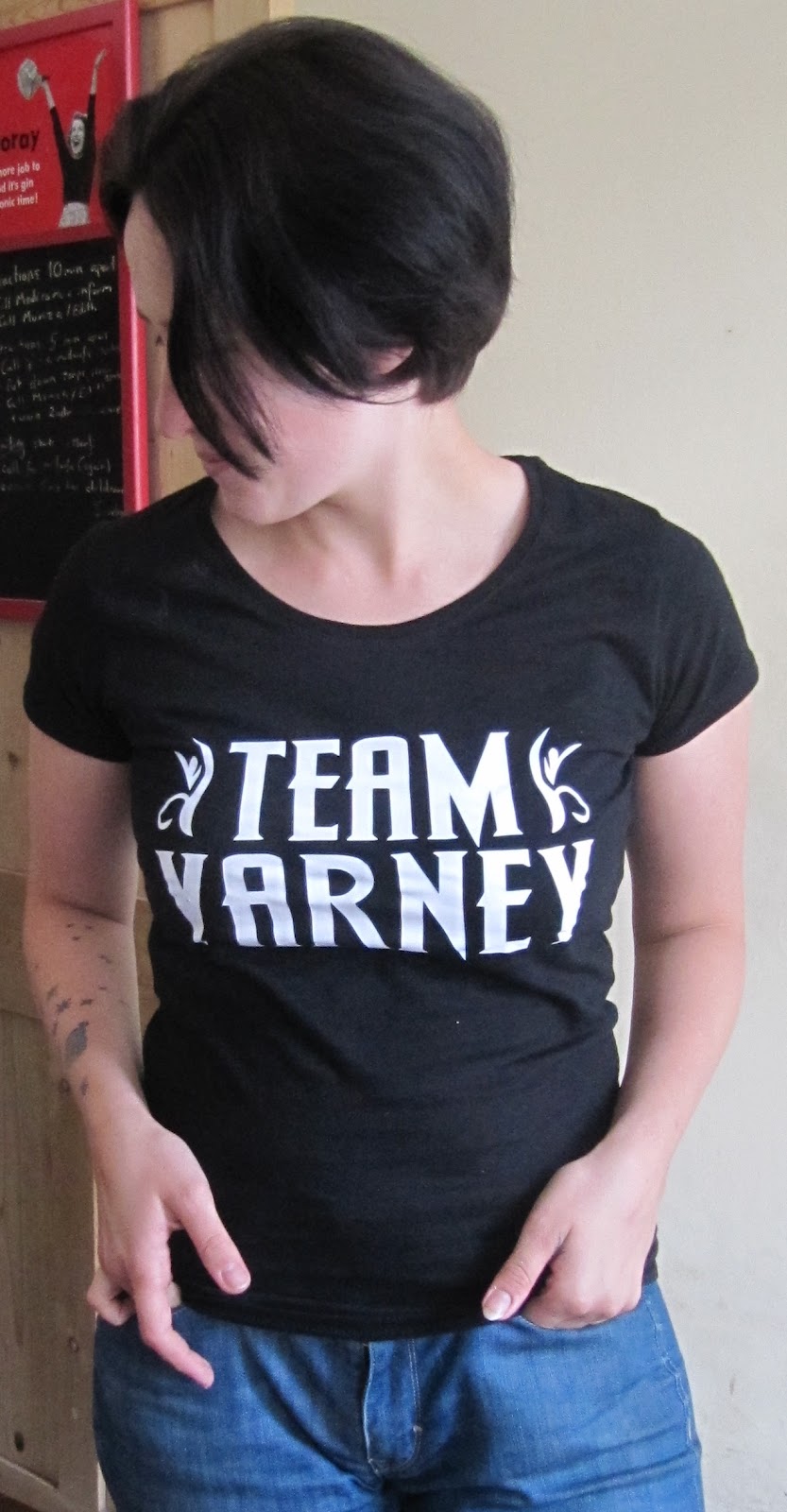
1If you have actually read the whole shebang, then do say so in the comments. We rule. We should have T-shirts. Actually, we do have t-shirts. See?
2Okay, I'll admit it, Sir Francis never actually sparkles, but... blah. Had to nit-pick, didn't you?

Wednesday, 5 September 2012

Female characters: What is strong?

So, another year rolls round, and there is another best-selling book, read mainly by women, that we are getting told off for enjoying1. The reasons we are given are plentiful, but familiar:  poor writing, slushy plot and a weak female lead. You know, a silly little bimbo who lets herself get pushed around, subscribes to a totally self-sacrificing ideal of love and ends up...

Actually, this is just far too boring. Go and look on any one of a million websites and you'll get some version of this diatribe in full. In fact, we heard it all last time anyway. I, for one, can't be bothered. Not getting involved, not interested. The reason I'm standing well back from it this time round can be traced to two female protagonists from books that are both acknowledged Classics2 and can therefore be safely discussed without anyone getting too vehement.3

So, two names: Jane Eyre and Fanny Price.

Let's start with the confession, but please, don't shoot:

I hate Jane Eyre. It is not only the single set text from an academic course that I have never actually finished4, I failed to finish it on two separate occasions and once even pulled a sickie to get out having to discuss it in a seminar. It's not that I can't handle 19th Century fiction (I love 19th Century fiction) it's that it's a turgid, repressive and oppressive wish fulfilment fantasy related by a main character with the pizazz and inner strength of an over-boiled turnip. I first studied it at an all girl's school, and our gushing teacher burbled incessantly about how virtuous, how committed, how inspirational a main character was dear, sweet Jane. I could just see them force feeding us this stuff, trying to get us to toe the line, behave in the acceptable way. I called b/s. I'll admit it, I ranted, and I swore  to anyone who would listen and I dissected that novel to prove my point. I did exactly the kind of thing that this blog post is complaining about, because it got right under my skin.

Then, a couple of year later, this happened:

I gave myself a holiday treat by reading all of Austen's novels, and was just about to start Mansfield Park. My mum, the consummate Austen fan5, looked at it and smirked. “Have you started reading that yet?” She asked.
No,” I responded, all innocence.
Oh, you are going to love Fanny Price.”

And I'll tell you something. I did. I liked Fanny,6 I respected Fanny, I was glad7 Fanny got her man. Okay, she wasn't so much fun as Austen's other heroines, but she was sincere, committed, and determined. No matter what might happen, she would not compromise herself, her beliefs, or her limits; even under pressure, even when there was no hope. What's more, she got what she wanted. Okay, she could have done better, but, hey, what's so great about giving up what we actually want based upon some arbitrary value system concerning life choices?

Good for Fanny Price! Three cheers! An inspiration!

Then I started reading some literary criticism.

Oh dear.

Turns out people were saying of Fanny the same things that I had been saying about Jane8. Oppressive. Wish fulfilment. Pizazz and inner strength of an over-boiled turnip (okay, not in those exact words...) These people, they had quotes too; they too had dissected the novel, pulled out bits and pieces to support themselves (“Out of context!” I cried.) Some of them even compared Fanny negatively to Jane, for Jane is liberated, has strength of mind, makes her own way in the world, does not compromise... I'll admit at times, I started to wonder if there had been some kind of bizarre mix-up in the heads of these people, and they had got the names the wrong way round.

But then I started talking to other readers, and reading articles about books and found that people I respect were saying Jane Eyre had moved them, had driven them, solaced them. People, women, were saying that Jane had been, on some level, their liberator – or at least a friend in their struggle. So I tried to read it again and could still see nothing more than a narrator incapable of either ducking or dissembling when a man is about to hurt her9. Then, reader, she marries him – you know, the repulsive, broke one who kept his last wife in an attic for years.

That was when the realisation came to me: this is literary criticism, darlings. We can all be right.

That's not to say all opinions are equally correct, some after all are patently wrong. This, though, is usually based upon a misunderstanding . An example of this might be a misapprehension regarding the word 'ejaculate' in that lovey dovey scene between Jane and Rochester in the garden. Such an interpretation of that scene would be... interesting... but not exactly worthy of serious attention. Others, while valid and interesting, take a certain perverse inspiration and a degree of stubbornness. One is reminded of the four hours I spent arguing that the events of Dracula are a collective delusion, and the essay where I stated that the thing of the Count's that Mina is sucking? It's not blood. Yes, it was enormously good fun, especially that last one, but really? No, neither of those are what happen in the novel.

Still, with an honest reading of something, when we respond naturally to the characters and get involved with the plot, there is actually no wrong response. So, something in me didn't get on with Jane Eyre and still doesn't. Other people can't stand Fanny Price. So what? We each bring to a book our own set of experiences and values, so that certain things trigger us in certain ways – certain aversions, certain sympathies. We all take away something from a book which shapes us and our future actions.

In Fanny Price, I saw a young woman who knew what she wanted, however unobtainable, and would not be swayed from that course by the glamour of something 'better'. Sometimes, when I face certain people and decisions, I look to Miss Price10 for her strength and resolution. In Jane Eyre, though, I saw a young woman who faced bullies and let them hurt her, let them break her. That will not be me.

Other people, I appreciate now, feel that should be the other way around. Fair enough - that's their response. I have not changed my mind, but I have stopped hurling the insults. A character is strong in the strength she confers and the characters from whom we draw strength are our own business. If one11 shy, lonely, unhappy teenage girl looks at Bella Swan and thinks, “It's okay. Adolescence ends. The things that scare me won't be scary forever,” then surely, for all the problems you personally see in the book, it can't be all bad.

I'm not saying don't argue about interpretations of books– for Gods' sakes, that's the fun of lit crit – what I'm saying is put down the pitchforks.
1No. I've not read it. I'm not going to. If I want erotica, I have Lost Girls and the works of Angela Carter.
2Whatever that means.
3Lights blue touch paper, retires.
4Okay, there is ONE other, but it was by the same author and had more or less the same main character and plot. (again, the bit about the blue touch paper)
5No, seriously, she's treasurer for the local branch of the Jane Austen Society.
6UK readers especially, please imagine an immature laugh at the end of each clause in this sentence.
7Double laugh .
8Nope. Can't help it. Smirk.
9At least in the first bit of the book there's an element of defiance to this, but... Jesus Christ. It doesn't get any better once she's been tamed, does it?
10Ha! Avoided it.
11Oh, god, here I go. For all the good it will do me.