Showing posts with label story-telling. Show all posts

Monday, 8 April 2019

Review: The Book of Dust, La Belle Sauvage by Philip Pullman

One of the reasons I don't use a formal rating system on this blog is that assigning something a certain number of stars always seems to result in injustice. For example, if a book by my favourite writer isn't quite as sublimely brilliant as I know they're capable of producing, I might give it four stars, even three if I'm feeling vindictive. However, were I to read the same novel by an unknown, it would have breezed its way to an effortless five based on my surprise by all the skill and qualities which familiarity would otherwise cause me to take for granted.

As a reader, a writer's work cannot be separated from their oeuvre, nor indeed from what they have meant to you at various points in your own life. Therefore, when I encounter a book that, taken solely on its own merits, is a perfectly adequate piece of middle grade fiction trying to pass itself off as an adult novel, I would probably be likely to give it three stars. Unless, of course, it was written by Philip Pullman, when I would feel a remarkable degree disgust, anger and personal betrayal.

Look. I loved His Dark Materials. I read them relentlessly as a child, they being one of the few things that did not talk down to me in terms of content, character, or events. I've written before about the state of middle grade and YA fiction for avid and intelligent readers of fantasy when I was that age, and Pullman was a huge part of me making the transition from Diana Wynne Jones and Susan Cooper to Robert Holdstock and Angela Carter. I cannot overlook this when I say that La Belle Sauvage is such a dreadful disappointment.

You see, it wants to be The River at Green Knowe when it grows up, an ambition which perhaps misses the point that The River at Green Knowe is a children's book. 

Moral messages that were subtle and carefully handled in the original trilogy are here presented with all the nuance of a cosh to the back of your head - we get it Phil, the church are the bad guys - the wonder and strangeness of Lyra's world is replaced by a series of frankly generic folkloric cameos, and our deeply abrasive, awkward, believable protagonist is replaced with... Malcolm.

I'm not even going to start talking about Malcolm. 

But on top of this dumbing down of style and content, there was the insistence that this was one for grownups. Perhaps the very same grownups who had grown up reading His Dark Materials, and it was this that really stuck the knife in because, put simply, La Belle Sauvage does not function if viewed as an adult novel.

It has long been a conviction of mine that the difference between adult, YA, and children's fiction is not so much a matter of content, as one of structure, pacing, and focus. Just as children's fiction - good children's fiction - is not merely adult fic with the 'inappropriate' content taken out and all the nastiness coddled up, adult fiction - or at least, good adult fiction - is not just a children's story with a bit of sex, swearing, and an absolutely gratuitous implied rape thrown in to it.

The two modes serve different needs, tells a story differently, talk to their readers in a whole different language, and this is why you never really outgrow good children's fiction - because its qualities remain. Historically, Pullman knew this. His Dark Materials is frequently devastating, lyrical, powerful - they are children's books, unashamedly, and in the very best senses of the words.  

La Belle Sauvage isn't even a very good children's book.

Ultimately, if this hadn't been something I was reading for bookclub, I wouldn't have finished it. I don't want my childhood heroes to diminish this much in my eyes. And, if that weren't enough?

[Spoilers for His Dark Materials, and La Belle Sauvage below]

Wednesday, 22 June 2016

Thunder in her Veins - the sacredness of geekdom


Some bits of childhood never do make sense.

Look: I grew up in a village with an unreliable bus service and two shops - that became one shop, and then none, and that's where it's settled. It was the sort of place where there were enough people who wore petticoats for the expression "Charlie's dead" to be part of my childhood lexicon. My elder sister was the first - the only - girl on the school's football team. It was a place where 'comic' meant the Dandy and the Beano, or - if you were really lucky - an old copy of Bunty*.

So how I ever came to read Marvel's Thor line is something of a mystery to me. I think I had a Spiderman annual once, and there was the X Men and the Fantastic Four on telly on a Saturday morning, but… Thor? Seriously? I might have been able to get it at the comic book store in the nearest town (seven miles and, apparently, a twenty year timeslip away) but, well, I always knew places like that weren't made for people like me**.

All the same, Thor I did read. A fair few, actually. Mostly the early ones, with Donald Blake in them. I remember being caught by something about them - the disabled man whose vocation was easing others' pain, his walking stick actually the hammer Mjolnir. I still can't really express why, but something about them felt very beautiful, very true.  Maybe it was the overtones of the Fisher King? Maybe it was just the myth connection.

Because I was a myth junkie, devouring folklore and fairytale. If a story was old and epic and glorious, then it was my kind of story. I grinned at the pranks of tricksters, railed at monsters, wept for Prometheus chained to his rock. Raised as both an Anglican and a Baptist (don't ask) I was used to God being male, ineffably right and absorbingly loving. My contact with the grim, problematic stories of the Bible was one sanitised by a Sunday school framing which repackaged them into a reassuring scholasticism where faith (read:goodness) was rewarded, and the wicked (read: unbelievers) were punished.

Used for review purposes
Noble failure...
Myths weren't like that. In myths, all bets were off. And that made for grandeur and for tragedy. It made for fatal flaws and noble failure. It made for Gods who were tricksy, passionate, even petty. They could be deceived, could deceive. They could be wrong. 

And yet despite all that, they were honourable, powerful, righteous.

It's probably fair to say that I found myself through reading Norse legends. Yes, I was too young, too uncertain, to call it 'faith', yet all the same something in me ran to those myths with a more intuitive open-heartedness than my parents' religion could ever call from me. More, they seemed to understand me. I craved them, the way you crave salt when dehydrated: dread, beautiful Freyja; bright, lost Baldur; Loki - quick, cunning, dangerous; and Thor.

Of course, Thor.

I always feel faintly ridiculous using the word 'sacrilege' in anything other than ironic hyperbole. All the same, there does need to be a word for that hurt that is located somewhere against your heart, behind your ribs, when the things you hold sacred are treated slightingly. As a Pagan who honours certain Norse deities, there is something wrong in seeing the stark, terrible beauty of your mythic landscape re-envisaged into slick, commercial print, complete with hulking villains and so. much. spandex.

Thus it was that, for years, I was embarrassed by the association. Marvel's Thor was not my Thor, their Odin not my AllFather. Drawing that distinction was important, remains important still. But scorning the former overlooks something vital, something powerful, something old. The memory of it came back to me with the release of the MCU film. A sense of struggle, of soaring glory, of a rightness at the very base of something. And, yes, it was more slickly packaged, and sexier than a fireside story about Sir Gawain, but it spoke of something grandiose and sweeping on that same, gut-deep level.
Used for review purposes
Something sweeping and grandiose

People tend to associate the numinous with a sense of peace, of silent wonder, but sometimes it is more a sense of your heart being pried apart with grinning exuberance. Sometimes, it is that twisting, cathartic need that comes with the raunchiest choruses of folksong, the catchiest reels of the Morris. Sometimes it was what we feel when we hear stories about heroes, about people in extremity, about villains we love to hate, and sometimes just love, despite ourselves.

And that feeling is sacred. Some narratives speak to something deep in us, something more real than anything we enounter in our daily lives.When they are slighted, undermined, mocked, we feel that little wince that cries out 'sacrilege!'. It is one of the reasons why feelings are running so high around this 'Hydra Cap' debacle. Some heroes should be held high, above baseness, above the taint of cynicism.

Yet, collectively, we disown these stories. Heroism, self-sacrifice, betrayal, need - the bright, bold colours of traditional stories - are things we insist upon shutting out as we become 'grown-up', 'critical', 'literary'. But these things are still nestled in us, occupying a space in what I can only call our soul.

My engagement with this comic was not adult. It was not smooth, questioning, probing. It was not the 'refined' tastes that I have spent years cultivating. No. It was the wild joy that got me into stories in the first place. It made me air punch, made me grin, made me arch my feet and press my eyes together. I cared from a place of total, unironic absorpsion. I felt this book, felt the way I once felt as I tore around the playground pretending to be the Human Torch.

(Flame on!)

But, as such, an actual review is beyond me. Is Mighty Thor: Volume 7 great art? Will it change the shape of Literature as we know it?

Is the story any good, even? Should you read it?

I have no fucking clue. Sorry.

I had to whittle this down to one awesome picture. THERE ARE SO MANY.
Also: Malekith the Accursed - just too FABULOUS for your morality.
There are some books out there that make you realise the futility of reviewing books, that make you see there is no helpful, universal rubric to define whether something is worthwhile. Yes, you can analyse craft and effect and technique, but sometimes a story speaks to something that is too pronounced and personal, its power over you too great to allow you to reach for your wonted pose of critical objectivity.

I have to admit that, while I tend to enjoy what I read, I'm not especially immersed in Marvel 616 stuff. As an adult reader, it's rare they provide me with more than an entertaining stopping post for an insatiable bookworm. Mighty Thor: Thunder in Her Veins went so far beyond that faint praise that there is no comparison - but those feelings are so subjective that I cannot extend to any of you.

As such, I really can't recommend it. Do you like stories about honour and righteousness, about family and longing, about war and good and evil, and some things that you just can't categorise? Then maybe read it. You might get something from it.

But, while we're on the subject of recommenations, what I have to say is that  it isn't really this comic you need to read. No. Don't seek out a specific story or book, don't listen to anything else. Instead, shrug off your irony. Ignore the cheap, headline grabbing shots, the 'risky' takes appealing to the part of you that wants to tarnish and tear down.

No. Reach into your heart and find those embarrasing remnants of unmitigated joy - however commerical, low brow or melodramatic they may be. Find your heroes - your glorious and impossible heroes - and cling to them. Celebrate them.

We are readers. We are better than that.

-----------------------------------------------------------------------------------------------------------------------------
*What? The stories were better.
** Shout out to 'The Grinning Demon' and 'Whatever Comics' of Maidstone, which (when I finally plucked up the courage to slip inside) were absolutely lovely. But you know what I meant.

Wednesday, 3 December 2014

Please, tell me a ghost story

Oh, I do love ghost stories. The staple of my late childhood reading, if you count out Narnia and Diana Wynne Jones, were stories of revenants and warnings from beyond the grave, beginning with my Dad's copy of Tales of Mystery and Imagination (not the Edgar Allan Poe compilation of the same name, but a TV tie in to what I'm guessing is this series and a lifelong confusion regarding that particular title) and going from there.

But, you see, I wasn't just surrounded by adults willing to hand me totally inappropriate books, I grew up surrounded by a rich tradition of the oral ghost story. Family tales, polished by time and hyperbole; odd, unresolved fragments of 'something strange that happened to me'; weird co-incidences; Urban (or perhaps rural) legends; and of course the "I live in the middle of nowhere, and the best form of fun is to make up shit and terrify my friends."

I know hundreds, and most of them gained from that opening gambit, or a book passed to me in desperation upon hearing it. Just because I know them doesn't mean that I can tell them, but there are a few that I can. Many of them have never found their way into print, or if they have only as part of a compilation of real life ghost stories. Because that's the thing about ghost stories, once you encounter them. The best ones are true, or at the very least 'true'.

"My Grandmother, who was not a fanciful woman..."

Do you believe in ghosts?

We are always assured that the original teller does not. M.R James, master of the form, understood this. Ghost stories do not - or at least, should not - happen to believers. A credulous person cannot be trustedin these things. They will always jump to the most sensational conclusion. No. What you need is someone calmer, someone rational and a little sceptical. At the very furthest reach, we need an open mind, an 'I've not seen enough evidence to persuade me either way." In James' work, his narrator is usually taken in hand by a older acquaintance, wry or solemn, who is older, more experienced, and more comfortable with the truth in Hamlet's words, "There are more things..." Even the believers do so quietly, without fuss.

In our own tales, we are equally discriminating. Our source is always reliable. My Great-grandmother was not a fanciful woman, but... My friend, who doesn't believe any of this stuff... It's the classic urban legend source, two removes. It does not happen to you, the listener, or the one telling the story, but someone with whom they could have direct contact, their great aunt, their cousin's friend, their next-door-neighbour's mum. It is close enough that belief is conceivable but, ah, always just that little bit too far to check the facts.

First hand ghost stories, in my experience, are generally told ruthlessly, without embellishment. Unless there is a gap of many years, they are dropped in a way that makes telling them to someone else a bore, "Yes, but you did you notice that..." Perhaps it takes some distance to spin a proper tale around them.

So do you believe in ghosts? According to this article, which I read about two years ago (and got angry at), 38% of the population of Britain believe in ghosts. But of that 62% who ticked the 'no' box, how many of them love a good, scary tale? How many of them will, in he right conversation, divulge some curious little fragment of their own life, or a family recollection by which they will swear? How many of them are undecided? Asking someone if they believe is almost invariably a prelude to getting a tale, a much more effective way than my childhood efforts. "Well, no. I don't. But..."

Friday, 25 July 2014

What I've been reading: The Count of Monte Cristo.

*Checks date*
Still here, I'm afraid.

Eeek. Sorry.

So, I'm on the home stretch with this, and this post this contains spoilers. Also, much SQEEEEEEE!

Where have we got to? Well, the Count of Morcerf has shot himself (YAY!), Valentine is languishing from strychnine poisoning (which has at least cleared her of murder) Albert is adorable (but not particularly bright), the footnotes were written by an idiot and Maximilian Morrel is frankly a bit of a dick.

Oh. And Eugénie is a lesbian. In case you hadn't noticed. Or if you'd forgotten.

 Seriously, if I had one complaint with this novel (besides the chronic idiocy of the editor) it was the sheer iron-bar quality with which Dumas handles Eugénie's sapphism. Because we get it. REALLY. WE GET IT.

Other than that, it's fan-fucking-tastic. After a slow middle bit (blah, gradual bankruptcy, blah, medical details of minor characters we don't really care about, necessesary foundation laying for this bit, blah, Maximillian bloody Morell...) it's all kicked off. Four (count 'em, four) challenges to duels, three deaths by poison, two attempted suicides by honour and AT LAST, someone blows their own brains out from feelings of shame!

Oooooh! And, while we're at it, the honour code in this! All the clenched fists and the deathly pale expressions and the choice of weapons at some place of your choosing! All the fainting and the thrown gloves and sudden reversion to calling your friend, "sir" like it's an insult....It's so delicious, so sharp and complicated and brilliant...

And Haydée, Haydée.... Is she actually the first portrayal of a sexual submissive in literature? Because I am shipping so hard...

So, yeah, this is basically such sheer, sexy, ego packed brilliance that I have been grinning for the last 24 hours. It's better, even, that Three Musketeers. And Dumas is such fun! 

That's one thing I never really realised back when the only copy I had was an abridgement. Sorry to hammer on this theme, but the biggest crime of the abridged versions is how they cut all this to the bone. The important bit is that Dantès shames Fernand, so that's all they give you. They don't give you Albert's anguish, his dilemma, his pride. They don't show him almost chucking his glove at Dantès in a crowded opera house while his friends hang around him with, "Don't do it, Morcerf, really, not smart." (And, seriously, that is a wonderful piece of pacing and building tension, even for someone who knows what happens next.) Oh, you get that Haydée is beautiful and submissive, but you don't see her taking the initiative, you don't see her shouting down her opponent in court. You don't see her bear herself like a queen. Without this, she is a child with a creepy crush, not someone in what is a prototype D/s relationship.

So, after slashing away all this wonderful stuff, you get cardboard cut-outs racing around as much plot as you can fit into 300 pages (a plot whose elegance and complexity is utterly muddled by these cuts) and, reading this, generations of idiots have the audacity to call Dumas a cheap cliché-ridden hack.

And, yeah, it's a bit melodramatic, it's a thing of bold, broad strokes, but there is also subtlety and real passion there. Last night, I read a scene of such breathtaking and tragic intensity that I suspect it will be joining Renfield's desperate plea of sanity  (Doctor Seward's diary, 1st October, 4am, Dracula, Chapter 18) as one of the scenes I murmur aloud in breathless, heartfelt tones every time I read it...  This damn fool of an editor thinks Dumas is condemning Mercédès here, but she shines! She burns like falling star! Oh, these feelings, so lost, so painful, so buried beneath years of torment but strong enough to control them and.... Ah! Perfect. Perfect.

This is everything I ever want in book. This is just....

Actually, it's probably the reason I'm using so many exclamation marks. 

So, go on. Clear your reading diary and have some fun. It's the holidays.

Friday, 13 December 2013

Adults and adultery: Cleaning up Dumas onscreen.

Some time ago, I watched the recent film of The Three Musketeers. The one with the airships.

If that wasn't a big enough deviation from common sense, I then watched 1993 Disney version and promptly choked on my own boiling spleen. This blog article has been over a year in the writing, mostly because trying to work on it it causes me to start spewing blood before I collapse, shivering, in a corner in some literary form of post traumatic stress syndrome.

Oh, I wish I were joking.

It did not look like this.
Before anyone points out that a movie is not the same thing as a novel, I'll clarify; I wasn't expecting it to look exactly like the novel. Films and books are different art-forms, with different requirements. For example, in the novel, the fight between the Musketeers and the Cardinal's Guards is three against five. In these circumstances, D'Artagnan's offer of assistance brings a realistic chance of victory while still showing the Musketeers as superior fighters - four against five: more than plausible. In a film, though, that wouldn't look so hot, so I was fully expecting improbably large numbers of the Cardinal's guards and one heck of a sword fight. That's fair enough. In the same way, I'd hardly expect screen minutes to be wasted explaining the fact D'Artagnan had to serve out the equivalent of an apprenticeship in another regiment because the Musketeers isn't open to raw recruits. Alright, maybe it was going a bit far to disband them entirely, but we'll run with that, shall we? In movies, we do exposition differently.

And then the characters. Again, I knew there would be some drift. I get it, I honestly do. You want a sympathetic Athos, not an alcoholic psychopath. And, yeah, Richelieu needs to be a plain-dealing-villain, not an anti-hero politician trying to do what he thinks is best for France... Sure, we lose a lot of depth, but we also cut the need for a lot of exposition.

I can handle all that. Really. I can. It makes me itch, it makes me mutter, sometimes it elicits a scornful laugh or two, but it comes up every time I watch a film adaptation of a book I happen to love. It does not reduce me to putting my head into my hands and whimpering, “Make it stop, please, kill me. Kill me now.”

It does not make me get the fucking novel out and start shouting quotations at the television.

So what was the problem, then?

...or indeed an appropriate prize for Bible study.
And I will answer you, oh my dear hypothetical ideal and obliging reader, Sex is what bothered me. Well, sex and Milady.

Wednesday, 3 April 2013

Iain Banks, a tribute

There is a church in Norwich, not far from where I live, which has some magnificent, 15th Century flush-work. Approaching it for the first time, one is struck by the sheer scale and beauty of the construction. The overall vista is a clear, serene shading of blue-grey flint and yellow sandstone. When one gets closer, we see that this grand, awe-inspiring whole is built from interlocking blocks of stone, cut, polished and inlaid into the sandstone. It might be possible to believe that this decreases the majesty of the whole, to see, literally, those building blocks of aesthetic effect. It does not, for the simple reason that flint is an absolute bastard to cut.

What you see, looking at that facade is not only a sweeping and impressive whole, but hours, weeks, months, years of careful, backbreaking labour, it's bloodied hands and torn muscles. It's the delicate precision of a master-mason fitting soft sandstone to hard, sharp flint. It's the swaying, precarious construction of scaffolding creeping up into the Norwich skyline in the days before mechanical construction, before modern health and safety. It is a labour of, what? Dedication? Fear? The economic self-aggrandisement of the wool-trade?

Love?

Reading an Iain Banks book for the first time had something of the same effect. Strictly speaking, it was an Iain M Banks book, one of his Culture novels, specifically, Look to Windward. At the time, I didn't read an awful lot of sci-fi. If I'm honest about things, I still don't. World building tries my patience, both in my own work of that of others. It's grunt work, and it's tedious, and it so rarely turns out well.

Here though...

I was struck, immediately struck, with the sheer scale of the construction, the unflinching, galaxy spanning complexity of Banks' creation. Immediately, I was snatched up, dragged out of myself into this huge, rich bewildering world. The effect was similar to one desired by the church designers of late-Medieval Norfolk, awe and wonder. A sense of the numinous.

Then I got closer. The closer I got, I began to see quite how well, quite how cleverly this world had been fitted together, with what consummate skill each event had been crafted, how this great, impressive whole was founded upon tiny, polished blocks of flint, hand-cut and placed to perfection, in such a way that the spreading grandeur of the Culture's galaxy could almost be believed to be a natural growth.

Reading one of Banks' novels - sci-fi or straight Lit - is, to a greater or lesser extent, to experience this. The worlds and characters he creates are intricately imagined, and are drawn in such perfect detail that the reader is engulfed by something that could, so easily could, be natural.

There are writers who, one feels, simply spilled out their genius onto the page. We are left with something with a wild, random beauty. It is something fragile, fortuitous, chance.

Banks is not one of these writers. Banks is something far more special. The sheer scope of his vision, his passion, cannot receive justice in a thoughtless outpouring.

Many of his characters, or so it seems to me, are scientists, mechanics, mathematicians, gamers. They are people who break the world down to its barest essentials and are able to reconstruct it from that point. This is also what he does in every single on of his novels.

His craft is clear in the careful planning, the exquisite story-telling, the layering of narrative and echo, the skill of his shifts in voice and mood. A reader can sense each blow of the chisel against the flint, can see the eye that observed the placement of each block, that laid the mortar so carefully. We can feel the sheer grunt work laying the foundation of the first draft simply by seeing the grand scale of the final realisation. Never a writer to avoid going out on a limb, we can sense, too, the terrifying sway of the timber we see the tiny figure on the scaffolding, braving the elements to put each piece in place. And we can sit back, see the finished product, a perfect, seamless, whole.

Banks is a great writer - not a casual, careless 'great' but truly, as in Alexander the. Compassionate, fearless, and grandiose he creates with a scientist's precision and an artist's eye. He is without equal.

Today's news should devastate every reader if good fiction. I cannot begin to imagine how it must affect his loved ones, his family, or the man himself.

I don't really know how to end this, except with a great sense of loss and of sorrow.

Friday, 8 February 2013

Wuthering Heights: In defence of amour fou

So, I took the plunge and went to a book group. 

Wow. Socialising. With real live people-persons who had real people personalities. That's not happened in a while. The book we were talking about was Wuthering Heights. I enjoyed the discussion; lots of interesting stuff raised, tangents and ideas about, not only the book in question, but about the nature of people-persons, and the way that said people-persons interact with books. It was good. Naturally, I did my usual seminar dear-God-no-wonder-you-had-no-friends-at-University routine, but that's a story for another day.

It also raised something that's been brewing in my head for quite a long time – something about the way our current society thinks about love. It may surprise none of you to learn that I agree with Angela Carter.

“Well,” my obliging hypothetical audience supply, “what do you agree with Angela Carter about, aside from 'practically-everything-with-the-notable-exception-of-clitoral-orgasm'?”

For a start, I agree with her about Wuthering Heights. And about love. There is a significant overlap between the two1

Obviously, the whole 'love' thing came up at the book group – notably the conception that Wuthering Heights is some kind of a romance novel2. We were asked, more as an opener to discussion than anything else, whether we thought Wuthering Heights was a love story. There was derisory laughter, slightly incredulous glances, and there was me, too much of a fucking coward to offer disagreement.

Which is this: 

We have a real problem with love in this country (or this society, or the English speaking bits of the world. Whatever.) We have a problem with it. So often, in the discussion, words came up to describe what Cathy and Heathcliff felt: obsession, infatuation. We are not, as a society, willing to believe that what those two experience is love. Ask people what love is, and there is a fair chance they will start quoting Corinthians 13:4 at you3.

Patient? Kind? Right... Are we even talking about the same thing, here?

No. We're not. That's one of the problems we face, just to have this discussion: there are a dearth of words in the English language to describe love. Of course, some kinds of love are patient, and kind, and they are valid, important types of love. They, however, are not what I am talking about. The Greeks have it slightly better, they have agápe, éros, philía, and storgē, but even they do not quite answer my purposes. These are different types of love used, exclusively or in combination, in different kinds of relationships. Most often, the distinction is used to separate basic human compassion from emotional love from lust. But I am not talking about physical love as opposed to emotional love, and whatever list of those one needs to build a happy relationship. I'm not, if I'm honest, talking about relationships. A relationship is an ongoing negotiation between two or more people; a relationship answers to sense, to reason, to common, human kindness.

No. I'm not talking about relationships.

There is, though, a distinction in the English language, a distinction that tells us more about ourselves than many of us would care to admit. We talk about loving and we talk about being in love.

Tuesday, 29 January 2013

Dance of the Undead: Why I don't like zombies and why that doesn't matter

The tide, thank Gods, has finally turned. Twice, twice! in the last two days, my twitter feed has revealed to me people disparaging zombies and the zombie genre. It's overdone! Give it a rest! Too mainstream!

Yippee!

I'll be honest with you: I've never had much time for zombies. If we're going to have revenants emerging grisly from their tombs, I prefer them to be incorporeal. If we're going to have monsters ravening for the flesh of the living, I prefer them to be equipped witty conversation and reasonable dress sense. Between friends, I'm a ghost girl, I'm (and I'm sure this will be a surprise to everyone) a vampire girl.

Zombies. I just don't like 'em.

What? You need reasons from me?

Okay. I think my first reason is the type of surface narrative zombies seem to engender: post-apocalyptic worlds, scratching faceless hordes, heroic (or anti-heroic) types marching round the place toting huge-arsed guns. It's food supplies and water filtration and constant, knife-edged danger. That's... well, that's okay, I suppose. It's not really my scene. I don't, in my escapist moments, imagine myself as some kind of tooled up commando, fighting for survival in a ghost world. I am not hard-bitten and taciturn, I am loquacious and somewhat effete.I know that there are vampire narratives like this, and I don't read those much, either.

Then, there's the second reason. Zombies are, actually, that little bit too scary for me. Perhaps it's just paranoia, but the idea of some huge population disaster that leaves us scrabbling around in the ruins of our civilisation seems just a mite too plausible. As, for that matter, does a worldview that sees a significant chunk of the population as faceless, needlessly destructive, and possible to be killed with a clean conscience. This is the kind of world I dread leaving to my children. I have nightmares about zombies. That this counts as a point against zombies troubles me, but it brings us to reason number three.

Zombies just aren't any fun.

Even the worst, most hackneyed vampire narratives are entertaining to me, whereas bad zombie narratives are just dull. Even good zombie stories only serve to make me jumpy, and while maybe that's part of what they are supposed to do, I just don't get off on that, thank you very much.

Thing is, the function of literature, should always be, to some small extent, to give your reader their jollies. Sure, hurt them; don't pull your punches, kick 'em while they're down, give them nightmares so bad they sleep with the light on for weeks*, or make them feel so sick that they can't eat for three days;** but while you're at it, throw them a fucking bone, won't you?

We escape, we fantasise, we fancy dress. We flinch from crucifixes.

Which brings us to four: from the little I've seen, zombie narratives seem to be more about the survivors. You didn't get bit so you acclimatise yourself to grief, to killing the monsters who wear the faces of your loved ones. You survive at all costs and maybe you lose. You try to live with yourself, with others, with terror, with grief. It is humans put in extremis - the zombies are more of an environmental hazard. And, again, this is too much like life. Vampires stories, ghost stories - these are far more concerned with the monster and that is where my interest lies, especially if we're given a ton of that pesky moral grey.

But... but... but... All this is personal taste. I'm convinced there is some brilliant zombie fiction out there, inspired, intelligent, gripping stuff. There is also a lot of enjoyable dross, and reading is something we do for pleasure, right? Zombie fans, go out and enjoy yourself, gorge yourself on the current glut.

Don't mind me, I'll be lurking with a well thumbed copy of Dracula.

So why the "yippie"?

Well, here's the thing: for the past five years I've heard one heck of a lot of "Vampires, oh God, that is so mainstream and overdone... Zombies, now they're hardcore." I've heard Goths (Goths, for Pete's sake) talk about how vampires have become 'stale' and how they are really pushing the envelope with 'zombie chic' (also, actually, zombie chic? WTF?) and been roundly mocked and condemned for my continuing allegiance to the children of the night.

My point is this: zombies, vampires, ghosts - they are all mainstream, they always have been. One comes to prominence for a bit and everyone jumps on the gravy train until the non-core fanbase get fed up and the wheel turns again. Vamps have had their turn, zombies, take a bow and slip back beneath the ground for a bit. It won't be for long.

So why the "yippie"?

Because you notice the third article on that list?

Come on, Montague Rhodes James!

*or too afraid to turn the light on because then they can see it coming for them...
** I'm looking at you, H.P Lovecraft

Incidentally, if you are a zombie fan, even after my reasons as to why you shouldn't be, check out the Science Museum's Zombie Lab: http://www.sciencemuseum.org.uk/Home/visitmuseum/events/festivals/zombies.aspx

Friday, 18 January 2013

Anne Rice: On falling in love with one's characters and 'the iron bar' factor

I have very recently come into possession of the majority of Anne Rice's 'The Vampire Chronicles'. So now I've got them all, and I've been reading them. Well, okay, not Blood and Gold or Mnenoch the Devil because the person who gave them to me didn't have those ones. Never mind, eh? Not like I've missed anything controversial or direction changing about the series then.

Now, I've always enjoyed Anne Rice, but, before I begin I will admit to a couple of pet peeves. There's the small matter of continuity – exactly how her vampirism works, as well as the physical characteristics and ages of her changeless vampires are somewhat open to discussion. Is Armand auburn, or is he strawberry blond? And, curly? Did his hair always curl? And is this blog really the place for insanely geeky speculations about relative strengths and telepathic abilities of her vampires?

I can answer that last one: No. So, Alys, stop it. Now.

Then there are the more significant concerns: her pervasive tendency to preach, whether her ideology of the moment is materialism, secularism or Catholicism; the absolute, conspicuous consumption of all her main characters as a way of burning through their obscene, nay, limitless wealth; her occasional, and irritating lapses of voice; the minor, subsidiary and unconvincing roles of her female characters; her bizarre, and frankly patronising, conception of age (especially annoying in the historical circumstances;) her total, I mean absolute inability to to write a convincing English gentleman, and her insistence upon narrating an entire book from such a vantage point.

The fact is, Anne Rice is a flawed writer, but I would argue that, in some measure, it is her flaws which make her lovable; I want to assure you of that before you come to the conclusion that I'm having some manner of apoplexy. So, while in several matters or style, taste and skill Anne Rice is far from perfect, she is still a remarkably compelling writer. And, for the record, I loved Merrick and think David Talbot is wonderful – he's not English by any stretch of the imagination, but he's none the worse for it.

So, for a quick review: although I found The Vampire Armand dragged in places, I've never had that much time for him as a character anyway, it was amusing enough. Pandora was a refreshing and thought provoking look at one of her much underused minor figures. Yes, Merrick stumbled in places, and Blackwood Farm in others, but both were well rounded, enjoyable reads – and to be honest, meeting some new faces was rather pleasant after so long with the same old crowd. Throughout all of these books there is a commitment to character and world development in the aftermath of the events of Mnenoch the Devil; events of which, I'll admit, I have only the foggiest understanding.

Which brings us to Blood Canticle. Which brings us, if I'm honest, to my biggest misgiving about the entire Vampire Chronicles series, a misgiving standing – as he so repeatedly tells us – 6 foot tall with his blond hair, blue eyes1 clad in understated designer clobber or else in velvet, leather and lace. Yes, dear old Lestat; Lestat, the Brat Prince who breaks down the fourth wall with all the subtlety of a bulldozer. Lestat, the demon turned anti-hero turned rock-star turned demi-God turned Saint turned... no, hang on, I'm a bit lost. Er...

Let's start again. Without Lestat, there would be no Vampire Chronicles; okay, we might have Louis moping into eternity with his irritating but compelling melancholy, because his Lestat is not our Lestat. Without Lestat, it is arguable that the world – and certainly Rice's fictional universe – would be a duller place. I have no problem with Lestat. I even have no problem with Lestat being snatched up into the ether and going on some strange, metaphysical journey, meeting Saint Veronica, meeting Chris and converting back to Catholicism. I don't mind that Lestat wants to be good; on some level, Lestat has always wanted to be good. At times, I might argue, he even succeeds.

No, my problem with Lestat is that he and Anne Rice get a little bit too close. Always, he has been given too much emphasis, too much power, too many excuses. Every now and then, his voice slips and we see no longer our alluring, conceited murderer desperate for redemption but a writer who wants us, who needs us to believe that Lestat is really okay. That what he did to Louis, or Claudia, or David, that any of that can be shunted under the carpet; that really, this being is a consummate charmer, a doomed individual worthy of our sympathies, of our love.

I can understand why Rice does this; she loves Lestat. From what I understand of her biography, he is, to an extent, her mirror. When we love someone, we invariably want the world to focus on their good characteristics – their flaws must always be seen as forgivable. When I write, before I get heartily sick of my protagonists and start being really unpleasant to them, I want the same thing: I want them understood, nurtured, I want to hand them over to people who will understand them in all their complexity. And in the intimacy of the first person, the confessional nature of it, this impulse is very hard to ignore.

Rice is lucky, of course. Lestat is very easy to love, if you're into that kind of thing; mouthy, attractive and impulsive, tortured, affectionate, sexual – oh, so very sexual – and dangerous, too. Readers who enjoy her books are generally willing to forgive him – at least, within the scope of the books themselves. All is well; the Brat Prince receives the adulation that he so clearly wants, and which Rice desperately asks. Then... then Mnenoch the Devil, which I haven't read.

After that, a slew of books about other people; Lestat is a minor figure, comatose and tragic, or else moving slowly and plagued by doubts. Taken from the limelight we can feel the equal measures of devotion and scorn which he invokes; and because David loves him, because David has forgiven him, we love him also. Quin falls in love with him on sight, and Lestat behaves with a charity suitable to the capricious and ardent nature we've seen elsewhere. Everywhere, he is shown to inspire love and to make some effort to be worthy of it. That's it – Claudia, Louis and David, that poor girl in Tale of the Body Thief who's name I've forgotten, all those past betrayals brushed under the carpet. The massacre of some thousands of men in Queen of the Damned of no further import. Impulsive, yes. Mislead, yes, easily mislead, but evil? Well, only enjoyably so.

On to Blood Canticle, and, as the effusive blurb informs us, “Lestat really is back with a vengeance”, an expression which will henceforth fill me with as much enthusiasm as a Doctor Who story entitled 'Insert appropriate noun of the Daleks'2.

Yes, Lestat is back, and Lestat is pissed off that people aren't taking his redemption seriously. Lestat is back and, however much he might doubt it, something important happened to him, dammit! Lestat is back and Lestat is... whining. He wants us to understand, wants us to see how important and seminal his experiences were and how we've no right to speak about him as a fictional character and complain that his behaviour has become inconsistent, just because he's changed. “How can I be inconsistent,” he asks, “when I'm as badass as ever?”

And this is my complaint: here he is inconsistent, here he is no longer being badassed. Frankly, Lestat is exactly the type of Vampire I'd expect to have some massive, spiritual experience. The image of him soaring up to heaven, plummeting down to Hell, drinking the blood of Christ himself and stumbling back into the modern day with an insanely valuable relic is his style precisely. If he's going to go all 'born again' on us, I wouldn't expect him to do it in any kind of understated, 'good works and clean living' kind of way; after all, in Queen of the Damned he didn't just bring the Vampires out into the light – he pretty much brought about their extinction as a species. What I don't expect him to do is mewl about it; “It's not my fault, it's not fair,” is the kind of thing Armand, might say, although even he'd say it with more dignity.

The whole problem, for me, is summed up in the character of Mona. About a third of the way through the book, she writes a little essay on what it means to have become a vampire, having been a committed Catholic until that point. Written in the style of a first year Lit student, it's main point seems to be that as Vampires can no longer be assessed within the human moral framework, she cannot know until she dies whether they are part of God's plan and can still achieve a form of salvation, and therefore can but try. All well and good – what else would a Christian, even a lip-service Christian, be worrying about after getting turned if not salvation, damnation and one's altered place in the grand scheme of things. Thing is, this is nothing new – this is what Rice was getting at in the first four bloody books. And the sixth. And the seventh. It takes Lestat 200 fucking years, and God knows how many pages, to reach the conclusion that 'maybe there is a God and, if there is, maybe he has a place for me and I'm not damned after all. I can't be sure though, as the only way to find out is through snuffing it, which I can't do. Cue existential despair.'

We get it, Anne Rice, we bloody well get it. It sounded better the first six times.

1Unless they're purple – I forget.
2This article was written, obviously, before Asylum of the Daleks, which, aside from a few minor points, was a marvellous example of storytelling. Well done, Moff. Keep up the good work.

Wednesday, 10 October 2012

Review: Susan Hill, The Various Haunts of Men: Pulling Punches and Killing the Spare.

It's very rare for a book to make me cry. It's very rare for something even to come close.

Same goes for films, television, whatever. There are a few things, there are moments when I get mawkish and sentimental,1 there are the few guaranteed tearjerkers in the world, but when my contemporaries were sobbing buckets over poor old Cedric Diggory, the best I could manage was a shrug. “Kill the spare”, splat – well, quite. If you insist.

In fact, I've always had a bit of beef with J.K about that whole business. Sure, she killed Sirius Black, and she killed him totally unfairly2, but in the last book she promised us a Weasley. Go on, then, I thought – she's not going to do for Ron, but Ginny maybe? Or Arthur. Definitely Arthur.

Fred? You what?

Okay. Better Fred than George3. You whack the Weasley who's got a double? What a bloody cop out.

Now, this, I'll admit, makes it sound as though I've a vendetta against everyone's favourite red-headed clan, but I've not. I like the Weasleys. Sod it, I like Fred. I'm talking about storytelling. From book four onwards, Harry Potter is filled with a cast of likeable, entertaining supporting characters who are murdered in the gradually escalating bloodbath that culminates in the battle for Hogwarts. Not Harry though. Not Ron, or Hermione or Hagrid. Not even Ginny, or Neville or Dean. No, it's Cedric, Sirius, Dumbledore, Dobby, Tonks, Lupin, Fred - everyone outside our enchanted little circle of main characters and their immediate friends. Flat-pack tragedy. Kill the spare.

If you had asked me who my favourite, favourite writer was when I was twelve years old, my response would have been without hesitation. Robin Jarvis. No, he's not as good a writer as Garner, nor as clever as Pullman, but he taught me one very valuable thing about storytelling.

Don't kill the spare.

No, wait, scrap that. Don't just kill the spare.

For those of you who aren't acquainted with Jarvis' work and doubt the veracity of this statement, Jarvis' best known series can be summarised thus: a faintly mythic bloodbath inhabited by anthropomorphic animals.

You got a favourite character? It's dead4. A favourite place? Razed. A favourite people? Massacred. There was a kind of glee in it, murder, murder, murder, mayhem, black magic and death. No, Jarvis wasn't killing his darlings, dear, he was killing yours. Of course, it wouldn't have worked if it had just been unremitting blackness5 - he played the heartstrings, but not too much. He pulled no punches.

Sometimes, though, he pulled something else, though: a fast one.

Which brings me onto our next point. Fast ones are great. I love fast ones. The end of The Whitby Series is one hell of a fast one. In fact, it's a whole sequence of fast ones. The Alchemist's Cat is still, to my mind, one of the best fast ones ever pulled. And sometimes the fast one is the way out – don't just kill the spare, kill the darling. Then bring them back.
They're great, fast ones. Every now and then they do stop something turning into an outright rout. They bring a little bit of lightness, of joy back to your reader's world. They promise to drive the nail in, to make the incision, only to pull back at the last minute. It's okay, chaps. Everything will be just peachy.

Which is all well and good, but they undermine what I see to be the first rule of storytelling. Don't try to please your reader. You are not a little child, trying to persuade a strict caregiver to provide sweets. You do not need to pander to their little whims. You are a writer, FFS. Within the little confines of your book, your world, your script, your whatever, you are GOD, and you do not need to be a nice one. When you pull a fast one, your readers should feel nothing other than sheer, bleeding relief. “Thank fuck,” should be what they are whispering to themselves. “I care. I care. I care.” And to get that reaction, you cannot pull them all the time6.

That's the thing about fast ones. They are throwing your reader the sponge, giving them the sticking plaster. They are kissing them, making it all better. If you always do it, bring your character to the edge of jeopardy, and pull them back at the last minute, your readers won't believe harm can really come to them. Your readers will slip inside a cosy little fantasy where everything will be okay. You stop being a cruel and implacable God and become a parent – scooping your reader up before they get to where the real darkness lives.

Don't do this. Do not get sentimental, do not make the red jerseys. Simply kill! Kill! KILL!

Ahem.

Sorry.

Which brings me to Susan Hill. She knows what its like, the punches are the things that she does not pull. I was never expecting any tenderness. About five chapters into The Various Haunts of Men I said to myself, “If she does not kill Character X, I am going to be so disappointed.” Character X was charming, lovable, even. Character X was engaging, sympathetic, central. Character X was not the spare.

By the end of the novel, I was begging for her to pull a fast one. Let X off, I prayed, just this once.

But she did not.

And I nearly cried.

Now that, my fine friends, is excellent storytelling.
1Branagh's Love's Labours Lost being a case in point.
2Not so much that she killed him, more that she couldn't think of anything else to do with him first.
3 Would anyone even have noticed had it been George?
4Except in the rare instance where it is the traitor who causes everyone else's death. But there you go.
5Although I'm not saying he wasn't prepared to give that a try.
6I'm looking at you, Steven Moffat.

Sunday, 30 September 2012

Review: Varney the Vampyre, or The Feast of Blood

So that's that, then. For those who have followed me on my epic, twitter sarcasm spree, I stand before you, the only person living who has read the whole of Varney, The Vampyre.

I don't say that lightly. As far as I'm aware, most versions only bother to print up to chapter 96 or so, and just leave the rest of the tome blank. Even the scholarly preface in my edition mentions nothing which occurs after Volume II. Alone. I am alone.1 The rest of you quit weeks ago.

If I'm honest, I can't say I blame you. As a novel, this does not hang together. I guess it's only human to give up when it becomes clear that not even the author had any real clue what was going to happen next, nor, indeed, what had happened previously. It's only human, after all, to want a story with a cohesive plot, a small cast of characters who each have clear goals, drives and motives. There is no place in modern literature for enormous, meandering doorstop tomes that allow themselves to indulge every little whim and silly joke that takes their fancy. Hand on heart, I can see your point entirely.

You fucking lightweights.

It rocks. Once you stop worrying about such trifling concerns as plot, character consistency, or direction it is enormous fun to read. In fact, it is 1166 pages of perfect delight. Let me reiterate. 1166 pages of AWESOME. Plus, the character arc of Sir Francis is fascinating. Okay, I will concede that, like the character arc of the Doctor in the classic series, it does need to be back engineered by a diligent fan, but still...

Actually, classic series Doctor Who is what this most resembles. Take one innovative, brilliant idea, (Time travel, for example, or Vampires) and enigma of a main character (say, The Doctor or Sir Francis) an initial problem (perhaps two schoolteachers getting kidnapped by an irascible time traveller, or an ancient family being stony broke) and GO. It will take you all kinds of places, raise all kinds of issues, have micro-stories within it (some of which have insane loose ends, others of which could do with a bit of pruning) create contradictions, paradoxes, and have the most charming, changeable, quixotic and prevaricating main character you will ever encounter.

Stick with it and you'll come to see the guiding principle, nay, the sheer bloody joy of Varney, the Vampyre has fuck all to do with a novel as we currently understand it. It's not about vampires, not really, it's about people and the silly things we do, and how easy we are to manipulate. And what it does,  in the simplest and purest form is by take every possible permeation of the vampire genre that you have ever encountered and run with it.

That's what I say; there has been nothing original since this. Not ever. Not at any point2.

So, go on, give it one more chance. We can do this together. In the next couple of weeks I'll be posting The Hitch-hiker's Guide to Varney the Vampyre, breaking it down into its distinct episodes in order to encourage and amuse the intrepid Varney reader. It may have many omissions, contain much that is apocryphal, or at least wildly inaccurate, but it will tell you highlights, central cast, genre and all the marvels of this much maligned novel - and all for less than thirty Alterian Dollars a day.

It'll be like Spark Notes, only sweary.

Don't forget your towel.

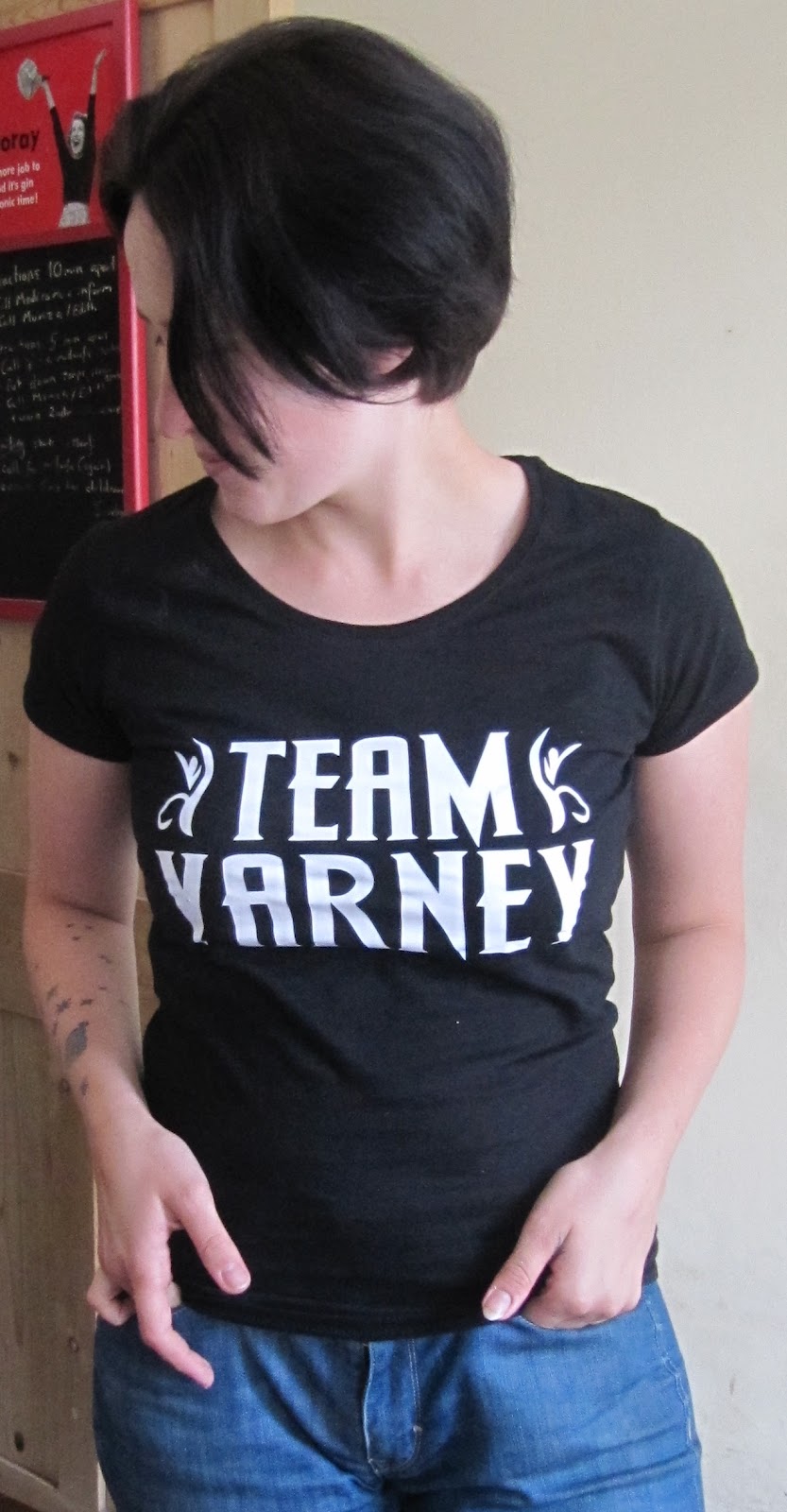
1If you have actually read the whole shebang, then do say so in the comments. We rule. We should have T-shirts. Actually, we do have t-shirts. See?
2Okay, I'll admit it, Sir Francis never actually sparkles, but... blah. Had to nit-pick, didn't you?

Saturday, 8 September 2012

Boneland: Alan Garner

I would be lying if I were to say this were a review.

This, I promise, is true: Last time I read The Alderley Books, I had an idea for a short story. It would be about Colin. He would have become an academic, and, tied to Alderley, he would search for his lost sister.

A month later, I get news of Boneland.

I exhaled. After all, I could never have done it justice.

In the past, I have waxed lyrical about how rare truly beautiful writing can be (http://alysdragon.blogspot.co.uk/2011/09/little-big-john-crowley-dangers-of.html) and I have iterated my cautious attitude to fangirling (http://alysdragon.blogspot.co.uk/2012/07/review-prisoner-of-heaven-carlos-ruiz.html) but I have answers to both of these points:

This is Alan Garner.

I have been waiting for this book for twelve years.

It's not been twelve years since I read The Moon of Gomrath, no.  It's not even been twelve years since I first read The Moon of Gomrath, I was... I don't know. In Primary school. A long time ago. It was twelve years ago, with all the hormones of the menarche screaming around me that I realised what happens at the end of that book, that I understood what Susan does, what Susan feels....

It needed a sequel - but that sequel is called adulthood, and it takes its time in coming.

And Alan Garner?

Let's go back to me at eights year old* - book crazy and myth addled. I always knew, though, the difference between reality and fiction - not for me the banging at the back of wardrobes trying to get passage to Narnia. For a start I knew the books too well: My wardrobe wasn't made from apple wood brought from the creation of Narnia now, was it? The rings were always a more reliable way of travelling between the worlds. But anyway, they were an allegory. Of course I played at Narnia, but I never expected to be whisked away there. Now, Robin Jarvis, he was a bit different. There's a nightmarish quality to his books which made them all too plausible, and sometimes I woke in a cold sweat because of them, but they were fictional. Some part of me always knew that they were fictional.

But The Weirdstone? The Owl Service? 

No. No, they weren't fiction at all.

They were landscape. They were myth.

Even that young, I could tell the difference.

As I say, I've waited twelve years for this.

To put it simply, this is what it is:
When we are children, we have an immediacy of connection with that world; we fight alongside dwarfs, we battle witches. The world is bright, fierce and inhabited. There is good and there is evil and we pick our sides and we reap the consequences.

When we reach adolescence, the older magic begins to be unbound in our bodies and our hearts. Terrifying, it defies classification or morality. We yearn, but it races, too fast, too hot, too dangerous. There are no sides, not any more.

Then there is adulthood. We cannot see, cannot even remember that it has a face. We cannot touch it so directly, but it is more powerful, latent in the landscape. The high magic becomes nothing more than futile artifice, its boundaries false, its presence merely fading injunctions. The wild hunt has flown. There is an older magic still, one without words, without personalities, and it has many meanings and no meanings at all. Everything is grey. Everything is bone. Everything is the Earth.

This is not fiction. Not fiction at all. This is landscape. This is myth.

*I'm guessing.

Wednesday, 8 August 2012

More Fun and Games with Sir Francis Varney

The vampyre and the plot device
or
Some thoughts on starting Chapter 105 of Varney, The Vampyre after having spent a bit too long reading Edward Lear poems to my daughters.

The Baron and the vampyre took to sea in a couple of stolen boats,
And the Baron got stopped by a fisherman,
Whom he paid with a five-pound note1
The reader looks up to the lights above
And sings, “This is too biazzare,
Oh, James Malcom Rymer
(or else, Thomas Prest)2
What a terrible plot-tease3 you are.
You are,
You are,
What a terrible plot-tease you are.

I hate to intrude on this strange interlude
(a boat chase?4 you're taking the piss!)
But Miss Bannerworth's married,
Chillingworth's plans miscarried
and Varney, the vampyre's been missed.
So, a Quaker defamed, and a Baron (in name5)
Fail to interest me a lot,
If there's no point to this stuff
Then leave off with the guff
And stop trying to string out the plot.
The plot,
The plot,
Stop trying to string out the plot.

“You've established two fiends whose tendency seems
To be biting young girls on the throat;
One's vampiric klout
Has been proved beyond doubt6
But which is still open for votes.
So, bring on a reveal
'cos I'm starting to feel
There's no longer such thing as 'too soon'.
I'll ask once again,
Is Sir Francis insane
Or was he revived by the moon?
The moon, the moon
Was he revived by the moon?"

So, anyway, those are my thoughts.

For those of you who have successfully avoided my Twitter ramblings on the subject, Sir Francis is (probably) not the Bannerworths' ancestor  - that was all a cunning ploy to freak the hell out of them. He still thinks he's a vampyre, though, and I guess Varney, the Slightly Delusional wouldn't sell so many books.

Actually, while we're on the topic, I wanted to include something about the barefaced cheek of calling a novel Varney, The Vampyre and failing to commit to there actually being a vampyre until chapter 104, but I couldn't make it scan. And, for all my bluster, this is still the most entertaining thing I've read in ages. 

Oh, and I still fancy Sir Francis like crazy, but that's a topic for another day, when you have supplied yourself with earplugs.

1No. Seriously. Chapter 105, opening paragraphs.
2Authorship being, as it is, uncertain
3The meaning of this word should be self-evident, but for the terminally slow: A plot-tease is a writer who keeps promising a revelation, explanation, or indeed, event but consistently fails to produce any of the above.
4No. Again. Not kidding. Like James Bond, but slower and more pointless.
5Probably not a Baron, all things considered.
6Well, possibly not, but I'm not even going to go in to that.

Tuesday, 31 May 2011

'Mobilis in Mobili': A Historical Perspective on Submarines, Swashbuckling and Rodents

Hello, my name is Alys and I like 19th Century trash fiction.

There, it's out in the open. My shameful little secret. They say admitting it's the first step.

“But what do you mean by 19th Century trash?” I hear you cry. Well, what I'm doing there is making a statement about 'high' and 'low' art and I'm being deliberately provocative. After all, tell someone you're reading a comic book, and there is a good chance they will look at you as if you are illiterate scum. Tell someone you're reading a novel by Dumas they will probably nod as if it's the most natural thing in the world. Some of them will even say, “how brave of you”.

Idiots.

As a culture, we seem to have a fear of the weighty tomes produced in the last century. Some people say it's the length that intimidates us, others the diction. I'm going to go out on a limb and say the defining factor is time. Give it a century or two and any old 'trash' can become 'literature'.

My intention here is not to criticise the 'trash', but to mock the people drawing the line. There is nothing inferior about a good comic, just as there is nothing inferior about Dumas. It is very easy to forget that, in Shakespeare's day, theatre was considered 'low' art. It is very easy to forget that 'novel' used to be an insult. The reason we forget is that the establishment appropriates these things because they are good. But some of us refuse to forget that, in their day, these things were scorned as appealing to the lowest common denominator.

And that's just what they do. It's why they are so bloody good. In order to grab attention they are fast paced, rip-roaring good yarns. They have wild adventures and exotic locations. They are full of witty dialogue and cheap laughs. They are immensely enjoyable. And, all too often, they have what the current Literary establishment would consider flaws. All the heroes are handsome and strong willed, all the heroines are beautiful, occasionally feisty and generally prone to fainting. These are not novels for the pompous - if you have a problem with so-called Mary-Sues, I might advise avoiding them. They are escapism. Truth be told, they are trash. But that's not an insult; it's one of the best things about them.

So, from an repentant AA type beginning, I find myself becoming an enabler. It's pretty easy to get hold of 19th Century trash – charity shops and second hand book stores are good sources. Do check and see that they're unabridged, though. If you have an e-reader, there is also the wonderful Project Gutenburg (http://www.gutenberg.org) which will give them to you for free.1

But... well. Before you begin, a couple of warnings.

19th Century trash requires a certain selective cultural blindness. There will be words and attitudes espoused by otherwise progressive authors that make any liberal reader wince. The trick is to whisper again and again, “they didn't know it was wrong.” In time, with willpower, the effect diminishes.

Then there's the problem of science. As we are often assured, hindsight is 20/20, and you would not have known any better then but... well, it can get a little tiresome to be assured that the properties of magnets, or electricity, or steam will lead to this, that or the other in the foreseeable future. Likewise, hearing phrenology and physiology described as 'sciences' without a 'pseudo' prefacing it, can strike one as odd. There will also probably be an endless stream of slightly dubious information underlying the plot. Abandon your pedantry all ye who enter here.

Perhaps from my tone you can tell I consider myself an old hand at this game. Still, it's possible to be taken by surprise.

In line with my addiction, I've just read '20,000 Leagues Under the Sea' (Jules Verne.) I had been meaning to read it for a while and I enjoyed it immensely. It had everything I could have desired: some seriously outlandish science (but check out that Nautilus, man!), more slightly dubious info on marine biology than I could ever hope to use, and the kind of anti-hero who can make girls like me go a little bit silly.

What's more, by the standards of the time, it's really quite enlightened. The narrator laments the greed which has endangered the whale, or that viciousness which clubs innocent sea-cubs. In the latter half of the book, Nemo consistently draws attention to mankind's hypocrisy, cruelty and tyranny. But the good Captain cannot stop man's man Ned Land from spending most of his time killing (or thinking about killing) things, nor the narrator for admiring that very characteristic.

Now, as I've said, I'm a seasoned reader of these things. Just as I did not let the word “endangered!” cloud my enjoyment of Hector de Sainte-Hermaine's tiger hunt in 'The Last Cavalier'. I tried not to get too discouraged when stout Ned shoots a sea otter for sport even though the narrator has admitted that they are practically extinct. And so, of course, I tended to read parts that involved Ned Land – or, indeed, any other human interaction with nature - with a fixed, but wry, smile upon my face. “It's just the time it was written” I reminded myself. “They didn't know any better.”

Then I read this:

“for Nature's creative power is far beyond man's instinct for destruction.”

After I'd read it, I stopped, blinked and read it again.

Nope, it was still there. That assertion, no matter what we do to nature, it can always repair itself. Verne's narrator states it as a matter of simple fact, as if it were obvious. Such innocence. Such naïvety.

And I, in my 21st Century way, had been quite cheerfully assigning the label of 'arrogant bloody Victorians' (well, okay, Verne was French and, Victoria only came to the throne in... oh, you know what I mean!) Essentially, I had condemned them as being wilfully wrong-headed and ignorant rather than just lacking the dubious benefit of my experience (over fishing, mass extinction, climate change.)

Essentially, I had become the kind of person that I hate.

Because I get so annoyed when people start talking about the past as though it's not only a foreign country, but another planet. I get fed up of wannabe historians describing all life before the Industrial Revolution as an endless stream of fear, sickness and poverty. Fed up of descriptions of the whole populace huddled around meagre fires in leaking hovels or draughty castles, dressed in rags and warding off starvation with a few handfuls of barley. Fed up of the idea that for whole centuries everyone was mad with superstitious fear and terrified of being burned for saying one wrong word. I'm fed up with people telling me life in the past was so totally different that we can have no conception of the inner life of our ancestors. In short, I'm fed up with stories of Poor Starving Peasants.

Because I read. And the thing is, when you read the literature of these people, hear what survives of their stories and their songs, look at their public buildings (mostly churches, I admit), they stop looking like poor, miserable waifs hanging on for the Enlightenment (and failing that, the Renaissance). They strike you as people, just like you and me, making the most of their time on this planet and asking the kind of questions we would ask about morality, religion and sex.

Still, it's easy to forget how much your environment shapes your assumptions. Still, it's easy to be taken by surprise.

Another thing I've read recently is the reissued first volume of 'The Pan Book of Horror Stories' (2010, Pan Books, first published 1959.)

Horror is another one of my things, and it was another brilliant read. It also illustrates my point perfectly. Most of the stories in there are still so fresh, so contemporary, that it seems implausible they were written over fifty years ago and many of them are earlier than that. One of my favourites was Hazel Heard's Lovecraftian The Horror in the Museum.

By this point, I had forgotten the age of the book, had forgotten the relative age of the story. This, to me, was set in the bustling metropolis of the early 21st Century. The characters were people I might know, the tone was contemporary, ironic, powerful. Then, once again, it happens:

“Rogers had once boasted that – for 'certain reasons' as he said – no mice or insects ever came near the place. That was very curious yet it seemed to be true.”

What? No mice? I should bloody hope not.

Now, I've not been sheltered as far as rodents are concerned. I've known of plenty of people who have mice in their lofts, or rats in their compost heaps, but, correct me if I'm wrong, is it not commonly accepted that most people no longer have rodents living in their wall space? Is not the Tom and Jerry style mouse hole a thing of the past?

The past. Yes.

We share so much common ground but, who, now, would think of mentioning that, “Oh by the way, I live in a rodent free house.” And who, two hundred, a hundred, even sixty years ago, would have bothered to comment upon a few mice. No, it is their absence - “very curious yet it seemed to be true.”

It doesn't occur to us to question our assumptions until someone faces us with something like that, something that seems to be an outright contradiction of good sense – not from the standpoint of bigotry or morality but of normality. Of expectation, even.

Because things have changed, and they continue to change. A couple of weeks ago Ian Birrell, former deputy editor of 'The Independent' described Rwanda's president, Paul Kagame as “despotic and deluded” on Twitter. As he included the necessary @, Kagame was able to reply and did so. In text speak.

In 1999, who could have predicted this? Text speak was a thing known only to those with mobile phones, and the internet was not even that prevalent (at least in my social milieu). Anyway, we were all far too worried that the Millennium bug was going to destroy computers forever to be thinking about such advanced communications technology. That was only twelve years ago. Yet when we think about it, don't we think of ourselves as the same people? Our world as, essentially, the same? Doesn't some part of us insist that nothing has really changed?

But it has done, and society with it. Rather more scary is the thought that, if we succeed in not wiping ourselves out, it will continue to change and that all the vaunted cultural assumptions we have will lose their force. “It was 21st Century” they will whisper. “They didn't know any better.” Perhaps Jules Verne was being more insightful than he knew. It is only by abandoning society and all its trappings that we can see its constructs as beliefs rather than truths. And it is only Captain Nemo who can turn his mirror upon humanity and show us what we are.
1Local copyright laws permitting...