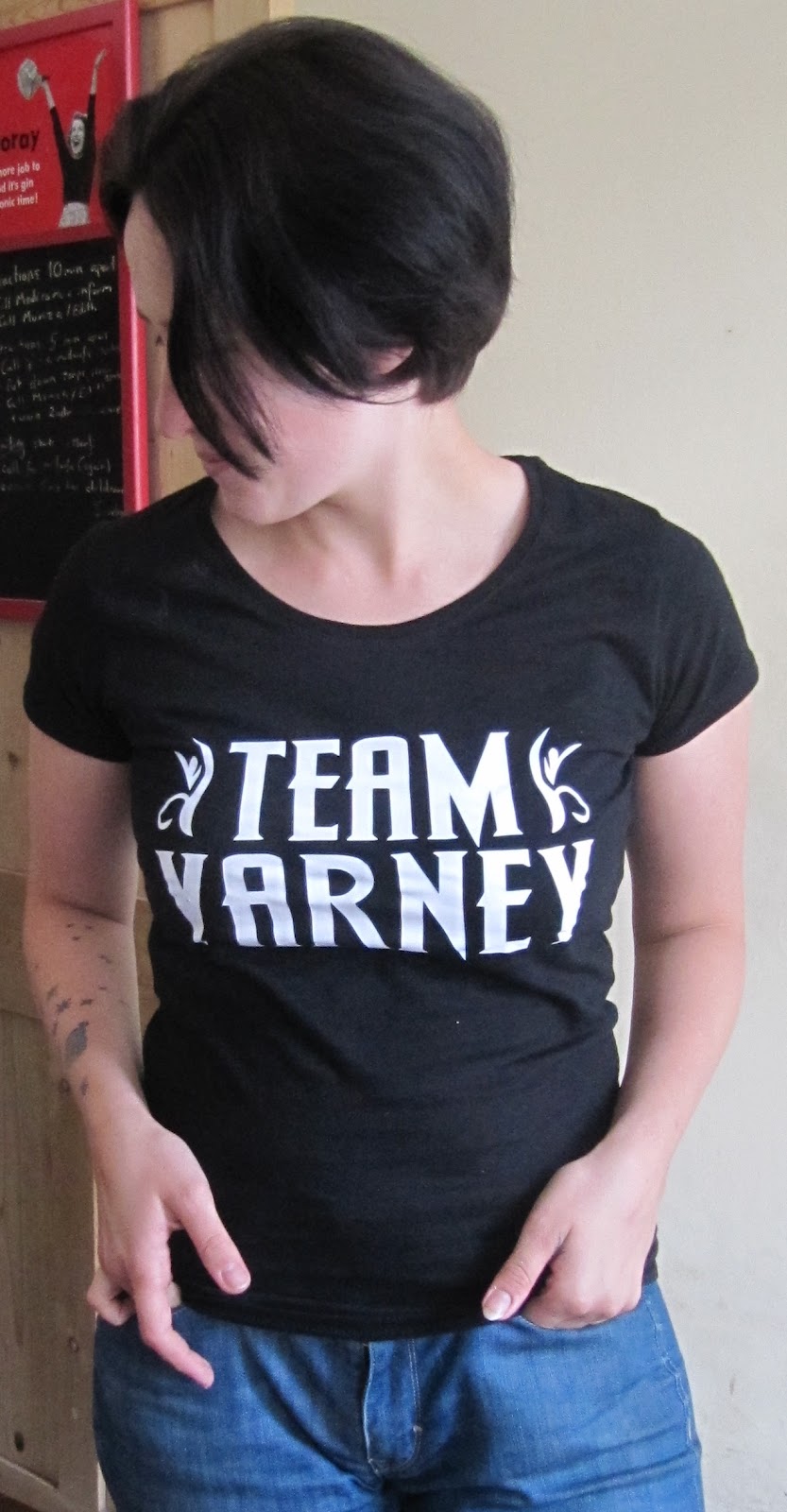
I read Fantasy novels and Adventure novels, I read Horror, and Historical Fiction full of sweet, charming, beautiful men and women. People who are honorable and upstanding, who are intelligent, kind, devoted and if I have to list the fiction heroes who get my heart racing, it stands at Wilhelmina Murray, Percy Blakeney and that's your lot.
I don't get crushes on heroes. Anti-heroes, maybe. Morally questionable, domineering types on a redemption arc, sure. Flat out, total bastards? Well, duh.
 |
| Okay. Maybe not all interest. |
If they were saved, I would lose all interest in them.
Yes, Edmond Dantès is sweet, and lithe and kind of pretty to think about, but it's only when he emerges as the socially aggressive and unprincipled Count of Monte Cristo and people start mistaking him for a vampire that I begin swooning in this ridiculous fashion. Frankly who would take a night with one of Shakespeare's vaguely insipid romantic leads if there was the offer of a night with Oberon? Sure, you'd regret it in the morning! Does that mean you shouldn't do it?
Well, probably, yeah.
Actually, I wouldn't advise it at all.
But that is entirely beside the point
Were I to draft a checklist of necessary qualities to invoke my fawning and excessive devotion to a character, it would start something like: powerful, ruthless, proud, unpredictable, amoral/morally questionable, domineering. After a few thousand synonyms, I might think to include some physical characteristics (cheekbones!) but no matter how pretty a character might be, unless xie can muster a fistful of evil, I'm not interested.
I might get emotional attachment to a hero, my heart might melt for them, I might cry myself to sleep at their pain. I might love Percy Blakeney with all the passion and truth that I could muster at thirteen, but if you put him a fight against Christopher Syn (something I'd pay to see), my feelings are going to be totally on the side of the Scarecrow.
 |
Mmm. Murderously ambiguous morality. |
Yet I have a husband. He is not a supervillain. In fact, he is one of the sweetest, kindest, gentlest and most honorable men you will ever have the pleasure of encountering.
Because, as far as the daily life goes, domineering bastards are obsolete. Dear Christ, can you actually imagine actually living with any of these people? Athos, with his brooding man-pain and his alcoholism? Sir Francis Varney and all the theft, the molestation, the jumping-on-chair-backs shenanigans?
None of this is real:
Being the submissive floozy of some supernatural baddie is nice for one's head-canon, but in real-world emotional terms it isn't exactly sustainable. Frankly, I don't see Jareth bringing me a cup of tea in the morning because I can't be bothered getting up. I don't see Nathaniel Crozier offering any sympathy if I get myself involved in a flame war and need a hug. Those among my literary crush stable who aren't actually malevolent tend to be emotional wrecks. Besides, they aren't exactly pleasant to be around. Villains, remember?
.jpg "(c) Robin Jarvis 1992") |
| Difficult themes through metaphor |
The tension that this creates in the reader or the viewer allows feelings and attachments that our real-world selves would not countenance. In some people this creates a turmoil, a breakdown of the boundaries of reality and fiction, but most people just get over it. We find a way to frame these emotions in a form we understand. I suspect the aforementioned 'Draco in Leather Pants' trope arises from people attempting this, that the conflict between sexual attraction and the repulsiveness of the character leads people to the 'walk two moons' approach: if we only saw this from the villain's p.o.v, they would not seem so bad. Others have, simply compartmentalise, drawing a line between 'real' and 'fantasy' and leaving it at that.
Well, that's the theory...
Which leads us to Rhett Butler
As I was making my pigheaded slog through Gone With the Wind and having one of my little kicking-the-kitchen-cupboard fits and ranting about how Rhett Butler was the most odious, manipulative, abusive bastard I had ever had the misfortune to read about, an unwelcome voice popped into my head and asked, "So why the hell don't you fancy him?"
Interesting.
I went back to the book with a more clinical perspective. Look, he's vile, overbearing and something of a bully - all strong indications. Ruthless, amoral, yep. He's even vain, which is always a plus. I came to my conclusions - Rhett Butler is essentially a shit. It really should have been a no-brainer.
So, in the thick of that literary annoyance of a book part of me was thinking, Just why the hell not? Heck, it would have made reading it more enjoyable.
Fiction allows us to go to places that reality will not take us, allows us to feel things that are not grounded in the logical world, but doing this requires a backing-away. In order to be lead into the darkest places within us, and come back more-or-less unscathed, we need to suspend some aspect of our disbelief, to recalibrate our moral compass. Even if, in real life, I would find Rhett Butler abhorrent, surely I'd fall for him in the context of the book? That's my whole thing.
No.
Why no?
Fiction, by its very nature, simplifies and sanitises. No matter how evil a character, the people they injure bleed ink, not blood. The results of their actions do not matter in actual human terms. Their glamour is a direct consequence of this. A healthy dose of realism would destroy any one of them, or at least the charms they appear to possess.
 |
| Go read Mystery Babylon |
To go one further, the splendid, uncomplicated, ruthless evil they represent is only possible within the boundaries of that fictional world, the metaphor through which they are created. If he weren't a vampire, Sir Francis Varney would be a dirty old man, Dracula a rapist. Sans magic, Nathaniel Crozier becomes a two-bit confidence trickster and thief. By inhabiting magical, or at least fantastical, worlds, these characters become part of a whole other moral discourses that daily life cannot touch. We allow them to display both the malevolence and the grace with which real-world monsters do not trouble themselves.
Much as it grieves me to admit it, you're never going to meet a Jareth, or a Christopher Syn, or a Milady. In the unlikely event that you did, you would probably run a mile. I know I bloody would. They are safe only because they are remarkable, exceptional, unreal. In short, they are a fantasy.
But you will have met a Rhett Butler
"That Rhett Butler," as Angela Carter wrote, "with his travelling salesman's lines...". You know the type, haunting the pub at University campuses, amateur philosophers with their well thumbed copy of Ayn Rand and their leer at any woman brainwashed enough to think that something is worth hearing just because it's a man saying it. Oh, Gods, have you met men like Rhett sodding Butler. They'll spout forth about how much they like, "strong women", but if they meet one will retreat as quickly as if they've been kicked in the nuts. They have a nauseating belief that everyone, everything, has it's price, and that price is well within their remit. They will say things like, "Your girlfriend is too clever for her own good."
 |
| Speaking of fierce, beautiful challenges... |
But Rhett Butler and his ilk are too much a part of this world to unsettle it. They are too invested in the dominant, cultural paradigms. Rhett is a misogynist, a capitalist. Oh, sure, he shakes things up a bit, but only within the sanctioned means of commerce and predatory male sexuality. The disruption he causes rides the same waves of profit and speculation that caused 12.5 million human beings to be shipped across the Middle Passage like so much cargo. Had he been born fifty years earlier, he would have wound up a plantation owner. If he lived today, he'd have made a killing selling bad debt and food securities, and sod the consequences. He's an opportunist, nothing more.
The same goes to his attitude towards women. The male examples of my adored villains can hardly be held up as examples of 'feminist ally of the year', but they at least have a basic respect and understanding of a woman's potential, a fear of that potential turned against them. Jareth might smoulder, "You're no match for me", but when push comes to shove he never denies that her will is as strong as his nor her kingdom as great. Nathaniel Crozier - misogynist extraordinaire- uses his sway over women to draw out their darkest, most terrifying capabilities (capabilities which he respects even as he abuses them.) Even Athos gives credit where credit is due when during a diatribe on Milady's wickedness he admits, "it must be allowed, she supported her rank becomingly". Nor does he ever underestimate her. When they meet face-to-face, he is smart enough to keep a pistol between them.
So, what of Rhett Butler and his claims that Scarlett is too good and too clever to waste away in widowhood?
He never seems to speak to Scarlett but to belittle her, never admits that her faculties might be on a par with his own. The women who are as smart as him (and smarter) he either flatters or avoids. He pursues Scarlett because she is not dangerous to him - she is 'gorgeous' when she is angry rather than potentially fatal. And from this position of arms-length, unshakeable tormentor he proceeds into a kind of abuse that is horribly familiar. He isolates Scarlett from her community by manipulating the perceptions of those around them, bringing the full weight of patriarchal disapproval upon her for behaviour which he has incited. He removes her children from her custody without her consent, vanishing with them for unspecified periods of time. He forbids her from taking contraceptive measures and threatens her with violence. When she withdraws sexual favours from him, he casually asserts that if he really wants to have sex with her, he will rape her.
There are too many men like Rhett fucking Butler. They all too real. I don't want my fantasy landscape cluttered with them as well.
Rant Aside
If you are one of those people who find his mojo alluring, then that is your fantasy life and I have no right to police it. I might hate the guy with a vengeance, but given the record of my literary crushes, any moral high-ground is currently avalanching from beneath my feet. The above few paragraphs of vented spleen are the merely the more or less logical thought processes which helped me understand my reaction.
Which is about where we draw the line on reality.
Because real world powerful, unprincipled seducers do not believe women to be 'fine, dark death-hounds' - they bully and bluster, manipulate and abuse. For all I might get into a girlish fluster about Mr Crozier (historian, warlock, philanderer) in the real world I do what I can to make sure men like him wind up before war-crimes tribunals. Edmond Dantès might charm me senseless between the pages of a book - but if I met him down the pub, I'd probably pick a fight.
For years, I struggled with this paradox. The scorn, the anger, the disbelief that people face when they admit such a predilection is remarkable. You will be mocked, belittled, told that your critical opinions have no worth. Often - in my experience - these verbal attacks are gendered. In terms of self-worth, it has an emotional toll. For all I said I wanted a lover, a friend, a soul mate, my mental space was packed with people who could be nothing of the kind. How could I claim to be worthy of love, respect, affection while still having a total passionate yen for utter, tyrannical bastards?
So, I write. It's what I do. I work through it in short stories, in novels, stretching existing metaphors, setting up the problematic of the attraction, creating terrible villains who allure, and their victims who bleed...
Well, it's still just ink, but I flatter myself that it's scarlet ink.
In my own life, though, I just drew a line. There is reality and there is pretend. Reality is where I live, and pretend is writing, is fantasy, is questions of morality the real world can not address. And, just as a child falling back in the playground, clutching their shoulder and crying, "Yah got me, pardner!" does not wish to be shot with an actual gun, neither do my escapist desires or worrying at a theme change or reframe my real-life rights and needs. The game is more complicated, but the rules remain. Pretending a thing does not make it real, but not wishing for a thing to be real does not mean that one is not permitted to pretend.
 |
| Alan Moore, there. Nailing it. |
But what Rhett Butler made me realise is that the line I have drawn is permeable, that it plunges and dives encompassing this, but not that, refusing one foible, but permitting its neighbour free reign. It does not only contain that notional space that is created when one opens a book, or watches a film, but is an ongoing conversation with the worlds of fiction and reality. It is personal, tied implicitly to how we escape, how we engage with those fantasies. It makes us uneasy.
For me to fancy Rhett Butler would be to reconcile myself with everything I detest. I cannot view him, or Gone With the Wind as anything other than a cultural artefact of genocide and misogyny. As such, he belongs to this world, to this reality. I tell myself that my creations are only fictions, but they slip this way and that, they hurt and they worry.
There is nothing empirical about unreality.

