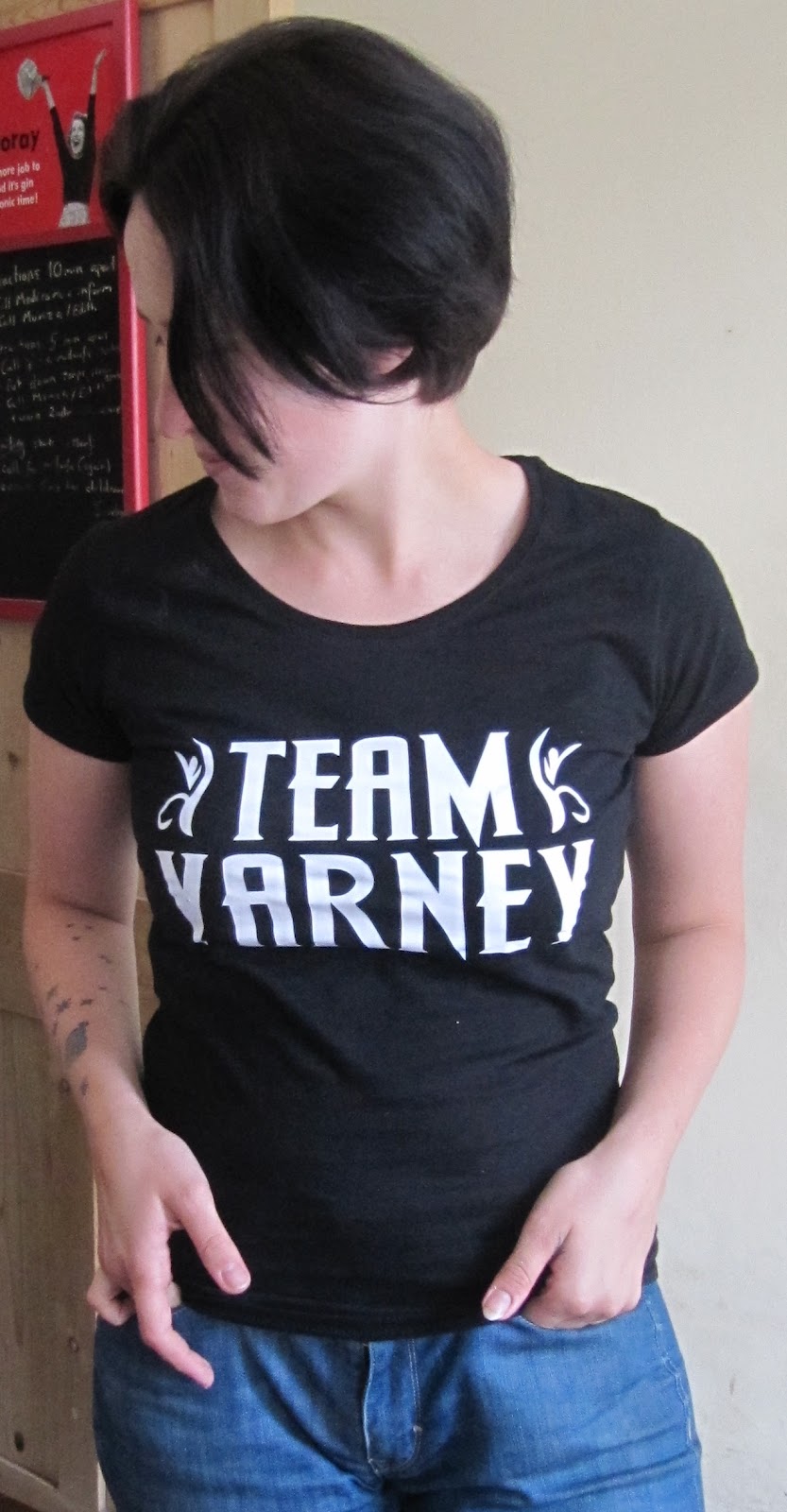
One of the reasons I don't use a formal rating system on this blog is that assigning something a certain number of stars always seems to result in injustice. For example, if a book by my favourite writer isn't quite as sublimely brilliant as I know they're capable of producing, I might give it four stars, even three if I'm feeling vindictive. However, were I to read the same novel by an unknown, it would have breezed its way to an effortless five based on my surprise by all the skill and qualities which familiarity would otherwise cause me to take for granted.
As a reader, a writer's work cannot be separated from their oeuvre, nor indeed from what they have meant to you at various points in your own life. Therefore, when I encounter a book that, taken solely on its own merits, is a perfectly adequate piece of middle grade fiction trying to pass itself off as an adult novel, I would probably be likely to give it three stars. Unless, of course, it was written by Philip Pullman, when I would feel a remarkable degree disgust, anger and personal betrayal.
Look. I loved His Dark Materials. I read them relentlessly as a
child, they being one of the few things that did not talk down to me in
terms of content, character, or events. I've written before about the
state of middle grade and YA fiction for avid and intelligent readers of
fantasy when I was that age, and Pullman was a huge part of me making
the transition from Diana Wynne Jones and Susan Cooper to Robert
Holdstock and Angela Carter. I cannot overlook this when I say that La Belle Sauvage is such a dreadful disappointment.
You see, it wants to be The River at Green Knowe when it grows up, an ambition which perhaps misses the point that The River at Green Knowe is a children's book.
Moral messages that were subtle and carefully handled in the original trilogy are here presented with all the nuance of a cosh to the back of your head - we get it Phil, the church are the bad guys - the wonder and strangeness of Lyra's world is replaced by a series of frankly generic folkloric cameos, and our deeply abrasive, awkward, believable protagonist is replaced with... Malcolm.
I'm not even going to start talking about Malcolm.
But on top of this dumbing down of style and content, there was the insistence that this was one for grownups. Perhaps the very same grownups who had grown up reading His Dark Materials, and it was this that really stuck the knife in because, put simply, La Belle Sauvage does not function if viewed as an adult novel.
It has long been a conviction of mine that the difference between adult, YA, and children's fiction is not so much a matter of content, as one of structure, pacing, and focus. Just as children's fiction - good children's fiction - is not merely adult fic with the 'inappropriate' content taken out and all the nastiness coddled up, adult fiction - or at least, good adult fiction - is not just a children's story with a bit of sex, swearing, and
an absolutely gratuitous implied rape thrown in to it.
The two modes serve different needs, tells a story differently, talk to their readers in a whole different language, and this is why you never really outgrow good children's fiction - because its qualities remain. Historically, Pullman knew this. His Dark Materials is frequently devastating, lyrical, powerful - they are children's books, unashamedly, and in the very best senses of the words.
La Belle Sauvage isn't even a very good children's book.
Ultimately, if this hadn't been something I was reading for bookclub, I wouldn't have finished it. I don't want my childhood heroes to diminish this much in my eyes. And, if that weren't enough?
[Spoilers for His Dark Materials, and La Belle Sauvage below]
Literary criticism, recommendations and whimsy from a devotee of the story in all its forms. Updates Fridays and every other Wednesday. All views my own, or thereabouts.
Showing posts with label morality. Show all posts
Monday, 8 April 2019
Review: The Book of Dust, La Belle Sauvage by Philip Pullman
Labels:
author's darlings,
bad guys,
children's books,
genre,
good guys,
Mary Sue,
moral grey,
morality,
occasional weeping despair,
Philip Pullman,
rant,
responsibility,
sequels,
story-telling,
the Iron Bar factor
Monday, 17 December 2018
Review: The Haunting of Drearcliff Grange School
Yes. Yesssssssssssss.
Oh, my blog was having its hiatus when the last one of these came out. The one where I bought half a dozen copies, gave them to all of my friends for Christmas and went, "Look, look! IT'S US!"
So: Did you go to a single sex school? Did you fucking hate it? Or, did you love it, but find yourself the 'red headed stepchild' all the same? Are you still mates with some of the weirdos you met there?
Okay. You need to read Drearcliff Grange.
How to describe this? Superpowers and eldritch abominations at St Trinians? Rip-roaring adventures, jolly hockeysticks, defeating facism, and overcooked swede? These books are nuts and it's fucking marvellous. Newman is the King of Pastiche and he owns this totally.
I need to calm down.
The Haunting of Drearcliff Grange School is the second in the Drearcliff series, and expands both the world and the themes that Newman developed in the first novel. It suffers a little from being a transitional piece between the self-contained first book, and the wider series - but it is still an immensely satisfying read. Moreover, Newman addresses that aspect of it thematically, taking Amy, Frecks, Kali, and Emma from the plucky girlhood and simple moralities of The Mysteries... to a adolescence, and a reappraisal of what it is to be a hero.
Certainties are challenged, characters change, and we explore the awkward ground between the broken and the malevolent, balance law agaisnt lawlessness, explore the dangers of privilege, the worth of trust, and the harm that can be done by the simplest of actions. At the heart of the novel is Amy, whose role as the benevolent Kentish Glory is reconsidered as she wonders if she might not do better as the more terrible Death's Head Hawkmoth.
Of course, its all terribly referential, both to adjacent literary worlds and Newman's other works, but that's all part of the fun. If that isn't your sort of thing then... honestly, you might want to find another book review blog.
More seriously, Newman's great strength as a writer is that he manages to drop every name under the sun without ever detracting from the story he is telling at that moment, and this book carries off that trick admirably. An absolute joy.
Oh, my blog was having its hiatus when the last one of these came out. The one where I bought half a dozen copies, gave them to all of my friends for Christmas and went, "Look, look! IT'S US!"
So: Did you go to a single sex school? Did you fucking hate it? Or, did you love it, but find yourself the 'red headed stepchild' all the same? Are you still mates with some of the weirdos you met there?
Okay. You need to read Drearcliff Grange.
How to describe this? Superpowers and eldritch abominations at St Trinians? Rip-roaring adventures, jolly hockeysticks, defeating facism, and overcooked swede? These books are nuts and it's fucking marvellous. Newman is the King of Pastiche and he owns this totally.
I need to calm down.
The Haunting of Drearcliff Grange School is the second in the Drearcliff series, and expands both the world and the themes that Newman developed in the first novel. It suffers a little from being a transitional piece between the self-contained first book, and the wider series - but it is still an immensely satisfying read. Moreover, Newman addresses that aspect of it thematically, taking Amy, Frecks, Kali, and Emma from the plucky girlhood and simple moralities of The Mysteries... to a adolescence, and a reappraisal of what it is to be a hero.
Certainties are challenged, characters change, and we explore the awkward ground between the broken and the malevolent, balance law agaisnt lawlessness, explore the dangers of privilege, the worth of trust, and the harm that can be done by the simplest of actions. At the heart of the novel is Amy, whose role as the benevolent Kentish Glory is reconsidered as she wonders if she might not do better as the more terrible Death's Head Hawkmoth.
Of course, its all terribly referential, both to adjacent literary worlds and Newman's other works, but that's all part of the fun. If that isn't your sort of thing then... honestly, you might want to find another book review blog.
More seriously, Newman's great strength as a writer is that he manages to drop every name under the sun without ever detracting from the story he is telling at that moment, and this book carries off that trick admirably. An absolute joy.
| I loved it so much, I did cosplay. |
Wednesday, 22 April 2015
Review: Spirit Houses by Die Booth
Alright, alright, let's come clean. This blog is officially on hiatus until August at least, but probably September. There are reasons but they are too dull to go into here.
Instead, I cite the bit of Twitter logic that brings me crawling back for a brief visit - if you like a book by an independent author, review it. A few weeks ago, I was recommended Die Booth's Spirit Houses, and my word, did I like it.
A romping, almost steam-punk adventure following Manda Connor and her fellow Field Nurses in the D.P.M - the Department of Paranatural Medicine - it does not rely over-much on the apparatus of non-functional gears and eldritch threats, being instead driven by engaging and entertaining characters.
It is a novel that quickly gives one the impression of being cast into a much larger world, so lush and fully realised are the premise and setting. Booth does not expend excess words upon world-building or set-up, but the detail of vision is constantly revealed by the plot. It's almost disconcerting how thoroughly built and convincing this alternative England is - the mental space it occupies feels more like a beloved film series, or long running television show than a novel. It seems so much bigger than it is; there is so much richness here, I sometimes felt the need to pace myself - although that may just have been the fact that I was screen-reading.
In tone cosy, the narrative and characters had an almost YA feel to them, something enhanced by both the institutional setting of the D.P.M, and the '20s pastiche of the setting - there is no sex, or language stronger than 'damn' - but there is a poise and maturity of theme that is reminiscent of Lanni Taylor. For all the tenderness with which the characters are painted, as a reader you worry about them. They are breakable, things may not turn out okay. And you want for it it turn out okay.
Naturally, it isn't flawless. If you have an issue with head-hopping (which I think is unfairly maligned, but each to their own) this is not the novel for you. Likewise the prose, while generally light and witty with moments of real beauty, sometimes loses itself in descriptors which grate - the characters do a lot of eye rolling. The opening chapters are also somewhat stilted, something not helped by the initial construction of Manda's character and the suggestion of a love-triangle surrounding her. However, Spirit Houses quickly finds its stride, and its protagonist's mixture of naïveté and passion soon create a heroine who is more than a cipher for events, or an idealised reader-insert. Spirit Houses is a novel about identity, about the choices we make and the people that we have to be to make them.
It is here that Spirit Houses finds its strength. Characters are revenants, werewolves, displaced souls. They make deals with demons, lie, manipulate their friends. But these issues do not define them; they are merely facets of personality, burdens to be borne, actions of necessity. This is a compassionate novel, and is written from a standpoint empathetic with otherness. Characters are outsiders: the slow, hard-working Ray who refuses to take advantage of his privileged background; the brilliant, cold Daniel proving his genius despite the handicap of his working class roots; genial, foppish Alex inciting the ire of the more conventionally masculine and, of course, Manda herself, battling the prejudice she faces at her lycanthropy, desperate for a place in the world.With astute political awareness, Booth weaves these personal struggles into the wider world of the D.P.M, its language of respect and patient consent offering a kinder and more intelligent picture of the integration of the para-natural than I am used to seeing.
I would hold this book up against Glen Duncan's brash and unconvincing The Last Werewolf as an example of what existence on the fringes of acceptability really looks like - not bloodbaths and 'gut-wrenching' last stands against cartoon villains as part of the great journey of the Virile White Man™ - but as the slow weight of judgement, the fight for dignity and health, for a normal life.
Well worth your time.
Instead, I cite the bit of Twitter logic that brings me crawling back for a brief visit - if you like a book by an independent author, review it. A few weeks ago, I was recommended Die Booth's Spirit Houses, and my word, did I like it.
A romping, almost steam-punk adventure following Manda Connor and her fellow Field Nurses in the D.P.M - the Department of Paranatural Medicine - it does not rely over-much on the apparatus of non-functional gears and eldritch threats, being instead driven by engaging and entertaining characters.
It is a novel that quickly gives one the impression of being cast into a much larger world, so lush and fully realised are the premise and setting. Booth does not expend excess words upon world-building or set-up, but the detail of vision is constantly revealed by the plot. It's almost disconcerting how thoroughly built and convincing this alternative England is - the mental space it occupies feels more like a beloved film series, or long running television show than a novel. It seems so much bigger than it is; there is so much richness here, I sometimes felt the need to pace myself - although that may just have been the fact that I was screen-reading.
In tone cosy, the narrative and characters had an almost YA feel to them, something enhanced by both the institutional setting of the D.P.M, and the '20s pastiche of the setting - there is no sex, or language stronger than 'damn' - but there is a poise and maturity of theme that is reminiscent of Lanni Taylor. For all the tenderness with which the characters are painted, as a reader you worry about them. They are breakable, things may not turn out okay. And you want for it it turn out okay.
Naturally, it isn't flawless. If you have an issue with head-hopping (which I think is unfairly maligned, but each to their own) this is not the novel for you. Likewise the prose, while generally light and witty with moments of real beauty, sometimes loses itself in descriptors which grate - the characters do a lot of eye rolling. The opening chapters are also somewhat stilted, something not helped by the initial construction of Manda's character and the suggestion of a love-triangle surrounding her. However, Spirit Houses quickly finds its stride, and its protagonist's mixture of naïveté and passion soon create a heroine who is more than a cipher for events, or an idealised reader-insert. Spirit Houses is a novel about identity, about the choices we make and the people that we have to be to make them.
It is here that Spirit Houses finds its strength. Characters are revenants, werewolves, displaced souls. They make deals with demons, lie, manipulate their friends. But these issues do not define them; they are merely facets of personality, burdens to be borne, actions of necessity. This is a compassionate novel, and is written from a standpoint empathetic with otherness. Characters are outsiders: the slow, hard-working Ray who refuses to take advantage of his privileged background; the brilliant, cold Daniel proving his genius despite the handicap of his working class roots; genial, foppish Alex inciting the ire of the more conventionally masculine and, of course, Manda herself, battling the prejudice she faces at her lycanthropy, desperate for a place in the world.With astute political awareness, Booth weaves these personal struggles into the wider world of the D.P.M, its language of respect and patient consent offering a kinder and more intelligent picture of the integration of the para-natural than I am used to seeing.
I would hold this book up against Glen Duncan's brash and unconvincing The Last Werewolf as an example of what existence on the fringes of acceptability really looks like - not bloodbaths and 'gut-wrenching' last stands against cartoon villains as part of the great journey of the Virile White Man™ - but as the slow weight of judgement, the fight for dignity and health, for a normal life.
Well worth your time.
Wednesday, 17 December 2014
What Price Fantasy? Consent and the policing of desire
This is sort of a follow-up to Alys' Addiction to Villains, dealing as it does with that fraught line between the fictional and the real.
"Romance novels are also examples of what love and sex should look like in the real world."
I ignored the flinch. I flinch a lot.
But as the article charged on breathless to its rebuttal of rape culture, the little bit of me that flinched wriggled around a bit, pulled and nagged at my mind, and before I knew it I had my arms crossed over my chest and there was that nasty little whisper that used to keep me awake at night, "Just what is wrong with you?"
Ouch.
I thought I'd kicked that one. I thought I'd accepted the kinky mess of my brain, thought I'd settled with myself that dark thoughts and darker desires were not incompatible with self-worth, that I knew what I really needed and deserved, and what was just fun to think about. I thought I was over this.
But you're never over it. And it never takes much to bring it back again. Just some sweeping comment from a misogynist, just some below-the-line comment from an intellectual lightweight trying to save me from myself.
Or a thoughtful, intelligent, necessary article from someone I'd be proud to call an ally.
My shipping, my head-canon, the erotica I write (that you chaps are seriously never reading) would this be judged by others as "examples of what love and sex should look like in the real world", when it's not, and it isn't intended that way, and for goodness sakes, aren't we all aware of that by now?
I'm done berating myself about this. I got angry.
Politically, I am left of centre.
Actually, I'm left of centre by quite a long way.
In fact, I probably couldn't see the centre with a telescope, but that's immaterial. As an unrepentant lefty, I would like to think that I am ethical. As such, I want an end to all the ways that people use power to hurt each other. I want an end to rape. I want, desperately, for every kind of non-consensual sexual activity eradicated from our world. I want our conversations around sex to become unambiguous and free from shame. I would like all abusive tosspots to learn how to be decent human beings and, frankly, while we're at it, I'd like an anarchist utopia.
That's what I pray for, after all: people being decent to each other not because of law, custom or fear, but because it's the decent thing to do.
But just because I want these things, doesn't mean I'm not allowed to read books that glamorise vicious feudal societies. Just because I'm anti-murder does that mean I must resist the charm of We Have Always Lived in the Castle. Just because I am a pacifist, am I not allowed to enjoy Preacher?
So, yeah, I'm anti rape. But does that mean I have to bar non-con from my fantasy life as well?
I have heard arguments from erotica writers and readers that this is how it should be, that non-con should always be framed as fantasy within the construct of a story. So, any scene where a questionable act is eroticised it is necessary to reveal it as a consensual activity where all participants are engaging in a mutual game of make-believe. We may see something vicious, even violent, but when the lens pans out we see the mutual laugh and hug afterwards, the safe-word and the quick release restraints. In a longer story, we see these safe guards working, we see that this is all consensual and that, however intense, it is all in the name of good fun.
BDSM gives us as neat a get-out clause in fiction as it does to real life. We can go to these places without ever bringing our ethics into question.
But when we're reading a novel or a story we already have a framing device which tells the reader that nothing that follows is really real. A work of fiction is, of itself, a consensual, mutual game between the reader and the author. If a reader likes the idea of a forceful hunk sweeping them up to the bedroom over their half-hearted protestations, then a book is a place they can have that without the ensuing emotional scars. If at any point something unsettles them, triggers them, hurts them, they can say a non-negotiable "no", and put down the book. Stopping reading is the best safe-word in the world.
What is more, most adults are capable of this distinction between reality and fiction. We know what we're reading isn't real - any crimes committed are not real crimes, the blood shed disappears with the next turned page. To add to this wonderful game a second disclaimer would be almost like a massive subtitle on the dangerous bits of an action film which state "These explosions are a special effect! Stunt doubles were used and not harmed!"
When one reads - especially when one reads erotica - one suspends one's disbelief in order to get one's jollies. One does not want to come back to earth with a thump. We get it. It's a construct. If you aren't conversant with that, you really shouldn't be playing the game - you are still scrabbling at the backs of wardrobes seeking passage to Narnia, still walking into walls between platforms at King's Cross.
So I could get scornful here, vicious against the people who fail to understand that, just because I entertain questionable notions in my head, doesn't mean I am ever going to act upon them in real, non pre-agreed reality.
Likewise, while I know that writers have no particular responsibility to their readers as a moral force, I am also aware of the part they play in creating cultural discourses and normative modes in the media. And these discourses - for all they are created in that 'harmless' realm of paper an ink - can cause real-world suffering, real world pain. I'm not talking about Harry Potter being the slippery slope into Satanism, I'm talking about semiotics. I'm talking about yet another strand of media excusing sexual assault, normalising it, glorifying it.
In short, I'm talking about rape culture. Faced with that, to say, "It's only fantasy, I won't self censor, sod the consequences" is to show either blinding privilege or borderline malice.
But I know, too, that if a story is told often enough to become our mode of understanding a thing it can do incalculable harm. I know if a person's, particularly a woman's, "No" comes to signify only token resistance, then we live in a society that excuses rape. And I am a hundred percent certain that this is wrong.
So I can't reach an answer. The line between fiction and reality is nothing like so definite as the line between enthusiastic consent and everything else. The boundary of what is too close to the bone changes from reader to reader, author to author, person to person. What's more, in a society that has so much shame, so much obfuscation around desire, too many people find themselves unable to communicate, to give or to ask consent. So, yes, we certainly need discourses which show us the words to do this, but as fiction reflects reality, we also need words which reflect back the pain of that inability, words for that struggle, for that uncertainty.
How much do writers owe to ethics? To reality? At what price do our fantasies come? I wish there were a rubric that I could get behind, a pocket guide to acceptability because with the cost so high in human suffering, I could do with one.
All I know for certain is this; I am a Gothic writer, a teller of fucked up little narratives with ambiguous moralities, and I am not always sure that I am doing the right thing.
Sex scenes and Consent:
A while ago, I read this fantastic article on the importance of consent in fiction by literary agent Laura Zats. The reason it's brilliant is because she's right. Consent is necessary, and hot and, y'know, the line between fun-times and sexual assault. Yet while the majority of my brain was cheering on this home-run of good sense and ethical sexy times in romance novels, I read this sentence and a tiny part of me flinched."Romance novels are also examples of what love and sex should look like in the real world."
I ignored the flinch. I flinch a lot.
But as the article charged on breathless to its rebuttal of rape culture, the little bit of me that flinched wriggled around a bit, pulled and nagged at my mind, and before I knew it I had my arms crossed over my chest and there was that nasty little whisper that used to keep me awake at night, "Just what is wrong with you?"
Ouch.
I thought I'd kicked that one. I thought I'd accepted the kinky mess of my brain, thought I'd settled with myself that dark thoughts and darker desires were not incompatible with self-worth, that I knew what I really needed and deserved, and what was just fun to think about. I thought I was over this.
But you're never over it. And it never takes much to bring it back again. Just some sweeping comment from a misogynist, just some below-the-line comment from an intellectual lightweight trying to save me from myself.
Or a thoughtful, intelligent, necessary article from someone I'd be proud to call an ally.
My shipping, my head-canon, the erotica I write (that you chaps are seriously never reading) would this be judged by others as "examples of what love and sex should look like in the real world", when it's not, and it isn't intended that way, and for goodness sakes, aren't we all aware of that by now?
I'm done berating myself about this. I got angry.
Fiction is another word for fantasy.
Even the most real-world, blow by blow account of an ordinary day is a fabrication, a falsity. And yeah, while I agree that we need a world that does not normalise sexual assault via media, can we not accept that some things are an escape? That some people like to think about things that - in real world terms - would constitute serious criminal acts?Politically, I am left of centre.
Actually, I'm left of centre by quite a long way.
In fact, I probably couldn't see the centre with a telescope, but that's immaterial. As an unrepentant lefty, I would like to think that I am ethical. As such, I want an end to all the ways that people use power to hurt each other. I want an end to rape. I want, desperately, for every kind of non-consensual sexual activity eradicated from our world. I want our conversations around sex to become unambiguous and free from shame. I would like all abusive tosspots to learn how to be decent human beings and, frankly, while we're at it, I'd like an anarchist utopia.
That's what I pray for, after all: people being decent to each other not because of law, custom or fear, but because it's the decent thing to do.
But just because I want these things, doesn't mean I'm not allowed to read books that glamorise vicious feudal societies. Just because I'm anti-murder does that mean I must resist the charm of We Have Always Lived in the Castle. Just because I am a pacifist, am I not allowed to enjoy Preacher?
So, yeah, I'm anti rape. But does that mean I have to bar non-con from my fantasy life as well?
Especially when we get kinky, it's all about consent.
It's probably about time I mentioned BDSM. This is, after all, as much as a fictional framing device as erotic fiction. However 24/7 a relationship, it is still has its limits, however extreme the actions, they are always bound by consent. BDSM allows people to hurt or be hurt at one remove, not to experience power but to play at it. Just because someone someone indulges in interrogation play does not mean they want to be interrogated. BDSM is a safe space for fantasies, it is a yes-but-not-really.I have heard arguments from erotica writers and readers that this is how it should be, that non-con should always be framed as fantasy within the construct of a story. So, any scene where a questionable act is eroticised it is necessary to reveal it as a consensual activity where all participants are engaging in a mutual game of make-believe. We may see something vicious, even violent, but when the lens pans out we see the mutual laugh and hug afterwards, the safe-word and the quick release restraints. In a longer story, we see these safe guards working, we see that this is all consensual and that, however intense, it is all in the name of good fun.
BDSM gives us as neat a get-out clause in fiction as it does to real life. We can go to these places without ever bringing our ethics into question.
But when we're reading a novel or a story we already have a framing device which tells the reader that nothing that follows is really real. A work of fiction is, of itself, a consensual, mutual game between the reader and the author. If a reader likes the idea of a forceful hunk sweeping them up to the bedroom over their half-hearted protestations, then a book is a place they can have that without the ensuing emotional scars. If at any point something unsettles them, triggers them, hurts them, they can say a non-negotiable "no", and put down the book. Stopping reading is the best safe-word in the world.
What is more, most adults are capable of this distinction between reality and fiction. We know what we're reading isn't real - any crimes committed are not real crimes, the blood shed disappears with the next turned page. To add to this wonderful game a second disclaimer would be almost like a massive subtitle on the dangerous bits of an action film which state "These explosions are a special effect! Stunt doubles were used and not harmed!"
When one reads - especially when one reads erotica - one suspends one's disbelief in order to get one's jollies. One does not want to come back to earth with a thump. We get it. It's a construct. If you aren't conversant with that, you really shouldn't be playing the game - you are still scrabbling at the backs of wardrobes seeking passage to Narnia, still walking into walls between platforms at King's Cross.
So I could get scornful here, vicious against the people who fail to understand that, just because I entertain questionable notions in my head, doesn't mean I am ever going to act upon them in real, non pre-agreed reality.
But this attitude is rather glib.
Because that isn't what this is about. Because even though books are safe spaces, even though they are the finest of fetish clubs, even I draw back from too much realism in my villain. One might be fine with the idea of an elf-lord dreamboat pinning one's hands and ripping one's bodice, but when the setting is a market town in Surrey and the ravisher in question is a stockbrocker then no matter how much emotionally escapist bliss comes into play, to me that's going to sound like date rape.Likewise, while I know that writers have no particular responsibility to their readers as a moral force, I am also aware of the part they play in creating cultural discourses and normative modes in the media. And these discourses - for all they are created in that 'harmless' realm of paper an ink - can cause real-world suffering, real world pain. I'm not talking about Harry Potter being the slippery slope into Satanism, I'm talking about semiotics. I'm talking about yet another strand of media excusing sexual assault, normalising it, glorifying it.
In short, I'm talking about rape culture. Faced with that, to say, "It's only fantasy, I won't self censor, sod the consequences" is to show either blinding privilege or borderline malice.
There should probably be a conclusion here
But there won't be. Because I know that people can't be held accountable for their fantasies provided those fantasies remain fiction (in whatever form). Because I know that reading about non-con, however horrific or scary, and getting off on it is not the same thing as wanting it to happen. I know that, as people, we need to challenge the dark bits of our minds, to embrace them and enjoy them if we can do that without harming people. I know that devotes of the macabre, fans of the kinky among us shouldn't have to feel like freaks, shouldn't need to be ashamed that they get a frisson from things a bit beyond the beaten track. The stigma against these things is strong enough as it is; let's not shame people further.But I know, too, that if a story is told often enough to become our mode of understanding a thing it can do incalculable harm. I know if a person's, particularly a woman's, "No" comes to signify only token resistance, then we live in a society that excuses rape. And I am a hundred percent certain that this is wrong.
So I can't reach an answer. The line between fiction and reality is nothing like so definite as the line between enthusiastic consent and everything else. The boundary of what is too close to the bone changes from reader to reader, author to author, person to person. What's more, in a society that has so much shame, so much obfuscation around desire, too many people find themselves unable to communicate, to give or to ask consent. So, yes, we certainly need discourses which show us the words to do this, but as fiction reflects reality, we also need words which reflect back the pain of that inability, words for that struggle, for that uncertainty.
How much do writers owe to ethics? To reality? At what price do our fantasies come? I wish there were a rubric that I could get behind, a pocket guide to acceptability because with the cost so high in human suffering, I could do with one.
All I know for certain is this; I am a Gothic writer, a teller of fucked up little narratives with ambiguous moralities, and I am not always sure that I am doing the right thing.
Wednesday, 24 September 2014
Functions of Fantasy, or, Alys's Addicition to Villains
It appears I have mentioned in passing something of a predilection for fictional bad guys and characters so morally grey that they could be used as camouflage on the dark night of no moon. Give me cads, rogues, and schemers of all types. Give me a character who is something of a bastard, who is ruthless, conniving, swaggering, manipulative, and the chances are I'll swoon and maybe put his name on some kind of t-shirt.
No. I am not joking. Yes. This is the way my mind works.
I read Fantasy novels and Adventure novels, I read Horror, and Historical Fiction full of sweet, charming, beautiful men and women. People who are honorable and upstanding, who are intelligent, kind, devoted and if I have to list the fiction heroes who get my heart racing, it stands at Wilhelmina Murray, Percy Blakeney and that's your lot.
I don't get crushes on heroes. Anti-heroes, maybe. Morally questionable, domineering types on a redemption arc, sure. Flat out, total bastards? Well, duh.
This is not Draco in Leather Pants. Sure, a bit of emotional complexity, a little bit of grayscale does not go amiss, but I do not want these characters redeemed. I do not want them to be any less evil and bastardy. I do not think they can be saved by the Love of a Good Woman™.
If they were saved, I would lose all interest in them.
Yes, Edmond Dantès is sweet, and lithe and kind of pretty to think about, but it's only when he emerges as the socially aggressive and unprincipled Count of Monte Cristo and people start mistaking him for a vampire that I begin swooning in this ridiculous fashion. Frankly who would take a night with one of Shakespeare's vaguely insipid romantic leads if there was the offer of a night with Oberon? Sure, you'd regret it in the morning! Does that mean you shouldn't do it?
Well, probably, yeah.
Actually, I wouldn't advise it at all.
But that is entirely beside the point
Were I to draft a checklist of necessary qualities to invoke my fawning and excessive devotion to a character, it would start something like: powerful, ruthless, proud, unpredictable, amoral/morally questionable, domineering. After a few thousand synonyms, I might think to include some physical characteristics (cheekbones!) but no matter how pretty a character might be, unless xie can muster a fistful of evil, I'm not interested.
I might get emotional attachment to a hero, my heart might melt for them, I might cry myself to sleep at their pain. I might love Percy Blakeney with all the passion and truth that I could muster at thirteen, but if you put him a fight against Christopher Syn (something I'd pay to see), my feelings are going to be totally on the side of the Scarecrow.
Yet I have a husband. He is not a supervillain. In fact, he is one of the sweetest, kindest, gentlest and most honorable men you will ever have the pleasure of encountering.
Because, as far as the daily life goes, domineering bastards are obsolete. Dear Christ, can you actually imagine actually living with any of these people? Athos, with his brooding man-pain and his alcoholism? Sir Francis Varney and all the theft, the molestation, the jumping-on-chair-backs shenanigans?
None of this is real:
Being the submissive floozy of some supernatural baddie is nice for one's head-canon, but in real-world emotional terms it isn't exactly sustainable. Frankly, I don't see Jareth bringing me a cup of tea in the morning because I can't be bothered getting up. I don't see Nathaniel Crozier offering any sympathy if I get myself involved in a flame war and need a hug. Those among my literary crush stable who aren't actually malevolent tend to be emotional wrecks. Besides, they aren't exactly pleasant to be around. Villains, remember?
Their lack of flat-mate qualities aside, their very unreality is sanctioned by the texts in which they appear. People
like this simply do not exist. Romantic
highwaymen and charming vampires are a thing of fiction. And that's a
good thing, by the way. Fiction is a door into a world that lets us
weigh up people and actions with far more care and nuance than we can
permit when dealing with flesh-and-blood individuals, with real
emotions. We can explore motivations that we would not normally
consider, try to understand moralities that are beyond our usual scope
of acceptability, and - most importantly - ask questions the which the real-world
forbids. As such, we need to create characters that do not exist, that
will never exist because they allow us to explore difficult themes through metaphor. They allow us to push events in a certain way, to lead to emotions and decisions that we would not otherwise understand.
The tension that this creates in the reader or the viewer allows feelings and attachments that our real-world selves would not countenance. In some people this creates a turmoil, a breakdown of the boundaries of reality and fiction, but most people just get over it. We find a way to frame these emotions in a form we understand. I suspect the aforementioned 'Draco in Leather Pants' trope arises from people attempting this, that the conflict between sexual attraction and the repulsiveness of the character leads people to the 'walk two moons' approach: if we only saw this from the villain's p.o.v, they would not seem so bad. Others have, simply compartmentalise, drawing a line between 'real' and 'fantasy' and leaving it at that.
Well, that's the theory...
Which leads us to Rhett Butler
As I was making my pigheaded slog through Gone With the Wind and having one of my little kicking-the-kitchen-cupboard fits and ranting about how Rhett Butler was the most odious, manipulative, abusive bastard I had ever had the misfortune to read about, an unwelcome voice popped into my head and asked, "So why the hell don't you fancy him?"
Interesting.
I went back to the book with a more clinical perspective. Look, he's vile, overbearing and something of a bully - all strong indications. Ruthless, amoral, yep. He's even vain, which is always a plus. I came to my conclusions - Rhett Butler is essentially a shit. It really should have been a no-brainer.
So, in the thick of that literary annoyance of a book part of me was thinking, Just why the hell not? Heck, it would have made reading it more enjoyable.
Fiction allows us to go to places that reality will not take us, allows us to feel things that are not grounded in the logical world, but doing this requires a backing-away. In order to be lead into the darkest places within us, and come back more-or-less unscathed, we need to suspend some aspect of our disbelief, to recalibrate our moral compass. Even if, in real life, I would find Rhett Butler abhorrent, surely I'd fall for him in the context of the book? That's my whole thing.
No.
Why no?
Fiction, by its very nature, simplifies and sanitises. No matter how evil a character, the people they injure bleed ink, not blood. The results of their actions do not matter in actual human terms. Their glamour is a direct consequence of this. A healthy dose of realism would destroy any one of them, or at least the charms they appear to possess.
To go one further, the splendid, uncomplicated, ruthless evil they represent is only possible within the boundaries of that fictional world, the metaphor through which they are created. If he weren't a vampire, Sir Francis Varney would be a dirty old man, Dracula a rapist. Sans magic, Nathaniel Crozier becomes a two-bit confidence trickster and thief. By inhabiting magical, or at least fantastical, worlds, these characters become part of a whole other moral discourses that daily life cannot touch. We allow them to display both the malevolence and the grace with which real-world monsters do not trouble themselves.
Much as it grieves me to admit it, you're never going to meet a Jareth, or a Christopher Syn, or a Milady. In the unlikely event that you did, you would probably run a mile. I know I bloody would. They are safe only because they are remarkable, exceptional, unreal. In short, they are a fantasy.
But you will have met a Rhett Butler
"That Rhett Butler," as Angela Carter wrote, "with his travelling salesman's lines...". You know the type, haunting the pub at University campuses, amateur philosophers with their well thumbed copy of Ayn Rand and their leer at any woman brainwashed enough to think that something is worth hearing just because it's a man saying it. Oh, Gods, have you met men like Rhett sodding Butler. They'll spout forth about how much they like, "strong women", but if they meet one will retreat as quickly as if they've been kicked in the nuts. They have a nauseating belief that everyone, everything, has it's price, and that price is well within their remit. They will say things like, "Your girlfriend is too clever for her own good."
The most terrible thing about real life bastards is that they are so grubby, so mundane. Vampires, femme fatales, Goblin Kings all these represent a fierce, beautiful challenge to the established order, to one's expected beliefs. Their purpose is to disrupt, to bring about change. They force the heroes, the reader, to confront their own shadows, to face their monsters. And to face a monster is to be transformed. Literary monsters are a test of fire, even if the status quo is eventually restored. A well written villain (especially an ambiguous one) is as much a threat to the powers-that-be as any rebellious hero. Even Richelieu feared Milady.
But Rhett Butler and his ilk are too much a part of this world to unsettle it. They are too invested in the dominant, cultural paradigms. Rhett is a misogynist, a capitalist. Oh, sure, he shakes things up a bit, but only within the sanctioned means of commerce and predatory male sexuality. The disruption he causes rides the same waves of profit and speculation that caused 12.5 million human beings to be shipped across the Middle Passage like so much cargo. Had he been born fifty years earlier, he would have wound up a plantation owner. If he lived today, he'd have made a killing selling bad debt and food securities, and sod the consequences. He's an opportunist, nothing more.
The same goes to his attitude towards women. The male examples of my adored villains can hardly be held up as examples of 'feminist ally of the year', but they at least have a basic respect and understanding of a woman's potential, a fear of that potential turned against them. Jareth might smoulder, "You're no match for me", but when push comes to shove he never denies that her will is as strong as his nor her kingdom as great. Nathaniel Crozier - misogynist extraordinaire- uses his sway over women to draw out their darkest, most terrifying capabilities (capabilities which he respects even as he abuses them.) Even Athos gives credit where credit is due when during a diatribe on Milady's wickedness he admits, "it must be allowed, she supported her rank becomingly". Nor does he ever underestimate her. When they meet face-to-face, he is smart enough to keep a pistol between them.
So, what of Rhett Butler and his claims that Scarlett is too good and too clever to waste away in widowhood?
He never seems to speak to Scarlett but to belittle her, never admits that her faculties might be on a par with his own. The women who are as smart as him (and smarter) he either flatters or avoids. He pursues Scarlett because she is not dangerous to him - she is 'gorgeous' when she is angry rather than potentially fatal. And from this position of arms-length, unshakeable tormentor he proceeds into a kind of abuse that is horribly familiar. He isolates Scarlett from her community by manipulating the perceptions of those around them, bringing the full weight of patriarchal disapproval upon her for behaviour which he has incited. He removes her children from her custody without her consent, vanishing with them for unspecified periods of time. He forbids her from taking contraceptive measures and threatens her with violence. When she withdraws sexual favours from him, he casually asserts that if he really wants to have sex with her, he will rape her.
There are too many men like Rhett fucking Butler. They all too real. I don't want my fantasy landscape cluttered with them as well.
Rant Aside
If you are one of those people who find his mojo alluring, then that is your fantasy life and I have no right to police it. I might hate the guy with a vengeance, but given the record of my literary crushes, any moral high-ground is currently avalanching from beneath my feet. The above few paragraphs of vented spleen are the merely the more or less logical thought processes which helped me understand my reaction.
Which is about where we draw the line on reality.
Because real world powerful, unprincipled seducers do not believe women to be 'fine, dark death-hounds' - they bully and bluster, manipulate and abuse. For all I might get into a girlish fluster about Mr Crozier (historian, warlock, philanderer) in the real world I do what I can to make sure men like him wind up before war-crimes tribunals. Edmond Dantès might charm me senseless between the pages of a book - but if I met him down the pub, I'd probably pick a fight.
For years, I struggled with this paradox. The scorn, the anger, the disbelief that people face when they admit such a predilection is remarkable. You will be mocked, belittled, told that your critical opinions have no worth. Often - in my experience - these verbal attacks are gendered. In terms of self-worth, it has an emotional toll. For all I said I wanted a lover, a friend, a soul mate, my mental space was packed with people who could be nothing of the kind. How could I claim to be worthy of love, respect, affection while still having a total passionate yen for utter, tyrannical bastards?
So, I write. It's what I do. I work through it in short stories, in novels, stretching existing metaphors, setting up the problematic of the attraction, creating terrible villains who allure, and their victims who bleed...
Well, it's still just ink, but I flatter myself that it's scarlet ink.
In my own life, though, I just drew a line. There is reality and there is pretend. Reality is where I live, and pretend is writing, is fantasy, is questions of morality the real world can not address. And, just as a child falling back in the playground, clutching their shoulder and crying, "Yah got me, pardner!" does not wish to be shot with an actual gun, neither do my escapist desires or worrying at a theme change or reframe my real-life rights and needs. The game is more complicated, but the rules remain. Pretending a thing does not make it real, but not wishing for a thing to be real does not mean that one is not permitted to pretend.
But what Rhett Butler made me realise is that the line I have drawn is permeable, that it plunges and dives encompassing this, but not that, refusing one foible, but permitting its neighbour free reign. It does not only contain that notional space that is created when one opens a book, or watches a film, but is an ongoing conversation with the worlds of fiction and reality. It is personal, tied implicitly to how we escape, how we engage with those fantasies. It makes us uneasy.
For me to fancy Rhett Butler would be to reconcile myself with everything I detest. I cannot view him, or Gone With the Wind as anything other than a cultural artefact of genocide and misogyny. As such, he belongs to this world, to this reality. I tell myself that my creations are only fictions, but they slip this way and that, they hurt and they worry.
There is nothing empirical about unreality.
No. I am not joking. Yes. This is the way my mind works.
I read Fantasy novels and Adventure novels, I read Horror, and Historical Fiction full of sweet, charming, beautiful men and women. People who are honorable and upstanding, who are intelligent, kind, devoted and if I have to list the fiction heroes who get my heart racing, it stands at Wilhelmina Murray, Percy Blakeney and that's your lot.
I don't get crushes on heroes. Anti-heroes, maybe. Morally questionable, domineering types on a redemption arc, sure. Flat out, total bastards? Well, duh.
![]() |
| Okay. Maybe not all interest. |
If they were saved, I would lose all interest in them.
Yes, Edmond Dantès is sweet, and lithe and kind of pretty to think about, but it's only when he emerges as the socially aggressive and unprincipled Count of Monte Cristo and people start mistaking him for a vampire that I begin swooning in this ridiculous fashion. Frankly who would take a night with one of Shakespeare's vaguely insipid romantic leads if there was the offer of a night with Oberon? Sure, you'd regret it in the morning! Does that mean you shouldn't do it?
Well, probably, yeah.
Actually, I wouldn't advise it at all.
But that is entirely beside the point
Were I to draft a checklist of necessary qualities to invoke my fawning and excessive devotion to a character, it would start something like: powerful, ruthless, proud, unpredictable, amoral/morally questionable, domineering. After a few thousand synonyms, I might think to include some physical characteristics (cheekbones!) but no matter how pretty a character might be, unless xie can muster a fistful of evil, I'm not interested.
I might get emotional attachment to a hero, my heart might melt for them, I might cry myself to sleep at their pain. I might love Percy Blakeney with all the passion and truth that I could muster at thirteen, but if you put him a fight against Christopher Syn (something I'd pay to see), my feelings are going to be totally on the side of the Scarecrow.
![]() |
Mmm. Murderously ambiguous morality. |
Yet I have a husband. He is not a supervillain. In fact, he is one of the sweetest, kindest, gentlest and most honorable men you will ever have the pleasure of encountering.
Because, as far as the daily life goes, domineering bastards are obsolete. Dear Christ, can you actually imagine actually living with any of these people? Athos, with his brooding man-pain and his alcoholism? Sir Francis Varney and all the theft, the molestation, the jumping-on-chair-backs shenanigans?
None of this is real:
Being the submissive floozy of some supernatural baddie is nice for one's head-canon, but in real-world emotional terms it isn't exactly sustainable. Frankly, I don't see Jareth bringing me a cup of tea in the morning because I can't be bothered getting up. I don't see Nathaniel Crozier offering any sympathy if I get myself involved in a flame war and need a hug. Those among my literary crush stable who aren't actually malevolent tend to be emotional wrecks. Besides, they aren't exactly pleasant to be around. Villains, remember?
![]() |
| Difficult themes through metaphor |
The tension that this creates in the reader or the viewer allows feelings and attachments that our real-world selves would not countenance. In some people this creates a turmoil, a breakdown of the boundaries of reality and fiction, but most people just get over it. We find a way to frame these emotions in a form we understand. I suspect the aforementioned 'Draco in Leather Pants' trope arises from people attempting this, that the conflict between sexual attraction and the repulsiveness of the character leads people to the 'walk two moons' approach: if we only saw this from the villain's p.o.v, they would not seem so bad. Others have, simply compartmentalise, drawing a line between 'real' and 'fantasy' and leaving it at that.
Well, that's the theory...
Which leads us to Rhett Butler
As I was making my pigheaded slog through Gone With the Wind and having one of my little kicking-the-kitchen-cupboard fits and ranting about how Rhett Butler was the most odious, manipulative, abusive bastard I had ever had the misfortune to read about, an unwelcome voice popped into my head and asked, "So why the hell don't you fancy him?"
Interesting.
I went back to the book with a more clinical perspective. Look, he's vile, overbearing and something of a bully - all strong indications. Ruthless, amoral, yep. He's even vain, which is always a plus. I came to my conclusions - Rhett Butler is essentially a shit. It really should have been a no-brainer.
So, in the thick of that literary annoyance of a book part of me was thinking, Just why the hell not? Heck, it would have made reading it more enjoyable.
Fiction allows us to go to places that reality will not take us, allows us to feel things that are not grounded in the logical world, but doing this requires a backing-away. In order to be lead into the darkest places within us, and come back more-or-less unscathed, we need to suspend some aspect of our disbelief, to recalibrate our moral compass. Even if, in real life, I would find Rhett Butler abhorrent, surely I'd fall for him in the context of the book? That's my whole thing.
No.
Why no?
Fiction, by its very nature, simplifies and sanitises. No matter how evil a character, the people they injure bleed ink, not blood. The results of their actions do not matter in actual human terms. Their glamour is a direct consequence of this. A healthy dose of realism would destroy any one of them, or at least the charms they appear to possess.
![]() |
| Go read Mystery Babylon |
To go one further, the splendid, uncomplicated, ruthless evil they represent is only possible within the boundaries of that fictional world, the metaphor through which they are created. If he weren't a vampire, Sir Francis Varney would be a dirty old man, Dracula a rapist. Sans magic, Nathaniel Crozier becomes a two-bit confidence trickster and thief. By inhabiting magical, or at least fantastical, worlds, these characters become part of a whole other moral discourses that daily life cannot touch. We allow them to display both the malevolence and the grace with which real-world monsters do not trouble themselves.
Much as it grieves me to admit it, you're never going to meet a Jareth, or a Christopher Syn, or a Milady. In the unlikely event that you did, you would probably run a mile. I know I bloody would. They are safe only because they are remarkable, exceptional, unreal. In short, they are a fantasy.
But you will have met a Rhett Butler
"That Rhett Butler," as Angela Carter wrote, "with his travelling salesman's lines...". You know the type, haunting the pub at University campuses, amateur philosophers with their well thumbed copy of Ayn Rand and their leer at any woman brainwashed enough to think that something is worth hearing just because it's a man saying it. Oh, Gods, have you met men like Rhett sodding Butler. They'll spout forth about how much they like, "strong women", but if they meet one will retreat as quickly as if they've been kicked in the nuts. They have a nauseating belief that everyone, everything, has it's price, and that price is well within their remit. They will say things like, "Your girlfriend is too clever for her own good."
![]() |
| Speaking of fierce, beautiful challenges... |
But Rhett Butler and his ilk are too much a part of this world to unsettle it. They are too invested in the dominant, cultural paradigms. Rhett is a misogynist, a capitalist. Oh, sure, he shakes things up a bit, but only within the sanctioned means of commerce and predatory male sexuality. The disruption he causes rides the same waves of profit and speculation that caused 12.5 million human beings to be shipped across the Middle Passage like so much cargo. Had he been born fifty years earlier, he would have wound up a plantation owner. If he lived today, he'd have made a killing selling bad debt and food securities, and sod the consequences. He's an opportunist, nothing more.
The same goes to his attitude towards women. The male examples of my adored villains can hardly be held up as examples of 'feminist ally of the year', but they at least have a basic respect and understanding of a woman's potential, a fear of that potential turned against them. Jareth might smoulder, "You're no match for me", but when push comes to shove he never denies that her will is as strong as his nor her kingdom as great. Nathaniel Crozier - misogynist extraordinaire- uses his sway over women to draw out their darkest, most terrifying capabilities (capabilities which he respects even as he abuses them.) Even Athos gives credit where credit is due when during a diatribe on Milady's wickedness he admits, "it must be allowed, she supported her rank becomingly". Nor does he ever underestimate her. When they meet face-to-face, he is smart enough to keep a pistol between them.
So, what of Rhett Butler and his claims that Scarlett is too good and too clever to waste away in widowhood?
He never seems to speak to Scarlett but to belittle her, never admits that her faculties might be on a par with his own. The women who are as smart as him (and smarter) he either flatters or avoids. He pursues Scarlett because she is not dangerous to him - she is 'gorgeous' when she is angry rather than potentially fatal. And from this position of arms-length, unshakeable tormentor he proceeds into a kind of abuse that is horribly familiar. He isolates Scarlett from her community by manipulating the perceptions of those around them, bringing the full weight of patriarchal disapproval upon her for behaviour which he has incited. He removes her children from her custody without her consent, vanishing with them for unspecified periods of time. He forbids her from taking contraceptive measures and threatens her with violence. When she withdraws sexual favours from him, he casually asserts that if he really wants to have sex with her, he will rape her.
There are too many men like Rhett fucking Butler. They all too real. I don't want my fantasy landscape cluttered with them as well.
Rant Aside
If you are one of those people who find his mojo alluring, then that is your fantasy life and I have no right to police it. I might hate the guy with a vengeance, but given the record of my literary crushes, any moral high-ground is currently avalanching from beneath my feet. The above few paragraphs of vented spleen are the merely the more or less logical thought processes which helped me understand my reaction.
Which is about where we draw the line on reality.
Because real world powerful, unprincipled seducers do not believe women to be 'fine, dark death-hounds' - they bully and bluster, manipulate and abuse. For all I might get into a girlish fluster about Mr Crozier (historian, warlock, philanderer) in the real world I do what I can to make sure men like him wind up before war-crimes tribunals. Edmond Dantès might charm me senseless between the pages of a book - but if I met him down the pub, I'd probably pick a fight.
For years, I struggled with this paradox. The scorn, the anger, the disbelief that people face when they admit such a predilection is remarkable. You will be mocked, belittled, told that your critical opinions have no worth. Often - in my experience - these verbal attacks are gendered. In terms of self-worth, it has an emotional toll. For all I said I wanted a lover, a friend, a soul mate, my mental space was packed with people who could be nothing of the kind. How could I claim to be worthy of love, respect, affection while still having a total passionate yen for utter, tyrannical bastards?
So, I write. It's what I do. I work through it in short stories, in novels, stretching existing metaphors, setting up the problematic of the attraction, creating terrible villains who allure, and their victims who bleed...
Well, it's still just ink, but I flatter myself that it's scarlet ink.
In my own life, though, I just drew a line. There is reality and there is pretend. Reality is where I live, and pretend is writing, is fantasy, is questions of morality the real world can not address. And, just as a child falling back in the playground, clutching their shoulder and crying, "Yah got me, pardner!" does not wish to be shot with an actual gun, neither do my escapist desires or worrying at a theme change or reframe my real-life rights and needs. The game is more complicated, but the rules remain. Pretending a thing does not make it real, but not wishing for a thing to be real does not mean that one is not permitted to pretend.
![]() |
| Alan Moore, there. Nailing it. |
But what Rhett Butler made me realise is that the line I have drawn is permeable, that it plunges and dives encompassing this, but not that, refusing one foible, but permitting its neighbour free reign. It does not only contain that notional space that is created when one opens a book, or watches a film, but is an ongoing conversation with the worlds of fiction and reality. It is personal, tied implicitly to how we escape, how we engage with those fantasies. It makes us uneasy.
For me to fancy Rhett Butler would be to reconcile myself with everything I detest. I cannot view him, or Gone With the Wind as anything other than a cultural artefact of genocide and misogyny. As such, he belongs to this world, to this reality. I tell myself that my creations are only fictions, but they slip this way and that, they hurt and they worry.
There is nothing empirical about unreality.
Labels:
bad guys,
desire,
Dracula,
Dumas,
fangirling,
Gone With the Wind,
Labyrinth,
Literary crushes,
loving books,
moral grey,
morality,
rant,
responsibility,
Robin Jarvis,
Scarlet Pimpernel,
Varney
Friday, 13 June 2014
What I've been reading: We Have Always Lived in the Castle, To Kill a Mockingbird, Preacher: Until the End of the World
I finished Gone With the Wind this week. My review is that the last chapter had my hands involuntarily clenching into fists so often that my knuckles started to ache. Let's be done with it.
So, now I've finally driven an iron stake through the heart of that dreadful book (not literally - I what do you take me for?) I've been free to follow my own projects and catch up with some real reading. Yay!
And, you know, it's felt like the Gods of Literature have been rewarding my for my perseverance. I have just read three books (three!) which demanded that desperate, breathless haste, three books that demanded I surrender those so-called necessities of sleep, food and personal hygiene, three books that were pretty damned close to flawless. I honestly don't think I've had a streak this good before. Kind of frightened of breaking it.
So, these books:
I have been meaning to read Shirley Jackson's We Have Always Lived in the Castle for years. It's one of those books you hear whispers about, the sort of book that's mentioned in interviews by writers that you love, or tucked into book reviews as a standard against which someone fails or succeeds. Bookshops tend not to carry it, um and arr about it being in print. If you try to get a copy from the library you'll discover that there's only one in the county, and they'll take three months sending it to you.
Worth it. Oh, it is worth it.
Will you judge me if I say it's charming? Even if I assure you I'm not gushing or being sentimental? This book is like a spell, one that weaves itself about you, much as the narrator Merricat rings her house with protective amulets.
Yes, Merricat. At first, I didn't trust her, viewed her with the same aggressive curiosity, the same unease, that she gets from the villagers. As the novel unfurled (and it does unfurl, like something natural, like a leaf,) as it became clear that Merricat is not the kind of person one can trust, I began to do so. Caught in her hostile, lonely, beautiful world, captured by her strange, angry magics, I was captivated by her, began to like her, love her, trust her. Oh, Merricat may be a villain, but she is more faithful, more consistent than any of the other characters in the book. We see their grotesquenesses through her eyes. Her life of rejection, of isolation, of otherness we recognise; we know her intense wild joy from the shadow-versions of it that we have lived.
Or that was how I felt about it, anyway.
It is a book about food, how the way it is portioned out, created, corrupted, denied, the way it is analogous with love. It is a mythic book, one where the ineffectual, childlike rituals of our narrator slowly become a potent magic, one with a power to shape the world, to bind Merricat herself- the true 'terrible one' at the heart of the novel. I could write about this for hours. I should probably stop now.
On to another book about rural American life, another bood with a precocious, tomboyish narrator, another book I had been planning to read for a while. Although, I suspect the comparisons should stop here because the novel is Harper Lee's To Kill a Mockingbird.
I'd always been a bit dubious about reading this. You need to understand that, in my mother's view, Atticus Finch was basically the perfect man. When it came down to it, Atticus Finch played be Gregory Peck was the equivalent of... I don't know... probably Henry Tilney played by Paul McGann. From the comparison, you can probably guess that my mother and I have values regarding these things.
Well, I shouldn't have waited so long. The book is as good as the hype, better maybe. I could scarcely go two pages without finding a sentence, a paragraph, an exchange, that I wanted to read aloud to whatever long suffering person was in the room with me.
As to Atticus Finch? No, I would not leave home for Atticus Finch. I can understand why someone would, though. His attitudes to gender and race are not modern, but are about as progressive as is possible for the time the novel is set. He also shows a remarkably accurate (albeit slightly paternalist) understanding of the very modern concept of privilege. A wonderful, beautiful, powerful book. I'd recommend it to anyone, but particularly as an antidote to the poison that was Gone With the Wind.
Last, but by no means least, we reach Preacher: Until the End of the World. Whereas this week's other books are tender, melancholy and poetic, while they focus on isolation, outsider statues, the effects of hatred and human compassion, Preacher is gleefully, viciously aggressive. While its main theme is a careful, moral exploration of religion and power, if it has an overall message, that message is that violence solves things. I won't pretend it isn't dark and nasty, that it doesn't splash itself across our minds with glorious, visceral impact. That is kinda the point.
Okay, it is not the book to read if you are triggered by... well, anything. It is bloodthirsty,it is vicious, it gives you a world that will kick you when you are down, one that will only back off it you kick back harder than you can imagine. In terms of the series, it's far better than the first instalment. I adored this book, but it's one of those when, on the brink of recommending it, I realise that it would not be everyone's cup of tea.
Steve Dillon's art is, of course, wonderful. There is a power and clarity to his lines that suits Garth Ennis' script perfectly. There are very few comic book artists who draw faces so expressively. There are even fewer who can make someone being shot in the head look so beautiful. Ennis' work - which didn't entirely convince me in Gone to Texas - is far stronger here, working with a wit, confidence and subtlety which drew me in from the very start.
Unashamedly violent, this book is not without tenderness, not, indeed, without a guiding morality. The scenes between Jesse and Tulip are painful in their sweetness, the balancing of moral relativity and moral absolute careful. There is some questionable content, sure - some jokes made that perhaps would not be made today, that perhaps should not have been made then. Some assumptions that aspects of the plot imply gave me pause. I can see this book being problematic, if not outright hurtful. But it is pervaded by a sense of joyous and perverse irresponsibility, a glee in showing the nightmares of the conservative mind that I personally did not find it offensive. Even if I did, I might forgive it: moving, harrowing, and wonderfully crafted, it also manages to be great fun, and that's better than you're going to get nine times out of ten.
Approach with caution, but if it's your kind of thing? Hell, let's tall about books.
So, now I've finally driven an iron stake through the heart of that dreadful book (not literally - I what do you take me for?) I've been free to follow my own projects and catch up with some real reading. Yay!
And, you know, it's felt like the Gods of Literature have been rewarding my for my perseverance. I have just read three books (three!) which demanded that desperate, breathless haste, three books that demanded I surrender those so-called necessities of sleep, food and personal hygiene, three books that were pretty damned close to flawless. I honestly don't think I've had a streak this good before. Kind of frightened of breaking it.
So, these books:
![]() |
| These 'Penguin Modern Classics' covers are bit boring. |
Worth it. Oh, it is worth it.
Will you judge me if I say it's charming? Even if I assure you I'm not gushing or being sentimental? This book is like a spell, one that weaves itself about you, much as the narrator Merricat rings her house with protective amulets.
Yes, Merricat. At first, I didn't trust her, viewed her with the same aggressive curiosity, the same unease, that she gets from the villagers. As the novel unfurled (and it does unfurl, like something natural, like a leaf,) as it became clear that Merricat is not the kind of person one can trust, I began to do so. Caught in her hostile, lonely, beautiful world, captured by her strange, angry magics, I was captivated by her, began to like her, love her, trust her. Oh, Merricat may be a villain, but she is more faithful, more consistent than any of the other characters in the book. We see their grotesquenesses through her eyes. Her life of rejection, of isolation, of otherness we recognise; we know her intense wild joy from the shadow-versions of it that we have lived.
Or that was how I felt about it, anyway.
It is a book about food, how the way it is portioned out, created, corrupted, denied, the way it is analogous with love. It is a mythic book, one where the ineffectual, childlike rituals of our narrator slowly become a potent magic, one with a power to shape the world, to bind Merricat herself- the true 'terrible one' at the heart of the novel. I could write about this for hours. I should probably stop now.
On to another book about rural American life, another bood with a precocious, tomboyish narrator, another book I had been planning to read for a while. Although, I suspect the comparisons should stop here because the novel is Harper Lee's To Kill a Mockingbird.
I'd always been a bit dubious about reading this. You need to understand that, in my mother's view, Atticus Finch was basically the perfect man. When it came down to it, Atticus Finch played be Gregory Peck was the equivalent of... I don't know... probably Henry Tilney played by Paul McGann. From the comparison, you can probably guess that my mother and I have values regarding these things.
Well, I shouldn't have waited so long. The book is as good as the hype, better maybe. I could scarcely go two pages without finding a sentence, a paragraph, an exchange, that I wanted to read aloud to whatever long suffering person was in the room with me.
As to Atticus Finch? No, I would not leave home for Atticus Finch. I can understand why someone would, though. His attitudes to gender and race are not modern, but are about as progressive as is possible for the time the novel is set. He also shows a remarkably accurate (albeit slightly paternalist) understanding of the very modern concept of privilege. A wonderful, beautiful, powerful book. I'd recommend it to anyone, but particularly as an antidote to the poison that was Gone With the Wind.
Last, but by no means least, we reach Preacher: Until the End of the World. Whereas this week's other books are tender, melancholy and poetic, while they focus on isolation, outsider statues, the effects of hatred and human compassion, Preacher is gleefully, viciously aggressive. While its main theme is a careful, moral exploration of religion and power, if it has an overall message, that message is that violence solves things. I won't pretend it isn't dark and nasty, that it doesn't splash itself across our minds with glorious, visceral impact. That is kinda the point.
Okay, it is not the book to read if you are triggered by... well, anything. It is bloodthirsty,it is vicious, it gives you a world that will kick you when you are down, one that will only back off it you kick back harder than you can imagine. In terms of the series, it's far better than the first instalment. I adored this book, but it's one of those when, on the brink of recommending it, I realise that it would not be everyone's cup of tea.
Steve Dillon's art is, of course, wonderful. There is a power and clarity to his lines that suits Garth Ennis' script perfectly. There are very few comic book artists who draw faces so expressively. There are even fewer who can make someone being shot in the head look so beautiful. Ennis' work - which didn't entirely convince me in Gone to Texas - is far stronger here, working with a wit, confidence and subtlety which drew me in from the very start.
![]() |
| I had real trouble finding an image that was neither too horrific, or too spoilerific. Still, lovely stuff. |
Unashamedly violent, this book is not without tenderness, not, indeed, without a guiding morality. The scenes between Jesse and Tulip are painful in their sweetness, the balancing of moral relativity and moral absolute careful. There is some questionable content, sure - some jokes made that perhaps would not be made today, that perhaps should not have been made then. Some assumptions that aspects of the plot imply gave me pause. I can see this book being problematic, if not outright hurtful. But it is pervaded by a sense of joyous and perverse irresponsibility, a glee in showing the nightmares of the conservative mind that I personally did not find it offensive. Even if I did, I might forgive it: moving, harrowing, and wonderfully crafted, it also manages to be great fun, and that's better than you're going to get nine times out of ten.
Approach with caution, but if it's your kind of thing? Hell, let's tall about books.
Wednesday, 16 April 2014
Songs of Kali: Orientalism, post-colonialism and the Calcutta Chromosone.
This is one of those articles I feel a bit weird writing, the sort of thing I worry when I approach. After all, I'm white.
Okay, sure, a good handful of my DNA has its origins in places like north India or the Middle East, but that isn't what I'm talking about. If you look at me in the street, there will be a little box that is ticked in your head: white. Probably British.
Not only am I white, I really don't know a whole heap of stuff about India. Sure, I've read Midnight's Children and while I don't want to say, "and that's about it", there isn't masses more I can bring to this conversation. When it comes to the subcontinent, I sit up, let other people do the talking, and I do try to pay attention.
Which is why, if we're honest about it, Song of Kali pissed me off. Heck, if I found so much of this book worrying and repellent, what was the response of people know about this stuff? People who have to deal with this kind of cultural assumption every day?
If you want an answer to that question, here's an article that seems to nail it. I've found plenty of people online who seem to think Song of Kali somewhere on the scale icky to downright indefensible. In the same manner, I can find lots of people on the web who are willing to praise Amitav Ghosh's The Calcutta Chromosone (and rightly so.) What I can't find, however, is anyone who thinks one might be a response to the other.
In Song of Kali, Robert Luczack is searching down the poetry and person of M.Das, an Indian poet of some celebrity. In The Calcutta Chromosome, Antar is seeking some explanation of the disappearance of a colleague, L. Murugan. One of the first people we are introduced to as being around Murugan before his disappearance? Sonali Das, the celebrated film star and writer.
Okay, common name. Still: Why did M.Das disappear? He contracted leprosy - a disease almost unknown in the West - and was restored by supernatural means. And L. Murugan? Syphilis. Again it is rare in the West, easily cured. But again, our character was cured not by modern medicine but a procedure given almost mystical status by the narrative - the action malaria upon syphilis.
These echoes of names and plot tease you throughout the text: Where is M.Das? He has been drawn into the underworld of Calcutta's cults, on whose behalf he writes powerful and impassioned pleas. Where is Sonali Das met? At the Rabindra Sadan auditorium, where the great writer Phulboni makes an impassioned plea to the "unseen presence" that must be sought in "the darkness of these streets". I even found myself asking if Antar's education, a scholarship at the Patrice Lumumba University in Moscow, was not meant to draw attention Simmon's narrator's naive and hostile understanding of communism.
Perhaps it's apt given the books I'm writing about that I'm picking up hints with all the care and illogic of someone chasing a conspiracy. Literary criticism can lead you astray, and before you know it, you're sincere and slightly scary, drawing certainties from co-incidence, and believing there is some grand design here. Still, even if The Calcutta Chromosome is not a direct response to Song of Kali, even if I am imagining things, even if Ghosh has never read Simmons, it remains that the books have something to say to each other.
Both writers make a great deal of pronunciation - especially pronunciation of names. In Simmons this is de-familiarisation at work - look at all this strange, Indian names! We see the narrator, Luczack, barging in, correcting everyone's attempts to fathom his Polish surname, yet visibly stumbling over that of everyone he meets. Ghosh, however, shows the secrets, the accommodations, the colonial mindset that informs the mispronunciation of a name. One knows where the power lies in an interaction where a foreigner introduces himself, "That's Loo-zack", and where it resides in one saying, "The name's Murugan[...] But feel free to call me Morgan."
Similarly, understanding of space is used to portray power in both narratives. The American locations in Song of Kali are given specificity: we are invited into them, asked to understands their quirks and secrets (that's Loo-zack), while Calcutta - indeed, the entire general global area of Asia - is a sprawling mass, a blank and grotesque canvass of 'otherness' inhabited by swarming, stinking, brown hordes of dirty, bodily sub-humanity (count the number of instances of the verb 'squat' to describe the actions of the inhabitants of Calcutta.) The few 'respectable' inhabitants live in ivory towers that are still squalid by Western standards, ignoring the poor and dispossessed in their midst.
For Ghosh, each city, each place, has its character. It shows different faces to outsiders, to insiders, to the interested and the personally involved. Calcutta is a city, nothing more. It has rich areas, poor areas, it has poverty - dreadful poverty from which Ghosh does not flinch - but also buses, social clubs, flower shops, markets, hospitals, memorials and auditoriums. The most important thing about this city is that it is inhabited and visited by people. They agree or disagree, they love or hate, they gossip or ignore.What is more, they move, both narratively, emotionally and socially. Urmila is poor and ambitious, yet she spends her time with the famous Sonali Das, with once-rich Mrs Aratounian, with Murugan, the westernised outsider. There is a discernment, a precision in Ghosh's writing - poverty is something which occurs by degrees, in ways that are not always recognised by those experiencing it. In showing the humanity, the specificity, his portrayal of its hardships is more precise, more effective.
The same goes for their portrayal of cults, of cultures. In Simmons, the antagonist is Kali, who he portrays as some sort of blood-cult-delusion meets eldritch abomination. This 'baddie' and her destructive intent is balanced - thematically, if not literally - against Mother Teresa. Those who inhabit and perpetuate Kali's 'song' are various communists strikers, the Indian literary establishment and, just for fun, most of the Middle East. When Luckzack tells us "there are other songs to sing", the only one he offers is a 'moderate risk' adventures about friendship and fun for American middle class children. If you're not already getting an vibe of "Western, American values and Christianity good, everything to do with brown-skinned people and, by the way, Karl Marx, bad", it's possible that you aren't paying attention.
Perhaps the worst thing about this is that, in creating his supernatural threat, Simmons uses an actual Goddess that real people actually worship. Perhaps realising the vilely offensive potential of doing so, he makes a big point of balancing the vicious, mindless cult of Kali with the peaceful, loving, mother-earth hippy type worship of Durga. Durga worshippers, he suggests, are not a threat to Western values. No. They are sweet, exploited and impoverished villagers who stay away from the hell-city that is Calcutta. Although I'm not an expert on this by any means, this Kali/Durga dichotomy strikes me as such a wilful misinterpretation of the nature of Godhead in Hindu belief, such a total set of false assumptions botched together by a failure to understand complex philosophical beliefs, that one could almost overlook how fucking patronising it is to type-cast an entire actual religion into bolshy cultists and the kind of person who tips their cap and says, "Gor blimey, thanks for the centuries of cultural imperialism, Guv'nor."
*deep breaths, Alys, deep breaths*
More sensitive to cultural identities, this is something Ghosh handles with far more respect. He is careful - he is extraordinarily careful - never to associate the cult of 'silence' as anything other than an aberration, as anything other than a woman who thinks she is a goddess, to a group of people who believe her to have supernatural power. That his model of silence, of the healing and the restorative power of something usually considered destructive, is much closer to what I understand of actual Kali worship is sort of the point. "Look," he seems to say, "let me explain this through metaphor, in a way you might understand - you are dealing with a different paradigm, something irreducible to battles between East and West, between bad and good."
Indeed, Ghosh even gives Western readers the suggestion that our culture may be viewed with as much horror as Simmons' heaps upon Kali. One image that resonates in both books is the severed head. In Song of Kali this is a response to the way that - in one of her four arms - Kali holds a severed head. In the temple of the cult the hand is ominously empty, to be filled by the beheading of an unsatisfactory initiate. We hear the drip, drip, drip of the blood falling onto the temple floor. As an portrayal of horror, of savagery, it is effective.
But, like so much of Simmon's work, this horror is founded on a misunderstanding. Just as the body upon which Kali places her foot is not a vanquished foe, so the head she brandishes is not 'real' in the sense of 'killing people'. It's function is either mythological - the head of a demon she has killed - or symbolic, the false consciousness she had destroyed with the sword of knowledge. Perhaps this does not mitigate the disgust felt by those who wonder why one is worshipping in front of a statue holding a severed head, but to think like this is to consider that disgust as the product of a cultural misunderstanding.
It is this cultural misunderstanding that Ghosh presents. He shows us not the leavings of a cult but the failed sensitivity of American computer who does not understand - or perhaps does not care - that humans might find such things upsetting. Again, the image is compelling in its horror. As Antar crops the hologram so that he does not need to see its whole body:
While reading, I found myself wondering if the reason Antar contracted malaria in the rather unusual Egypt was to point out Simmons' homogenising of the geographically and religiously diverse East into 'Song-of-Kali-general-mindless-evil'. Found myself asking if his conspiracy-of-malaria were not a way of pointing out that, when dealing with real people, one needs to be careful of what one says. Wondering if the unprecedented scorn Murugan faces at daring to challenge the official, colonial narrative of science were not another way of showing that the rules are different if you are not white. Even if the references are not direct, it answers the tendency of orientalism that informs Simmons' work. Not only is The Calcutta Chromosome a better book, it's provides us with a far more vital narrative.
Better still, it doesn't just reassure and flatter those up to their necks in privilege. It makes them think.
Okay, sure, a good handful of my DNA has its origins in places like north India or the Middle East, but that isn't what I'm talking about. If you look at me in the street, there will be a little box that is ticked in your head: white. Probably British.
Not only am I white, I really don't know a whole heap of stuff about India. Sure, I've read Midnight's Children and while I don't want to say, "and that's about it", there isn't masses more I can bring to this conversation. When it comes to the subcontinent, I sit up, let other people do the talking, and I do try to pay attention.
Which is why, if we're honest about it, Song of Kali pissed me off. Heck, if I found so much of this book worrying and repellent, what was the response of people know about this stuff? People who have to deal with this kind of cultural assumption every day?
If you want an answer to that question, here's an article that seems to nail it. I've found plenty of people online who seem to think Song of Kali somewhere on the scale icky to downright indefensible. In the same manner, I can find lots of people on the web who are willing to praise Amitav Ghosh's The Calcutta Chromosone (and rightly so.) What I can't find, however, is anyone who thinks one might be a response to the other.
In Song of Kali, Robert Luczack is searching down the poetry and person of M.Das, an Indian poet of some celebrity. In The Calcutta Chromosome, Antar is seeking some explanation of the disappearance of a colleague, L. Murugan. One of the first people we are introduced to as being around Murugan before his disappearance? Sonali Das, the celebrated film star and writer.
Okay, common name. Still: Why did M.Das disappear? He contracted leprosy - a disease almost unknown in the West - and was restored by supernatural means. And L. Murugan? Syphilis. Again it is rare in the West, easily cured. But again, our character was cured not by modern medicine but a procedure given almost mystical status by the narrative - the action malaria upon syphilis.
These echoes of names and plot tease you throughout the text: Where is M.Das? He has been drawn into the underworld of Calcutta's cults, on whose behalf he writes powerful and impassioned pleas. Where is Sonali Das met? At the Rabindra Sadan auditorium, where the great writer Phulboni makes an impassioned plea to the "unseen presence" that must be sought in "the darkness of these streets". I even found myself asking if Antar's education, a scholarship at the Patrice Lumumba University in Moscow, was not meant to draw attention Simmon's narrator's naive and hostile understanding of communism.
Perhaps it's apt given the books I'm writing about that I'm picking up hints with all the care and illogic of someone chasing a conspiracy. Literary criticism can lead you astray, and before you know it, you're sincere and slightly scary, drawing certainties from co-incidence, and believing there is some grand design here. Still, even if The Calcutta Chromosome is not a direct response to Song of Kali, even if I am imagining things, even if Ghosh has never read Simmons, it remains that the books have something to say to each other.
Both writers make a great deal of pronunciation - especially pronunciation of names. In Simmons this is de-familiarisation at work - look at all this strange, Indian names! We see the narrator, Luczack, barging in, correcting everyone's attempts to fathom his Polish surname, yet visibly stumbling over that of everyone he meets. Ghosh, however, shows the secrets, the accommodations, the colonial mindset that informs the mispronunciation of a name. One knows where the power lies in an interaction where a foreigner introduces himself, "That's Loo-zack", and where it resides in one saying, "The name's Murugan[...] But feel free to call me Morgan."
Similarly, understanding of space is used to portray power in both narratives. The American locations in Song of Kali are given specificity: we are invited into them, asked to understands their quirks and secrets (that's Loo-zack), while Calcutta - indeed, the entire general global area of Asia - is a sprawling mass, a blank and grotesque canvass of 'otherness' inhabited by swarming, stinking, brown hordes of dirty, bodily sub-humanity (count the number of instances of the verb 'squat' to describe the actions of the inhabitants of Calcutta.) The few 'respectable' inhabitants live in ivory towers that are still squalid by Western standards, ignoring the poor and dispossessed in their midst.
For Ghosh, each city, each place, has its character. It shows different faces to outsiders, to insiders, to the interested and the personally involved. Calcutta is a city, nothing more. It has rich areas, poor areas, it has poverty - dreadful poverty from which Ghosh does not flinch - but also buses, social clubs, flower shops, markets, hospitals, memorials and auditoriums. The most important thing about this city is that it is inhabited and visited by people. They agree or disagree, they love or hate, they gossip or ignore.What is more, they move, both narratively, emotionally and socially. Urmila is poor and ambitious, yet she spends her time with the famous Sonali Das, with once-rich Mrs Aratounian, with Murugan, the westernised outsider. There is a discernment, a precision in Ghosh's writing - poverty is something which occurs by degrees, in ways that are not always recognised by those experiencing it. In showing the humanity, the specificity, his portrayal of its hardships is more precise, more effective.
The same goes for their portrayal of cults, of cultures. In Simmons, the antagonist is Kali, who he portrays as some sort of blood-cult-delusion meets eldritch abomination. This 'baddie' and her destructive intent is balanced - thematically, if not literally - against Mother Teresa. Those who inhabit and perpetuate Kali's 'song' are various communists strikers, the Indian literary establishment and, just for fun, most of the Middle East. When Luckzack tells us "there are other songs to sing", the only one he offers is a 'moderate risk' adventures about friendship and fun for American middle class children. If you're not already getting an vibe of "Western, American values and Christianity good, everything to do with brown-skinned people and, by the way, Karl Marx, bad", it's possible that you aren't paying attention.
Perhaps the worst thing about this is that, in creating his supernatural threat, Simmons uses an actual Goddess that real people actually worship. Perhaps realising the vilely offensive potential of doing so, he makes a big point of balancing the vicious, mindless cult of Kali with the peaceful, loving, mother-earth hippy type worship of Durga. Durga worshippers, he suggests, are not a threat to Western values. No. They are sweet, exploited and impoverished villagers who stay away from the hell-city that is Calcutta. Although I'm not an expert on this by any means, this Kali/Durga dichotomy strikes me as such a wilful misinterpretation of the nature of Godhead in Hindu belief, such a total set of false assumptions botched together by a failure to understand complex philosophical beliefs, that one could almost overlook how fucking patronising it is to type-cast an entire actual religion into bolshy cultists and the kind of person who tips their cap and says, "Gor blimey, thanks for the centuries of cultural imperialism, Guv'nor."
*deep breaths, Alys, deep breaths*
More sensitive to cultural identities, this is something Ghosh handles with far more respect. He is careful - he is extraordinarily careful - never to associate the cult of 'silence' as anything other than an aberration, as anything other than a woman who thinks she is a goddess, to a group of people who believe her to have supernatural power. That his model of silence, of the healing and the restorative power of something usually considered destructive, is much closer to what I understand of actual Kali worship is sort of the point. "Look," he seems to say, "let me explain this through metaphor, in a way you might understand - you are dealing with a different paradigm, something irreducible to battles between East and West, between bad and good."
Indeed, Ghosh even gives Western readers the suggestion that our culture may be viewed with as much horror as Simmons' heaps upon Kali. One image that resonates in both books is the severed head. In Song of Kali this is a response to the way that - in one of her four arms - Kali holds a severed head. In the temple of the cult the hand is ominously empty, to be filled by the beheading of an unsatisfactory initiate. We hear the drip, drip, drip of the blood falling onto the temple floor. As an portrayal of horror, of savagery, it is effective.
But, like so much of Simmon's work, this horror is founded on a misunderstanding. Just as the body upon which Kali places her foot is not a vanquished foe, so the head she brandishes is not 'real' in the sense of 'killing people'. It's function is either mythological - the head of a demon she has killed - or symbolic, the false consciousness she had destroyed with the sword of knowledge. Perhaps this does not mitigate the disgust felt by those who wonder why one is worshipping in front of a statue holding a severed head, but to think like this is to consider that disgust as the product of a cultural misunderstanding.
It is this cultural misunderstanding that Ghosh presents. He shows us not the leavings of a cult but the failed sensitivity of American computer who does not understand - or perhaps does not care - that humans might find such things upsetting. Again, the image is compelling in its horror. As Antar crops the hologram so that he does not need to see its whole body:
he discovered that Ava had done such a realistic job of severing the head that every artery and vein was clearly visible. He could see the throbbing capillaries; even the directional flow of blood was reproduced, in motion, so that the head looked as though it was spouting gore.What comes next is what is really interesting. Antar reacts with horror, not only because the image is so visceral (even though no-one has been hurt) but because it reminds him of:
The message is clear; what to one mind is horror and savagery, to another is religious art. What to one is a clear representation of certain facts (literal or mythological) to another is nauseating and obscene. It is something that Simmons' narrator, with his brash insistence on the pronunciation of his name, is unable to comprehend. It is something of which Ghosh's narratorial voice is acutely aware.
a vision that often recurred in his worst nightmares; an image from a medieval painting he had once seen in a European museum, a picture of a beheaded saint, holding his own dripping head nonchalantly under his arm, as though it were a fresh-picked cabbage.
While reading, I found myself wondering if the reason Antar contracted malaria in the rather unusual Egypt was to point out Simmons' homogenising of the geographically and religiously diverse East into 'Song-of-Kali-general-mindless-evil'. Found myself asking if his conspiracy-of-malaria were not a way of pointing out that, when dealing with real people, one needs to be careful of what one says. Wondering if the unprecedented scorn Murugan faces at daring to challenge the official, colonial narrative of science were not another way of showing that the rules are different if you are not white. Even if the references are not direct, it answers the tendency of orientalism that informs Simmons' work. Not only is The Calcutta Chromosome a better book, it's provides us with a far more vital narrative.
Better still, it doesn't just reassure and flatter those up to their necks in privilege. It makes them think.
Friday, 13 December 2013
Adults and adultery: Cleaning up Dumas onscreen.
Some time ago, I
watched the recent film of The Three Musketeers. The one with the airships.
If that wasn't a big enough deviation from common sense, I then watched 1993 Disney version and promptly choked on my own boiling spleen. This blog article has been over a year in the writing, mostly because trying to work on it it causes me to start spewing blood before I collapse, shivering, in a corner in some literary form of post traumatic stress syndrome.
Oh, I wish I were joking.
Before anyone points out that a movie is not the same thing as a novel, I'll clarify; I wasn't expecting it to look exactly like the novel. Films and books are different art-forms, with different requirements. For example, in the novel, the
fight between the Musketeers and the Cardinal's Guards is three against five. In these circumstances, D'Artagnan's offer of assistance brings a realistic chance of victory while still showing the Musketeers as superior fighters - four against five: more than plausible. In a film, though, that wouldn't look so hot, so I was
fully expecting improbably large numbers of the Cardinal's guards and
one heck of a sword fight. That's fair enough. In the same way, I'd
hardly expect screen minutes to be wasted explaining the fact D'Artagnan
had to serve out the equivalent of an apprenticeship in another
regiment because the Musketeers isn't open to raw recruits. Alright,
maybe it was going a bit far to disband them entirely,
but we'll run with that, shall we? In movies, we do exposition differently.
It does not make me get the fucking novel out and start shouting quotations at the television.
And I will answer you, oh my dear
hypothetical ideal and obliging reader, Sex is what bothered me. Well, sex
and Milady.
If that wasn't a big enough deviation from common sense, I then watched 1993 Disney version and promptly choked on my own boiling spleen. This blog article has been over a year in the writing, mostly because trying to work on it it causes me to start spewing blood before I collapse, shivering, in a corner in some literary form of post traumatic stress syndrome.
Oh, I wish I were joking.
![]() |
| It did not look like this. |
And then the characters. Again, I knew there would be some drift. I get it, I honestly do. You want a sympathetic Athos, not an alcoholic psychopath. And, yeah, Richelieu needs to be a plain-dealing-villain, not an anti-hero politician
trying to do what he thinks is best for France... Sure, we lose a lot of depth, but we also cut the need for a lot of exposition.
I can handle all that. Really. I can. It makes me
itch, it makes me mutter, sometimes it elicits a scornful laugh
or two, but it comes up every time I watch a film adaptation of a
book I happen to love. It does not reduce me to putting my head into
my hands and whimpering, “Make it stop, please, kill me. Kill me
now.”
It does not make me get the fucking novel out and start shouting quotations at the television.
So what was the problem, then?
![]() |
| ...or indeed an appropriate prize for Bible study. |
Friday, 8 February 2013
Wuthering Heights: In defence of amour fou
So, I took the plunge and went to a
book group.
Wow. Socialising. With real live people-persons who had real
people personalities. That's not happened in a while. The book we
were talking about was Wuthering Heights.
I enjoyed the discussion; lots of interesting
stuff raised, tangents and ideas about, not only the book in
question, but about the nature of people-persons, and the way that said people-persons interact with books. It was
good. Naturally, I did my usual seminar
dear-God-no-wonder-you-had-no-friends-at-University routine, but
that's a story for another day.
It also raised something that's been
brewing in my head for quite a long time – something about the way
our current society thinks about love. It may surprise none of you to
learn that I agree with Angela Carter.
“Well,” my obliging hypothetical
audience supply, “what do you agree with Angela Carter about, aside from
'practically-everything-with-the-notable-exception-of-clitoral-orgasm'?”
For a start, I agree with her about Wuthering Heights. And about love. There is a significant overlap between the
two1.
Obviously, the whole 'love' thing came up at the book group –
notably the conception that Wuthering Heights is
some kind of a romance novel2.
We were asked, more
as an opener to discussion than anything else, whether we thought Wuthering
Heights was a love story. There was derisory
laughter, slightly incredulous glances, and there was me, too much of
a fucking coward to offer disagreement.
Which is this:
We
have a real problem with love in this country (or this society, or
the English speaking bits of the world. Whatever.) We have a problem
with it. So often, in the discussion, words came up to describe what
Cathy and Heathcliff felt: obsession, infatuation. We are not, as a
society, willing to believe that what those two experience is love. Ask people what love
is, and there is a fair chance they will start quoting Corinthians
13:4 at you3.
Patient?
Kind? Right... Are we even talking about the same thing, here?
No.
We're not. That's one of the problems we face, just to have this
discussion: there are a dearth of words in the English language to
describe love. Of course, some kinds of love are patient, and kind,
and they are valid, important types of love. They, however, are not what I am talking about. The Greeks have
it slightly better, they have agápe,
éros, philía,
and storgē, but even
they do not quite answer my purposes. These are different types of
love used, exclusively or in combination, in different kinds of
relationships. Most often, the distinction is used to separate basic
human compassion from emotional love from lust. But I am not talking
about physical love as opposed to emotional love, and whatever list
of those one needs to build a happy relationship. I'm not, if I'm
honest, talking about relationships. A relationship is an ongoing
negotiation between two or more people; a relationship answers to
sense, to reason, to common, human kindness.
No.
I'm not talking about relationships.
There
is, though, a distinction in the English language, a distinction that
tells us more about ourselves than many of us would care to admit. We talk about loving
and we talk about being in love.
Labels:
childhood,
classics,
Emily Brontë,
Englishness,
female characters,
freedom,
good guys,
Lit Crit,
love,
moral grey,
morality,
passion,
Puritanism,
rant,
relativity,
semiotics,
story-telling,
tragedy,
Wuthering Heights
Subscribe to:
Posts (Atom)


.jpg)