Friday, 26 September 2014

What I've been reading: The State of the Art, The Thirteen and a Half Lives of Captain Bluebear

If you ever plan on coming to visit me, my house has an important rule: don't leave your books unattended.

Seriously, unattended books will be kidnapped, and read, and you may get them back when I have finished. It is a known hazard, a general health warning applying to any house which I inhabit. You think that my husband might have worked that out by now...

Yay! Banks.
So, I've just reread The State of the Art and endured the ensuing resentful glances. Oh, but I do like this book. Yes, it isn't Surface Detail, and, yes, Iain M. Banks was clearly feeling out the possibilities of this genre rather than pushing them, and - if I'm honest - it reads like something written near the beginning of someone's career, but none of that matters. If you're sick minded, cynical and left-wing, it's a total gem.

A collection of short stories with a SF bent, told with all of Banks' freshness and wit. Although some are clearly better than others, and none of them reach the scope or heart-rending grandeur of some of his later work, there is not a single bum note. And, invariably, his world-building floors me. In the two Culture stories, we see a civ that is fully realised and remarkably rendered. Okay, I wouldn't recommend it as an introduction to Banks, or to anyone who wasn't already into their SF, but it's worth picking up a copy. Or stealing one from your life partner.

Now for something a little more....

....

....

Okay, sometimes, you just encounter a book that leaves you utterly unsure how to... I don't even...

What does this cover tell you?
The 13 1/2 Lives of Captain Bluebear by Walter Moers! Perhaps I'm taking it all too seriously. I don't know. Send help. Send supplies. Send me a bloody bookmark.
It's huge, it's confusing, it's...

Part memoir, part encyclopaedia of the continent of Zamonia (you know! Zamonia, with the Demerara Desert and Atlantis and the Gloomberg Mountains...) it feels very eighteenth century. I suspect it reads a little like Gulliver's Travels (which, to my shame, etc. etc.) except that Gulliver's Travels was not narrated by a blue bear of middling size.

I have got through just over half of the titular lives and... No idea. Completely lost. Don't even know why I'm still reading other than the fact I seem to have lost the ability to stop. This is not the kind of book I'd recommend to read when from sleep deprivation. It doesn't make any sense and I really don't think its going to start any time soon. I will keep you posted - unless I actually start to hallucinate.

If that happens you can all send me cards during my convalescence.

Take care!

Wednesday, 24 September 2014

Functions of Fantasy, or, Alys's Addicition to Villains

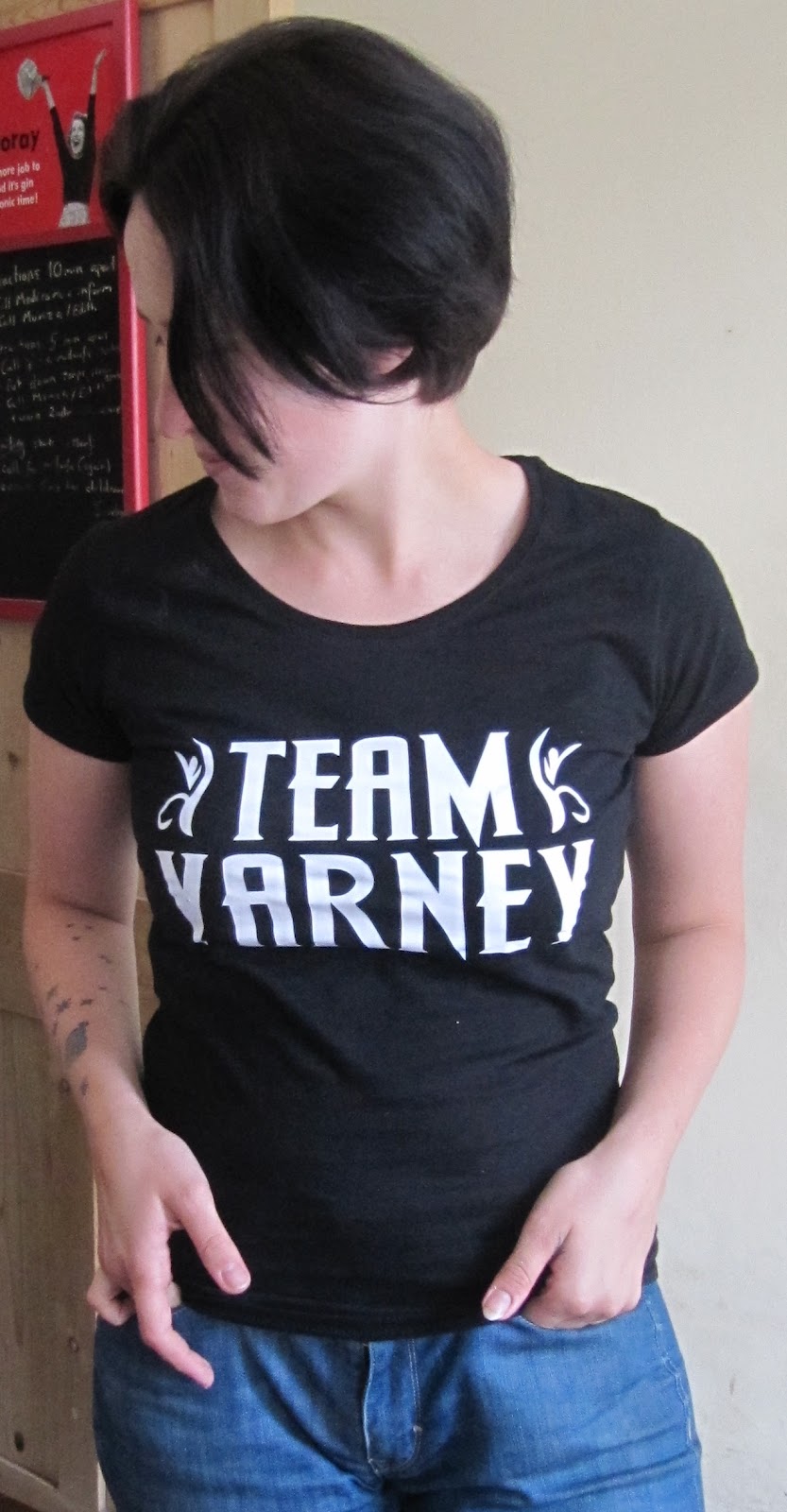
It appears I have mentioned in passing something of a predilection for fictional bad guys and characters so morally grey that they could be used as camouflage on the dark night of no moon. Give me cads, rogues, and schemers of all types. Give me a character who is something of a bastard, who is ruthless, conniving, swaggering, manipulative, and the chances are I'll swoon and maybe put his name on some kind of t-shirt.

No. I am not joking. Yes. This is the way my mind works.

I read Fantasy novels and Adventure novels, I read Horror, and Historical Fiction full of sweet, charming, beautiful men and women. People who are honorable and upstanding, who are intelligent, kind, devoted and if I have to list the fiction heroes who get my heart racing, it stands at Wilhelmina Murray, Percy Blakeney and that's your lot.

I don't get crushes on heroes. Anti-heroes, maybe. Morally questionable, domineering types on a redemption arc, sure. Flat out, total bastards? Well, duh.

Used for review purposes.
Okay. Maybe not all interest.
This is not Draco in Leather Pants. Sure, a bit of emotional complexity, a little bit of grayscale does not go amiss, but I do not want these characters redeemed. I do not want them to be any less evil and bastardy. I do not think they can be saved by the Love of a Good Woman.

If they were saved, I would lose all interest in them.

Yes, Edmond Dantès is sweet, and lithe and kind of pretty to think about, but it's only when he emerges as the socially aggressive and unprincipled Count of Monte Cristo and people start mistaking him for a vampire that I begin swooning in this ridiculous fashion. Frankly who would take a night with one of Shakespeare's vaguely insipid romantic leads if there was the offer of a night with Oberon? Sure, you'd regret it in the morning! Does that mean you shouldn't do it?

Well, probably, yeah. 

Actually, I wouldn't advise it at all.

But that is entirely beside the point

Were I to draft a checklist of necessary qualities to invoke my fawning and excessive devotion to a character, it would start something like: powerful, ruthless, proud, unpredictable, amoral/morally questionable, domineering. After a few thousand synonyms, I might think to include some physical characteristics (cheekbones!) but no matter how pretty a character might be, unless xie can muster a fistful of evil, I'm not interested.

I might get emotional attachment to a hero, my heart might melt for them, I might cry myself to sleep at their pain. I might love Percy Blakeney with all the passion and truth that I could muster at thirteen, but if you put him a fight against Christopher Syn (something I'd pay to see), my feelings are going to be totally on the side of the Scarecrow. 

Used for review purposes.

Mmm. Murderously ambiguous morality.


Yet I have a husband. He is not a supervillain. In fact, he is one of the sweetest, kindest, gentlest and most honorable men you will ever have the pleasure of encountering. 

Because, as far as the daily life goes, domineering bastards are obsolete. Dear Christ, can you actually imagine actually living with any of these people? Athos, with his brooding man-pain and his alcoholism? Sir Francis Varney and all the theft, the molestation, the jumping-on-chair-backs shenanigans?  

None of this is real:

Being the submissive floozy of some supernatural baddie is nice for one's head-canon, but in real-world emotional terms it isn't exactly sustainable. Frankly, I don't see Jareth bringing me a cup of tea in the morning because I can't be bothered getting up. I don't see Nathaniel Crozier offering any sympathy if I get myself involved in a flame war and need a hug. Those among my literary crush stable who aren't actually malevolent tend to be emotional wrecks. Besides, they aren't exactly pleasant to be around. Villains, remember? 

Used for review purposes
Difficult themes through metaphor
Their lack of flat-mate qualities aside, their very unreality is sanctioned by the texts in which they appear. People like this simply do not exist. Romantic highwaymen and charming vampires are a thing of fiction. And that's a good thing, by the way. Fiction is a door into a world that lets us weigh up people and actions with far more care and nuance than we can permit when dealing with flesh-and-blood individuals, with real emotions. We can explore motivations that we would not normally consider, try to understand moralities that are beyond our usual scope of acceptability, and - most importantly - ask questions the which the real-world forbids. As such, we need to create characters that do not exist, that will never exist because they allow us to explore difficult themes through metaphor. They allow us to push events in a certain way, to lead to emotions and decisions that we would not otherwise understand. 

The tension that this creates in the reader or the viewer allows feelings and attachments that our real-world selves would not countenance. In some people this creates a turmoil, a breakdown of the boundaries of reality and fiction, but most people just get over it. We find a way to frame these emotions in a form we understand. I suspect the aforementioned  'Draco in Leather Pants' trope arises from people attempting this, that the conflict between sexual attraction and the repulsiveness of the character leads people to the 'walk two moons' approach: if we only saw this from the villain's p.o.v, they would not seem so bad. Others have, simply compartmentalise, drawing a line between 'real' and 'fantasy' and leaving it at that.

 Well, that's the theory...

Which leads us to Rhett Butler

As I was making my pigheaded slog through Gone With the Wind and having one of my little kicking-the-kitchen-cupboard fits and ranting about how Rhett Butler was the most odious, manipulative, abusive bastard I had ever had the misfortune to read about, an unwelcome voice popped into my head and asked, "So why the hell don't you fancy him?"

Interesting.

I went back to the book with a more clinical perspective. Look, he's vile, overbearing and something of a bully - all strong indications. Ruthless, amoral, yep. He's even vain, which is always a plus. I came to my conclusions - Rhett Butler is essentially a shit. It really should have been a no-brainer.

So, in the thick of that literary annoyance of a book part of me was thinking, Just why the hell not? Heck, it would have made reading it more enjoyable.

Fiction allows us to go to places that reality will not take us, allows us to feel things that are not grounded in the logical world, but doing this requires a backing-away. In order to be lead into the darkest places within us, and come back more-or-less unscathed, we need to suspend some aspect of our disbelief, to recalibrate our moral compass. Even if, in real life, I would find Rhett Butler abhorrent, surely I'd fall for him in the context of the book? That's my whole thing.

No.

Why no? 

Fiction, by its very nature, simplifies and sanitises. No matter how evil a character, the people they injure bleed ink, not blood. The results of their actions do not matter in actual human terms. Their glamour is a direct consequence of this. A healthy dose of realism would destroy any one of them, or at least the charms they appear to possess. 
Used for review purposes
Go read Mystery Babylon

To go one further, the splendid, uncomplicated, ruthless evil they represent is only possible within the boundaries of that fictional world, the metaphor through which they are created. If he weren't a vampire, Sir Francis Varney would be a dirty old man, Dracula a rapist. Sans magic, Nathaniel Crozier becomes a two-bit confidence trickster and thief. By inhabiting magical, or at least fantastical, worlds, these characters become part of a whole other moral discourses that daily life cannot touch. We allow them to display both the malevolence and the grace with which real-world monsters do not trouble themselves. 

Much as it grieves me to admit it, you're never going to meet a Jareth, or a Christopher Syn, or a Milady. In the unlikely event that you did,  you would probably run a mile. I know I bloody would. They are safe only because they are remarkable, exceptional, unreal. In short, they are a fantasy. 

But you will have met a Rhett Butler

"That Rhett Butler," as Angela Carter wrote, "with his travelling salesman's lines...". You know the type, haunting the pub at University campuses, amateur philosophers with their well thumbed copy of Ayn Rand and their leer at any woman brainwashed enough to think that something is worth hearing just because it's a man saying it. Oh, Gods, have you met men like Rhett sodding Butler.  They'll spout forth about how much they like, "strong women", but if they meet one will retreat as quickly as if they've been kicked in the nuts. They have a nauseating belief that everyone, everything, has it's price, and that price is well within their remit. They will say things like, "Your girlfriend is too clever for her own good."

Speaking of fierce, beautiful challenges...
The most terrible thing about real life bastards is that they are so grubby, so mundane. Vampires, femme fatales, Goblin Kings all these represent a fierce, beautiful challenge to the established order, to one's expected beliefs. Their purpose is to disrupt, to bring about change. They force the heroes, the reader, to confront their own shadows, to face their monsters. And to face a monster is to be transformed. Literary monsters are a test of fire, even if the status quo is eventually restored. A well written villain (especially an ambiguous one) is as much a threat to the powers-that-be as any rebellious hero. Even Richelieu feared Milady.

But Rhett Butler and his ilk are too much a part of this world to unsettle it. They are too invested in the dominant, cultural paradigms. Rhett is a misogynist, a capitalist. Oh, sure, he shakes things up a bit, but only within the sanctioned means of commerce and predatory male sexuality. The disruption he causes rides the same waves of profit and speculation that caused 12.5 million human beings to be shipped across the Middle Passage like so much cargo. Had he been born fifty years earlier, he would have wound up a plantation owner. If he lived today, he'd have made a killing selling bad debt and food securities, and sod the consequences. He's an opportunist, nothing more.

The same goes to his attitude towards women. The male examples of my adored villains can hardly be held up as examples of 'feminist ally of the year', but they at least have a basic respect and understanding of a woman's potential, a fear of that potential turned against them. Jareth might smoulder, "You're no match for me", but when push comes to shove he never denies that her will is as strong as his nor her kingdom as great. Nathaniel Crozier - misogynist extraordinaire- uses his sway over women to draw out their darkest, most terrifying capabilities (capabilities which he respects even as he abuses them.) Even Athos gives credit where credit is due when during a diatribe on Milady's wickedness he admits, "it must be allowed, she supported her rank becomingly". Nor does he ever underestimate her. When they meet face-to-face, he is smart enough to keep a pistol between them.

So, what of Rhett Butler and his claims that Scarlett is too good and too clever to waste away in widowhood? 

He never seems to speak to Scarlett but to belittle her, never admits that her faculties might be on a par with his own. The women who are as smart as him (and smarter) he either flatters or avoids. He pursues Scarlett because she is not dangerous to him - she is 'gorgeous' when she is angry rather than potentially fatal.  And from this position of arms-length, unshakeable tormentor he proceeds into a kind of abuse that is horribly familiar. He isolates Scarlett from her community by manipulating the perceptions of those around them, bringing the full weight of patriarchal disapproval upon her for behaviour which he has incited. He removes her children from her custody without her consent, vanishing with them for unspecified periods of time. He forbids her from taking contraceptive measures and threatens her with violence. When she withdraws sexual favours from him, he casually asserts that if  he really wants to have sex with her, he will rape her.

There are too many men like Rhett fucking Butler. They all too real. I don't want my fantasy landscape cluttered with them as well.

Rant Aside
If you are one of those people who find his mojo alluring, then that is your fantasy life and I have no right to police it. I might hate the guy with a vengeance, but given the record of my literary crushes, any moral high-ground is currently avalanching from beneath my feet. The above few paragraphs of vented spleen are the merely the more or less logical thought processes which helped me understand my reaction. 

Which is about where we draw the line on reality.

Because real world powerful, unprincipled seducers do not believe women to be 'fine, dark death-hounds' - they bully and bluster, manipulate and abuse. For all I might get into a girlish fluster about Mr Crozier (historian, warlock, philanderer) in the real world I do what I can to make sure men like him wind up before war-crimes tribunals. Edmond Dantès might charm me senseless between the pages of a book - but if I met him down the pub, I'd probably pick a fight. 

For years, I struggled with this paradox. The scorn, the anger, the disbelief that people face when they admit such a predilection is remarkable. You will be mocked, belittled, told that your critical opinions have no worth. Often - in my experience - these verbal attacks are gendered. In terms of self-worth, it has an emotional toll. For all I said I wanted a lover, a friend, a soul mate, my mental space was packed with people who could be nothing of the kind. How could I claim to be worthy of love, respect, affection while still having a total passionate yen for utter, tyrannical bastards? 

So, I write. It's what I do. I work through it in short stories, in novels, stretching existing metaphors, setting up the problematic of the attraction, creating terrible villains who allure, and their victims who bleed... 

Well, it's still just ink, but I flatter myself that it's scarlet ink.

In my own life, though, I just drew a line. There is reality and there is pretend. Reality is where I live, and pretend is writing, is fantasy, is questions of morality the real world can not address. And, just as a child falling back in the playground, clutching their shoulder and crying, "Yah got me, pardner!" does not wish to be shot with an actual gun, neither do my escapist desires or worrying at a theme change or reframe my real-life rights and needs. The game is more complicated, but the rules remain. Pretending a thing does not make it real, but not wishing for a thing to be real does not mean that one is not permitted to pretend. 
Used for review purposes
Alan Moore, there. Nailing it.

But what Rhett Butler made me realise is that the line I have drawn is permeable, that it plunges and dives encompassing this, but not that, refusing one foible, but permitting its neighbour free reign. It does not only contain that notional space that is created when one opens a book, or watches a film, but is an ongoing conversation with the worlds of fiction and reality. It is personal, tied implicitly to how we escape, how we engage with those fantasies. It makes us uneasy.

For me to fancy Rhett Butler would be to reconcile myself with everything I detest. I cannot view him, or Gone With the Wind as anything other than a cultural artefact of genocide and misogyny. As such, he belongs to this world, to this reality. I tell myself that my creations are only fictions, but they slip this way and that, they hurt and they worry.

There is nothing empirical about unreality.

Thursday, 11 September 2014

What I've Been Reading: London Under, I Will Repay, Daughter of Smoke and Bone.

Used for review purposes.
"I don't want to be a day bird," said Plop, "day is NASTY."

Okay, reviews for the week 26/08/14 to 01/09/14.

I heard about Peter Ackroyd's London Under at about the time it first came out, and finally bowed to the pressure of being in a bookshop and wanting it a couple of months back. If you have a copy, read it. It is an absolute delight.

Lyrical and beguiling, it drags you deep down into the London clay, into the strange magic of the Underground, the silent sterility of the telegraph wires, the gradual sink of history into the mud. Ackroyd captures the depth and power of the places under the earth, the fear and the energy of a metropolis. London Under is a love-song to a London that is at once infernal and sacred. It bewitches. It makes you want to travel those secret, dim, waterlogged paths. It makes you want to use big words to describe them.

If I have one complaint, though, it is that it isn't that useful as an informative book. Ackroyd's prose is masterful, and you traverse themes in a giddy stream of facts, of mood, of place, but buggered if you can remember any of it afterwards. I was fascinated as I read, but like surfacing from a shamanic journey, I got to bring very little home with me. I was also a little disappointed that it didn't namecheck Neil Gaiman's Neverwhere, but I shan't hold it against him.

Anyway, a reading book, rather than a reference one, but a must for all affecionados of the subterranean life.

For a total change of mood now, I will now talk about Baroness Orczy's I Will Repay, or as it is perhaps better known as 'Ooh, The Scarlet Pimpernel, did well, I should probably write a sequel'.

I think the sheer harshness of my judgement on this one is probably less the fault of the work itself, and more a result of the circumstances in which it has been read. I encountered The Scarlet Pimpernel at around twelve or thirteen, when my head was full of Richard E. Grant in the BBC adaptation. I read the novel in one sitting, leaning against a radiator in the school library. All later re-readings have been informed by the breakneck rapture which attended that first time. But - due to my school library's poor stocking habits, and my own pigheaded attitude towards reading series - I never actually got round to any of the later books.

Until now.

'Number of pages' is a sure sign of quality.
Visiting the lovely Chapel Books in Westleton (a brilliant shop, give them all your money), I laid my hands on this rather smashing omnibus. Yet while I attempted to recreate my original experience via the simultaneous consumption of many cups of tea and a dangerous quantity of chocolate, there appears to be no condiment sufficient to change the nature of this book. And this book's nature is a remarkably obvious romance strung on the bones of a somewhat transparent heist. Don't get me wrong; at twelve, I would have devoured it. At *ahem, cough, splutter, none of your business*, I am wide awake to its flaws. It is mushy, it is predictable and it is incredibly right-wing.


I'm not saying I didn't enjoy it, because it does still possess a certain charm. I just doubt that it's a book to which I doubt I will be returning.

Time for another total mood change - well I'm nothing if not eclectic - we have Daughter of Smoke and Bone, a book I bought at the same time, and on the same advice, as C. Robert Cargill's Shadows and Dreams. As such, I've been avoiding it. Actually, I'd been avoiding it anyway. It seemed too much of a piece with the teenage-girl-and-generic-mythic-creature YA romance trend which was dying off around the time I purchased it. It wasn't so much that I dislike that plot, rather - like the rest of us - I was fatigued by it and not really looking to read anything else in that vein.

Yet while the opening chapters did not fill me with confidence, the story soon started to stretch at the confines of that genre. It began to change into something other, something far more adult, something powerful, even something important. As I was drawn into the world Karou inherits, the world in which Akiva battles, the YA Romance padding fell away, and I was left with a brutal tale of war, of exploitation, of power and prejudice. Reading it was almost like an insight into an authorial mind, where the conception for a fraught love-story matured with the telling into something darker, sadder and more cynical.

Gods, though. I wish this were a YA book. It is so important that books like this are given to teenagers, books that strip back our learned moralities and make us question things.

I got caught up in it. By the time I was half-way through, I was trembling. It's a magical book, a heart-wrenching, harrowing book that builds towards perfect, exquisite conclusion, a blow laid hard against you at just the right moment to break your heart...

And then it trails off to a weak finale and the promise of a sequel. A sequel which I now have to read, a sequel which - apparently - isn't anything like as good.

 It should have stopped. It should have finished. That ending should have been perfect.

I bloody hate sequels.

Friday, 5 September 2014

What I've been reading is postponed.

Suddenly realises what day it is.
No book reviews this week, while I get used to my new, improved super-early mornings that involve so much more human interaction than I'd willingly have in a week. (I know, no sympathy. But I'm a night bird.) Double helping next week, I promise, and also (very soon) a return to proper articles...

Breathes out.

Tries not to fall asleep.

Friday, 29 August 2014

What I've been reading: Pride and Prejudice

Okay, okay. This isn't the only thing I've been reading this week. It's just the only thing I've finished because it's the only thing I've been reading with any consistency.

Look, I'd been having a pretty rough week - it's the school summer holidays, we've had lots of visitors and done lots of visiting and I am an introvert with a personal space bubble of about fifteen feet. I'm worn out. I needed a comfort read, something fun, something familiar. So it was a Pride and Prejudice situation.

I have actually turned into my mother.

While it may seem strange that, with all my stated love for the darkness, for blood and thunder, I should be an Austen fan, you have not touched upon some squishy internal emotional wreck here. Let me make one thing dazzlingly clear to those who are not acquainted with dear Jane; this is as far as it is possible to get from mush.

Just as we disgrace Dumas by assuming he wrote for children, so we mutilate Austen by assuming what she created were romances at their worst - dull farragos of misunderstandings that would be resolved if people treated each other like human beings, sentimental works that end in inevitable marriages. Austen's worldview is bleak, dark, realist. Dare I even say it, they are proto-feminist novels.

Yes, yes, I know, we do not see Lizzy Bennet rolling up her sleeves and becoming a surgeon, nor Lydia eloping with Wickham because women should have freedom of sexual choice as well you know. Austen did not write speculatively; if she could not offer her heroines the hammer with which to smash the patriarchy, she at least gave them the clearness of sight to recognise it and a survival kit of workarounds to prevent it from crushing them.

One of the major criticisms of Austen is her desperate focus on marriage, but consider: a character like Elizabeth Bennet has no employment prospects. She could become a governess, work which paid - on average - a little more than farm labouring but which required a full abandonment of any social prospect. The family for whom she worked would view her as a subordinate, the servants would see her as an object of scorn and an outsider. Isolated for her working life, when she became 'too old' - at no more than 40 - she would be cut adrift on what little savings she had managed to amass.

If she could not get an appointment (likely, considering her relative lack of accomplishments) her income - after her father's death would be approximately £40. In 2008's terms that is roughly £1,400 a year before rent. Not to romanticise the position of the working classes in this time, but a labourer with a family could expect some income from his spouse and older children - an unmarried woman could not.

This is not to say that there would have been no way out. There were, of course, remarkable women who flew in the face of such social expectations (Austen herself was one of them, supplementing her family's income by writing) but she was very keen to make her heroines unremarkable. Too many of her contemporaries wrote paragons; she focused upon ordinary gentlewomen of no particular education, fortune or genius.

And yet, these unremarkable women prevail, and, as they do so, she show just how messed up is the system against which they must contend. The wonderful thing about Austen is that she shows us how the system is broken still.

Take, for example, Mr Collins; pompous, creepy, ugly and stupid. He makes Lizzy an offer (as the parlance goes), so, early in the novel, our heroine receives a proposal from a man she finds repulsive. So far, so romance. Yet this overlooks the tacit knowledge of Austen's audience - just as they would know how straitened the Bennets' prospects were, they would also know that 'marriage' is often a shorthand for 'sex'. And, boy, does Mr Collins employ that shorthand here. Among his first reasons for wanting to get hitched is to set a good example to his parishioners - doubtless reminding everyone that the traditional Anglican marriage service includes a bit on marriage being a way of allowing people to experience the pleasures of the flesh.

So, having not so much proposed to as propositioned her, Mr Collins received a refusal. And, in a move familiar to any woman who has received street or online harrassment anywhere, he refuses to accept this rejection as valid. Women, he claims, often say no at first. Of course, they don't really mean it, and with the correct inducements (another proposal, the advice from her parents) she will say yes at a later date. When Lizzy persists in her refusal, because, he turns nasty. In the most verbosely mannerly, 19th Century way he tells her that her market value as a sexual commodity is not particularly high, and she is unlikely to get other offers. Modernised, what he says is no different from the pick-up artists who go from a "Hey, sexy" to, "Fat, ugly slag!" when you tell them to stuff it.

And Lizzy is supposed to accept this. This - according to the mores of Lizzy's time - is a good match. This is security and relative autonomy and the assurance that she will continue to live in the style and class to which she is accustomed. To marry Mr Collins is to have a respectable clergyman's income for some years, and then the equivalent of £70k a year after Mr Bennet's death. She is not being offered mere financial security, but wealth.

I know, tiny violin. But this choice, this awful choice between lifelong prostitution to a man who is repelent to her in every way and poverty, shows that Elizabeth Bennet is in a damned good social position. She has privilege and opportunity in spades. She has intelligence, family, social standing. Her choices are far wider than that of many of the women around her. This option - which I defy anyone reading this not refuse - is one which Charlotte Lucas - older, less attractive, more pragmatic - grabs with both hands.That is the model, the society, the system in which Austen is working.

But she herself refuses it. Our author is clear; Lizzy should not be overwhelmed with gratitude for the attention of Mr Collins, nor for proposal of Mr Darcy (bringing an income of about 340k) - despite their dreadfully limited possibilities, Austen is adamant: her women are not commodities. Yes, they are circumscribed by money - Elizabeth give up her partiality to Wickham as she their joint income would be insufficient to raise a family - but they never sell themselves. 

Yet, Austen is not painting a utopia. She is showing a world that systematically breaks women down, beats them, constrains them. That she could have written such tales is clear from the palpable misery that surrounds so many of her characters. Would her characters welcome a world where they could love where they liked earn their own living without shame? Almost certainly. But they cannot have that, so they play upon what terms they can, and they win.

 All of Austen's heroines (with the possible exception of Marriane) marry for affection first, and have material comfort anyway. That happiness of that kind can be snatched in the face of such odds is the miracle of Austen's work. She saw the probable outcome of her characters lives and she refused it. Without leaving the stark bounds of realism, she showed that joy was possible, and love, and sexual fulfilment, despite every attempt of the world to destroy those things.

This is not a reconciliation with a broken system, this is a cry of hope. It is an acknowledgement that women are strong, that whatever else is taken from us, we can snatch a little handful of happiness. That with honesty and integrity and just a little bit of pushyness, it can work out. As a feminist model for the rebuilding of a utopia, it isn't much. But as an evisceration of the world's foibles and a, "hang on in there", it's wonderful.

Every time I read Austen, I am breathing relief that I was born in the late 20th century, not the early 19th. Every time I see the messed up conversations we are having about gender, finance, sex and relationships, it is a comfort, a promise, a ray of light. It is a cause for thanks, and for rejoicing.

 All figures taken from: http://janeaustensworld.wordpress.com/2008/02/10/the-economics-of-pride-and-prejudice-or-why-a-single-man-with-a-fortune-of-4000-per-year-is-a-desirable-husband/ and http://janeaustensworld.wordpress.com/2009/04/18/the-governess-in-the-age-of-jane-austen/

Friday, 22 August 2014

What I've Been Reading: The Goldfinch, Donna Tartt and Bad Dreams, Kim Newman

It appears there has been some controversy about this month's book group selection. No, not the more interesting kind of controversy where people get very shouty and use words like 'immorality', more the sarcastic and passive-aggressive controversy that confines itself to the literary establishment. If you yawned and missed it:

While some heralded The Goldfinch as the literary smash hit of last year, it has left some member of the ancien regime rather less convinced. For the hardline snobs, the novel is "further proof of the infantilization of our literary culture", it is a simplistic, hackneyed, unremarkable book. It lacks that certain special something (*ting*) which separates popularist, middle-brow, genre-dross from Art.

And, well, high handed and out-of-touch as such a condemnation might be... I kind of agree with them.

Don't get me wrong, The Goldfinch isn't a bad book. I quite enjoyed parts of it, even though it wasn't really my thing. Yet, while I don't think any less you if you found it one of those worldbendingly fabulous novels that reaches inside your head and rearranges things, it failed to satisfy. To damn it with faint praise, it was okay. Readable, but not compelling; the characters weren't uninteresting, but it never moved me. It was probably a bit longer than it needed to be. It was a little predictable.

You see, here's the thing that I and the head-in-fundament, genre defying Literary types have in common; we don't always feel books should have a payload, a message, a reveal. We know that plot, that compulsive readability is not the mark of quality. We know that sometimes artistry, or exquisite craftspersonship, can be an end in itself. They just make the mistake of assuming a marker of this is slavish realism.

The Goldfinch falls into the rather sizeable crack between our world-views. In terms of 'Art', of Literarty accomplishment, it is lacking. Its subtext is swamped by plot before being finally hammered out in tedious exposition. It slots together too neatly for a literary novel, but for a genre novel the plot is insufficiently realised to make this moment like the pleasing assembly of jigsaw pieces. It felt a little careless, gave the impression of a writer with literary spurs genre-slumming. It missed on both counts.

And here comes the sting, you see, because so many of my favourite authors have been doing what this book attempts for years, without being given the mainstream legitimacy that Tartt takes for granted. If The Goldfinch is neither fish nor fowl, then the works of John Crowley, Poppy Z. Brite and Robert Holdstock (to name but three) are glorious chimeras. Yet, outside of genre circles, you don't see their work heralded as 'Book of the Year'.

Okay, that turned into something of a rant. Now, for something shorter, sharper and sweeter, if - to pinch a metaphor - a peach on the brink of rotting can be called sweet. Genre time, and that genre is horror of the finest, gross-out variety.

 Published in 1990, Bad Dreams isn't a Newman novel I'd encountered before, and while parts of it have dated somewhat, much of it is depressingly relevant. An indictment of the '80s establishment and its exploitative denizens, much of it will seem familiar to those who've read Newman's other work - vampiric entities, left-wing principles, pop culture and vicious satire. Some of the names used appear in later novels, too, (notably, Jago) and the character of Anna Nielson channels both Geneviève and Katie Reed. While it isn't as accomplished as the better Anno Dracula novels, it's well worth a look in its own right. A tightly plotted, skilful little novel, it strikes hard and viciously in all the right places. Great fun.

Friday, 8 August 2014

What I've been reading: Angelmaker, Three Supernatural Classics, The Scarlet Pimpernell

You know, I'm not sure if I've ever read any Algernon Blackwood before - which is a little odd, given that I spent most of my youth and early adolescence reading ghost stories. What I have certainly never done before is had to go grovelling to library to tell them I ruined one of the books.

 I am mortified. 

Suffice to say that a very windy day and a child stuck in deep mud at a beach have ruined the habit of a lifetime, and, more importantly, my local library's copy of Three Supernatural Tales.

But it isn't the outside of a book that matters, *bites fist and moans softly* it's the words in it that make the difference. So, before I die of shame, our supernatural tales ; The Willows, The Wendigo and The Watcher. Of these, The Watcher was easily my favourite. Not to disparage Blackwood's ingenuity in creating less usual supernatural threats, it was the only 'proper' ghost story of the three, with a mystery to be solved based upon the lives of the unquiet dead and a threat to be averted. The denouement was a little weak, but the suspense, the sense of growing madness, the shaking passion of the narrative was utterly compelling. Good work.

The Willows and The Wendigo were far more ambitious, and while beautifully realised (and more narratively satisfying, in terms of explanations) they left me a little cold. Both these stories felt very Lovecraftian in the way that the supernatural threat was inhuman and implacable, primal and horrific. Yet while I found Blackwood a far better writer than Lovecraft (don't shoot!), and his approach rather more literary, there was a sense of missed opportunity. While our dear H.P never lets a moment slip in terms screaming horror (sometimes at the expense of style or clarity) Blackwood has a tendency to undercut his most effectively chilling writing with explanation of that fear. And while his literariness gives him greater scope for exploring the more philosophical aspects of abject terror at the universe, the sense of internal drama in his characters was lacking; we heard that they were distressed, but got no sense of it. In a genre so empathetic as the supernatural story, this is something of a short-coming - and a sadness, as it was a technique at which he excelled in The Listener.

Still, definitely worth a look for fans of the genre.

For a more open-hearted commendation, if you're looking for a holiday read,the only problem with Nick Harkaway's Angelmaker is that you may get so caught up that you forget to do ordinary holiday things like eat ice cream, swim in the sea, or play cricket.
Isn't that just a beautiful cover?

Seriously, my kids got so pissed off with me.

It's a clever book, with characters you genuinely care about, and a real light touch for poignant details. Never mawkish, or sentimental, it is perfectly balanced - like a skilfully made clock. And it's compulsive. A wild ride that flirts with steam-punk and political commentary while never losing the core value of just being a huge amount of fun. Yeah, fun. Look, it isn't the best book I've read this year, but it was beautiful, witty and entertaining. It was gut-wrenching, it was sexy, it was intelligent... and it had a bi-sexual, cross-dressing super-spy. And frankly, that should be enough for anyone.


And talking about bi-sexual, cross dressing superspies.... Except that, outside my headcanon, there is absolutely no evidence that Percy Blakeney batted for both teams. *Sigh*. Still, hot on the tail of The Count of Monte Cristo, I was in the mood for a rather more slushy and anglo-centric rip-roaring adventure narrative, which sent me back into the pages of my beloved The Scarlet Pimpernell.

Look, I could write an essay about everything that is wrong with this book, but I don't want to, so I shan't.

Instead, I'll say that what always interests me about film and stage adaptations of this novel is that Percy's mode of dress becomes part of his ploy- he acts like a brainless dandy, and to do so, he must dress like one. In the novel, he just likes dressing that way. Being daring enigmatic, intelligent and heroic does not preclude on looking fabulous. 

So there.